
HSK 4 | El té de aceite de Guilin

桂林油茶Guilin Oil Tea

Una historia de HSK 4, de 503 caracteres, con audio en voz femenina y masculina. Por el equipo de CLI.

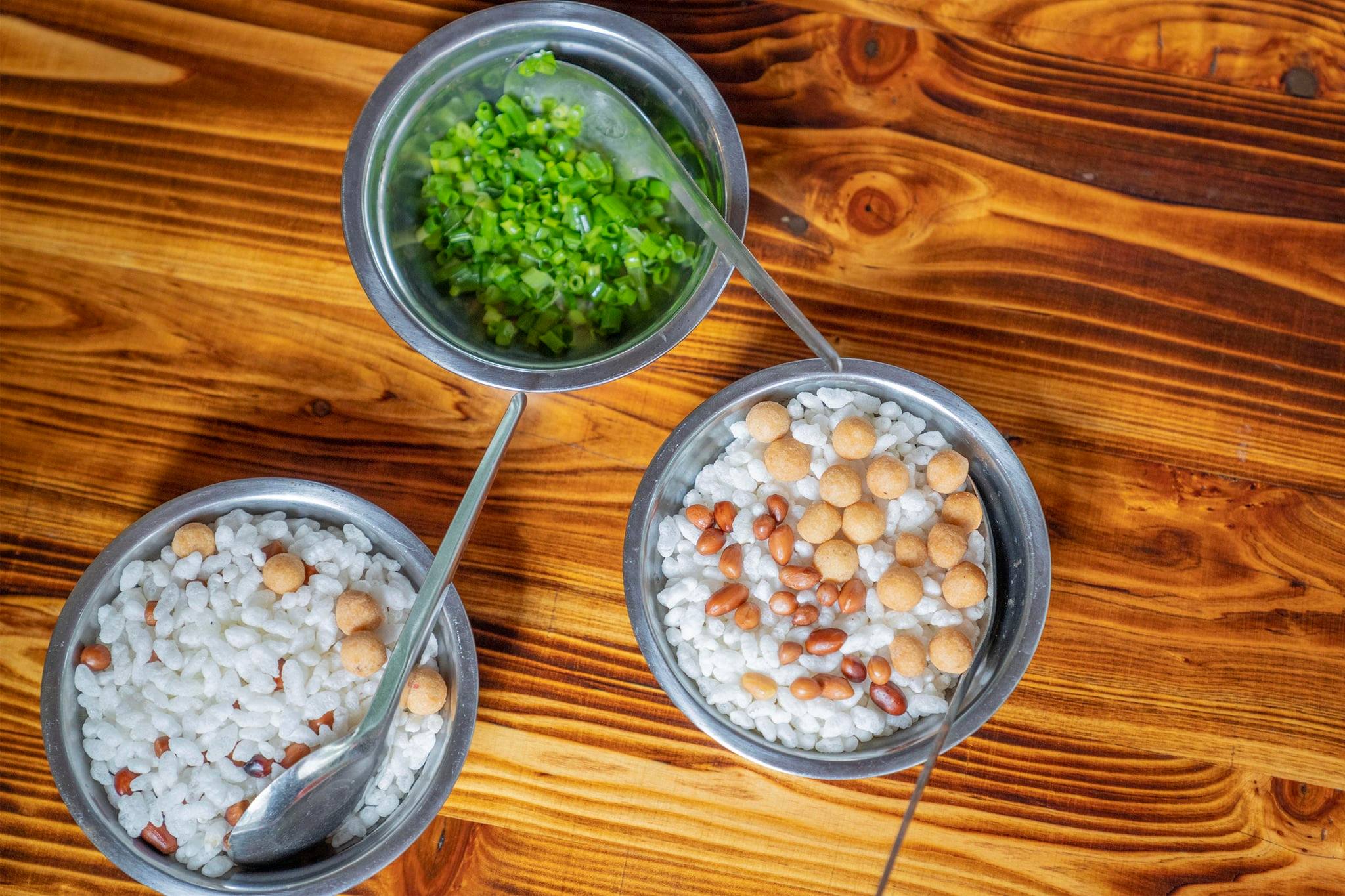
Three metal bowls on a wooden table: puffed rice with peanuts and fried soybean balls, and chopped scallions

Activa JavaScript para escuchar la historia, ver el pinyin y tocar las palabras para ver su significado.

一天下课以后,我的朋友阿玲对我说:“明天早上来我家吧,我奶奶给你打油茶。”我听了觉得很奇怪:茶怎么能“打”呢?在这以前,我一直以为油茶是一种茶,就像绿茶、红茶一样。后来我才知道,油茶不只是喝的东西,还是早饭。

One day after class, my friend A-Ling said to me, "Come to my house tomorrow morning. My grandma will beat some oil tea for you." I thought that sounded very strange. How can you "beat" tea? Until then, I had always thought oil tea was a kind of tea, just like green tea or black tea. Only later did I learn that oil tea isn't just something to drink. It's breakfast, too.

第二天早上七点,奶奶已经在厨房里等我了。她先在锅里放了一点儿油,等油热了,再放进茶叶和姜,炒得满屋子都是香味。然后,她拿起一把木头做的小锤子,在锅里一下一下地打,把茶叶打碎。“所以我们不说‘做油茶’,说‘打油茶’。”阿玲告诉我。最后,奶奶往锅里加水,煮了几分钟,把茶倒进碗里。

At seven the next morning, Grandma was already waiting for me in the kitchen. She first poured a little oil into the wok. When the oil was hot, she put in tea leaves and ginger and stir-fried them until the whole room smelled wonderful. Then she picked up a small wooden hammer and pounded the leaves in the wok, stroke after stroke, until they broke into pieces. "That's why we don't say we 'make' oil tea. We say we 'beat' it," A-Ling told me. Last, Grandma added water to the wok, boiled it for a few minutes and poured the tea into bowls.

桌子上还放着好几个小盘子,有米花、花生,还有别的小吃。阿玲说,喝油茶要自己往碗里放这些东西,想放多少就放多少。我放了满满一碗,看起来特别好吃。

On the table there were also several small plates, with puffed rice, peanuts and other little snacks. A-Ling said that with oil tea, you add these things to your bowl yourself, as much as you like. I filled my bowl to the top, and it looked delicious.

可是我喝了第一口,脸马上就变了:又苦又辣,还有点儿咸。奶奶看着我笑了:“我们桂林人常说,一碗苦,二碗涩,三碗四碗好油茶。”意思是,第一碗觉得苦,第二碗觉得涩,喝到第三碗、第四碗,你就会爱上它了。

But after my first sip, my face changed at once: it was bitter and spicy, and a little salty too. Grandma watched me and laughed. "We Guilin people have a saying: the first bowl is bitter, the second is rough, the third and fourth are good oil tea." It means the first bowl tastes bitter and the second leaves your mouth dry, but by the third or fourth bowl you'll love it.

我不太相信,但还是喝了第二碗、第三碗。奇怪的是,到了第三碗,我真的不觉得苦了,身上也很暖和,很舒服。奶奶还想给我倒第四碗,阿玲赶紧告诉我:如果喝够了,就跟奶奶说“我喝够了,谢谢”,不说的话,她会一直给你倒。

I didn't really believe her, but I still drank a second bowl and a third. Strangely, by the third bowl it really didn't taste bitter anymore, and I felt warm all over and very comfortable. Grandma wanted to pour me a fourth bowl, so A-Ling quickly told me: if you've had enough, tell Grandma, "I've had enough, thank you." If you don't say it, she'll keep pouring.

阿玲还说,最有名的油茶在恭城,离桂林市区不远,那里很多人每天都要喝。现在每到冬天的早上,我都会去学校附近的小店喝一碗油茶。老板已经认识我了,看见我就问:“今天第几碗?”

A-Ling also told me that the most famous oil tea comes from Gongcheng, not far from the city of Guilin, where many people drink it every day. Now, every winter morning, I go to a little shop near my school for a bowl of oil tea. The owner knows me by now. As soon as he sees me, he asks, "Which bowl are we on today?"

生词 Palabras nuevas

Estas palabras están subrayadas en la historia. Toca los caracteres para escucharlos.

名词Sustantivos

油茶yóucháoil tea (a Guilin breakfast drink)
茶叶cháyètea leaves
锅guōwok, pot
锤子chuízihammer
木头mùtouwood
姜jiāngginger
老板lǎobǎnowner (of a shop)

动词Verbos

炒chǎoto stir-fry
煮zhǔto boil

形容词Adjetivos

苦kǔbitter
涩sèastringent, rough on the tongue
咸xiánsalty
碎suìbroken into small pieces

副词Adverbs

赶紧gǎnjǐnquickly, hurriedly

语法点 Gramática

1. 想 + Verb + Question word + 就 + Verb + Question wordas much (or whatever, wherever) as you like

A question word such as 多少 (duōshao), 什么 (shénme) or 哪儿 (nǎr) can appear twice in one sentence. Here it is not a question: it means "whatever amount, whatever thing, wherever." The verb repeats too.

想 + Verb + 多少 + 就 + Verb + 多少

想放多少就放多少。
Xiǎng fàng duōshao jiù fàng duōshao.
Add as much as you like.
你想吃什么就吃什么,今天我请客。
Nǐ xiǎng chī shénme jiù chī shénme, jīntiān wǒ qǐngkè.
Eat whatever you want. It's my treat today.
放假的时候,我想去哪儿就去哪儿。
Fàngjià de shíhou, wǒ xiǎng qù nǎr jiù qù nǎr.
On vacation, I go wherever I want.
2. 先…再…, 最后… (xiān … zài …, zuìhòu …)first …, then …, finally …

To tell someone the steps of a job, put 先 (xiān) before the first verb and 再 (zài) before the next one. 然后 (ránhòu) and 最后 (zuìhòu) carry on the list.

先 + Verb 1,再 + Verb 2,最后 + Verb 3

她先在锅里放了一点儿油,等油热了,再放进茶叶和姜。
Tā xiān zài guō li fàng le yìdiǎnr yóu, děng yóu rè le, zài fàngjìn cháyè hé jiāng.
She first put a little oil in the wok. When it was hot, she added the tea leaves and ginger.

This 再 means "then, after that." It is about order, not about doing something again.

我们先吃饭,再去看电影。
Wǒmen xiān chīfàn, zài qù kàn diànyǐng.
Let's eat first and then go to the movie.
先洗手,再拿筷子,最后坐下来吃。
Xiān xǐ shǒu, zài ná kuàizi, zuìhòu zuò xiàlai chī.
Wash your hands first, then get your chopsticks, and last, sit down and eat.
3. Adjective + 的是 (… de shì)what is (strange, funny, good) is …

Start a sentence with an adjective plus 的是 to tell the listener how you feel about the news before you give it. It works like "Strangely, …" or "The good thing is …" in English.

Adjective + 的是,Sentence

奇怪的是,到了第三碗,我真的不觉得苦了。
Qíguài de shì, dào le dì-sān wǎn, wǒ zhēn de bù juéde kǔ le.
Strangely, by the third bowl it really didn't taste bitter anymore.
有意思的是,这家米粉店的老板是北方人。
Yǒu yìsi de shì, zhè jiā mǐfěn diàn de lǎobǎn shì běifāng rén.
Funnily enough, the owner of this rice noodle shop is from the north.
可惜的是,那家店今天没开门。
Kěxī de shì, nà jiā diàn jīntiān méi kāimén.
Too bad that shop isn't open today.

测试 Comprueba lo que entendiste

5 preguntas sobre la historia. Elige una respuesta para ver si es correcta.

1以前,“我”以为油茶是什么?

2为什么叫“打油茶”?

3“我”喝了第一口,觉得油茶怎么样?

4如果喝够了,应该怎么做?

5阿玲说,最有名的油茶在哪儿?

更多故事 Más historias

Envíanos un mensaje por WeChat

Código QR del Chinese Language Institute (CLI) en WeChat

En WeChat en tu teléfono, toca + y luego Escanear, y apúntalo a este código.

Toma una captura de pantalla de este código. En WeChat, toca + y luego Escanear y elígelo desde tu álbum.

Mantén presionado el código y elige la opción para escanearlo.

Luego toca Seguir y envíanos un mensaje.

Respondemos de lunes a viernes, de 8:30 a.m. a 6:00 p.m., hora de Beijing.