
HSK 3 | Aprender caligrafía

玛丽亚学书法Learning Calligraphy

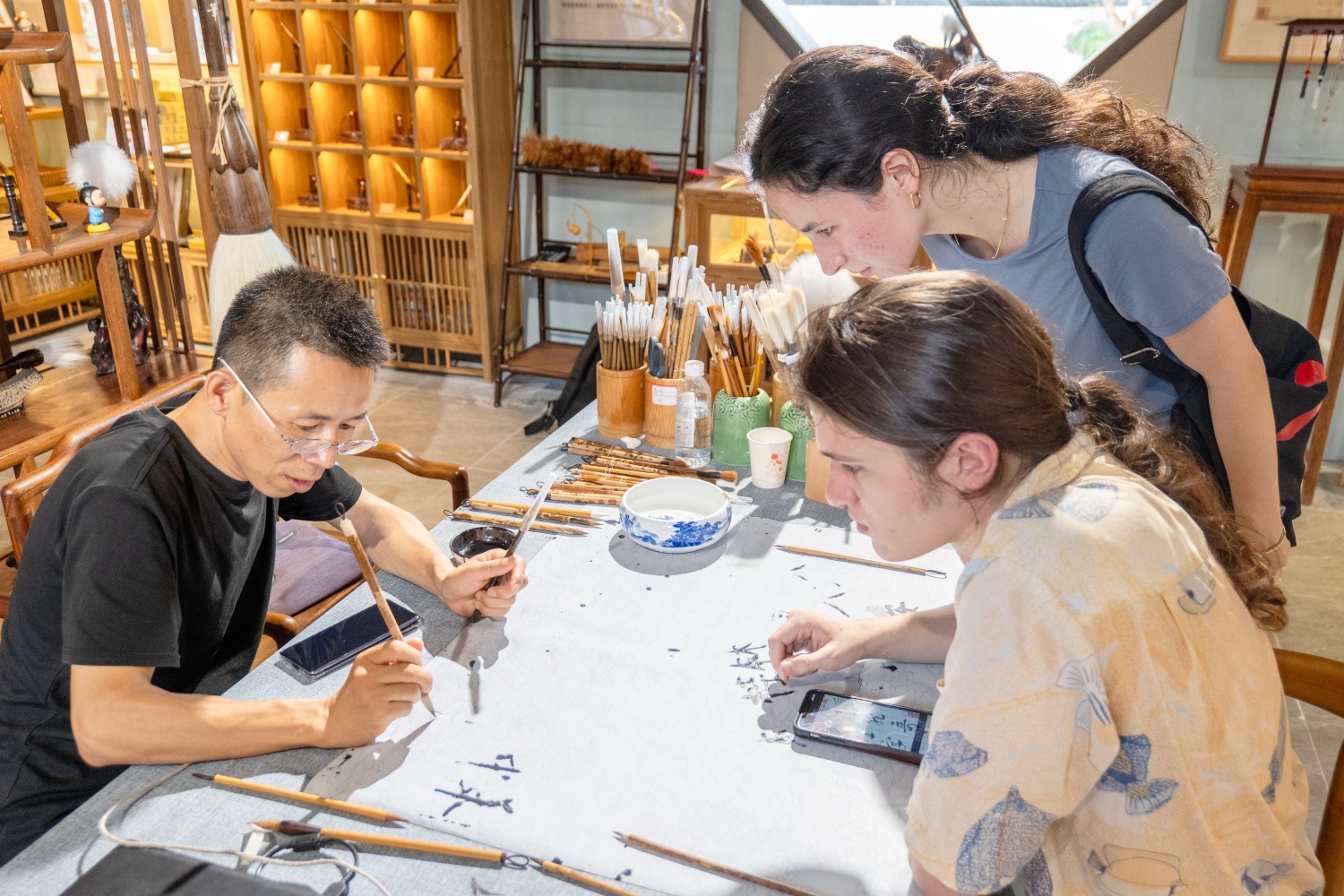
A calligraphy teacher holds a brush as two students lean in to watch at a table of brushes and ink

By the CLI Team

Activa JavaScript para escuchar la historia, ver el pinyin y tocar las palabras para ver su significado.

“老师,毛笔怎么拿?”玛丽亚拿着毛笔,好像拿着筷子。这是她的第一节书法课,我给了她毛笔、纸和墨。

"Teacher, how do I hold this brush?" Maria was holding the brush like a pair of chopsticks. It was her first calligraphy class. I gave her a brush, paper and ink.

我告诉她,毛笔一定要拿直,手也不能动来动去。她试了一下,但是她的手一直在动,笔也一直在动。她说:“我以为拿毛笔很容易!”

I told her the brush must be held upright, and her hand couldn't wobble around. She gave it a try, but her hand kept moving, and so did the brush. "I thought holding a brush would be easy!" she said.

我说:“今天我们只写一个字:永。”“永”字只有五笔,不太难写。但是书法里有八种最重要的笔画,“永”字里,这八种都有。所以我的学生学书法,第一个字都写“永”。

I said, "Today we're writing just one character: 永." The character 永 has only five strokes, so it isn't very hard to write. But calligraphy has eight key kinds of strokes, and 永 has all eight. So the first character all my students write is 永.

玛丽亚写的第一个“永”,看起来像一条小鱼。第二个墨太多了,看不清楚是什么字。写到第十个的时候,她的手上、脸上都是墨。她有点儿着急,想写得快一点儿。

Maria's first 永 looked like a little fish. The second had so much ink on it that you couldn't tell what character it was. By the time she got to the tenth, she had ink all over her hands and face. She got a bit impatient and wanted to write faster.

我说:“别着急!写书法不能快。你先看,再想,然后慢慢地写。”我告诉她,我学书法已经三十年了,现在每天还在写“永”字。玛丽亚听了,不说话了,开始慢慢地写。

"Don't rush!" I said. "Calligraphy can't be done fast. First look, then think, and then write slowly." I told her I have been studying calligraphy for thirty years, and I still write 永 every day. When she heard that, Maria stopped talking and began to write slowly.

那天下午,她一共写了五十个“永”。最后一个虽然还不太好看,但是比第一个好多了。我在它旁边写了一个“好”字。下个星期上课的时候,玛丽亚说:“老师,今天我还想写‘永’。”

That afternoon she wrote fifty 永 characters in all. The last one still wasn't very pretty, but it was much better than the first. Next to it, I wrote the character 好, "good." In class the next week, Maria said, "Teacher, today I want to write 永 again."

生词 Palabras nuevas

Estas palabras están subrayadas en la historia. Toca los caracteres para escucharlos.

名词Sustantivos

书法shūfǎcalligraphy
毛笔máobǐwriting brush
墨mòink (for calligraphy)
纸zhǐpaper
笔画bǐhuàstroke (of a character)
脸liǎnface

动词Verbos

以为yǐwéito think (wrongly)
试shìto try
动dòngto move

形容词Adjetivos

直zhístraight, upright
着急zháojíanxious, in a hurry
容易róngyìeasy

副词Adverbios

一共yígòngen total, en conjunto
先xiānfirst

量词Clasificadores

种zhǒngkind, type

短语Frases

永yǒngforever; the character 永, used to practice the basic strokes

语法点 Gramática

1. 虽然…但是… (suīrán … dànshì …)although …, (still) …

Chinese marks both halves of an "although" sentence: 虽然 starts the first half, and 但是 starts the second. English uses only one word here, but Chinese is happiest with both.

虽然 + fact, 但是 + result that you might not expect

最后一个虽然还不太好看,但是比第一个好多了。
Zuìhòu yí ge suīrán hái bú tài hǎokàn, dànshì bǐ dì-yī ge hǎo duō le.
Although the last one still wasn't very pretty, it was much better than the first.

虽然 can come before or after the subject. Both of these are fine: 我虽然很累… and 虽然我很累…

虽然外面很冷,但是我们还是去了公园。
Suīrán wàimian hěn lěng, dànshì wǒmen háishi qù le gōngyuán.
Although it was cold outside, we still went to the park.
书法虽然很难,但是我很喜欢。
Shūfǎ suīrán hěn nán, dànshì wǒ hěn xǐhuan.
Calligraphy is hard, but I really like it.
2. 先…再…然后… (xiān … zài … ránhòu …)first …, next …, then …

To put steps in order, start with 先 (first). Use 再 for the next step, and 然后 for the step after that. 先 and 再 sit right before the verb.

先 + step 1,再 + step 2,然后 + step 3

你先看,再想,然后慢慢地写。
Nǐ xiān kàn, zài xiǎng, ránhòu mànmàn de xiě.
First look, then think, and then write slowly.
我们先吃饭,再去看电影吧。
Wǒmen xiān chīfàn, zài qù kàn diànyǐng ba.
Let's eat first and then go see a movie.
每天早上,我先喝一杯茶,然后去上课。
Měi tiān zǎoshang, wǒ xiān hē yì bēi chá, ránhòu qù shàngkè.
Every morning I have a cup of tea first, and then I go to class.
3. A 比 B + adjective + 多了 (duō le)A is much more … than B

A plain 比 sentence says that A is more … than B. Add 多了 after the adjective to say the difference is big. Don't put 很 in front of the adjective in a 比 sentence.

A + 比 + B + Adjective + 多了

最后一个比第一个好多了。
Zuìhòu yí ge bǐ dì-yī ge hǎo duō le.
The last one is much better than the first.
今天比昨天冷多了。
Jīntiān bǐ zuótiān lěng duō le.
Today is much colder than yesterday.
坐车比走路快多了。
Zuò chē bǐ zǒulù kuài duō le.
Taking the bus is much faster than walking.

测试 Comprueba lo que entendiste

5 preguntas sobre la historia. Elige una respuesta para ver si es correcta.

1第一节课,玛丽亚只写了哪个字?

2老师说,毛笔要怎么拿?

3玛丽亚写的第一个“永”看起来像什么?

4写到第十个的时候,玛丽亚的手上、脸上都是什么?

5下个星期,玛丽亚还想写什么字?

更多故事 Más historias

¿Encontraste un error o tienes una idea? 发现错误或有建议?

Comentarios sobre esta historia 对这篇故事的反馈

En general, esta historia es… 整体来看,这篇故事…
¿Qué debería cambiar? 哪里要改?

Una nota por problema. 每个问题写一条。 Omite esto si la historia está lista. 如果可以直接用,这部分不用填。

Consejo: toca una palabra de la historia antes de abrir este formulario y se elegirá su oración automáticamente. 先点故事里的词,再打开反馈,句子会自动选好。

Profesores de CLI: por favor, agrega tu nombre. 本校老师请留下姓名。

Agrega tu correo electrónico si quieres que podamos responderte. 如需回复,请留下邮箱。

Envíanos un mensaje por WeChat

Código QR del Chinese Language Institute (CLI) en WeChat

En WeChat en tu teléfono, toca + y luego Escanear, y apúntalo a este código.

Toma una captura de pantalla de este código. En WeChat, toca + y luego Escanear y elígelo desde tu álbum.

Mantén presionado el código y elige la opción para escanearlo.

Luego toca Seguir y envíanos un mensaje.

Respondemos de lunes a viernes, de 8:30 a.m. a 6:00 p.m., hora de Beijing.