

- 中国的数字文化很大程度上源于谐音,即数字的读音与另一个更有寓意的词相近。
- The numbers 2, 8, and 9 are widely seen as auspicious 吉利 (jílì), while 4 is considered inauspicious 不吉利 (bù jílì) and 5 and 7 get mixed views.
- 4 是中国人最忌讳的数字,因为它的读音与“死”相近。
- 数字还催生了一大类中文网络用语,用数字代替整句话。
- 中文有两套书写数字的系统:日常使用的小写 小写(xiǎoxiě)和防欺诈的大写 大写(dàxiě)。
In China, many numbers carry a lucky or unlucky meaning, and it affects real choices: which phone number to buy, which floor to live on, and how much money to put in a red envelope. Knowing the main superstitions helps you follow these customs, from gift-giving to choosing a wedding date.

This guide explores the meaning behind lucky and unlucky numbers, the hand gestures used to count to ten, and the playful number slang found all over the Chinese internet. If your goal is to Learn Chinese in China, this background will help you understand why people joke about some numbers and quietly avoid others.
01 数字背后的含义
Chinese homophones have a profound influence on Chinese culture. In numerology, certain numbers are considered auspicious 吉利 (jílì) or inauspicious 不吉利 (bù jílì), mainly because of how they are pronounced.
In traditional Chinese culture, almost every number carries some kind of special meaning. Many people regard 2, 8, and 9 as very auspicious and treat 4 as unlucky, while 5 and 7 have both good and bad associations.
这种思维方式与中国人生活中的其他象征体系并存。关于吉时的观念,也见于传统的农历和风水原则之中,人们相信布局与平衡会影响运势。
02 吉利数字(2、8 和 9)
数字 2
按照中国的数字文化,成双成对是吉利的。这也解释了为什么婚联和婚礼装饰上常常能见到 双喜(shuāngxǐ,“双喜”)。
春节时也是同样的道理:人们会在门的两侧贴上对联来装饰家门。成双成对图吉利,在中国婚俗中同样常见,成对的物品和对称的布置都象征着和谐。

数字 8
吉利数字 8 八(bā)的发音与 发(fā)相近。这个字出现在 发财(fācái,发财)一词中,因此 8 与财富和兴旺有着紧密的联系。

数字 9
数字 9 九(jiǔ)的发音与 久(jiǔ)相近,意为时间长久,因此它象征长寿与永恒。
正因为有这层寓意,中国情侣常把这个数字融入浪漫的表达中。常见的例子有在 9 月 9 日结婚,或在订婚时送上 99 朵玫瑰。
Most of the main gates of the Forbidden City carry 81 nails, arranged in a 9×9 grid, reflecting the imperial importance of the number 9.

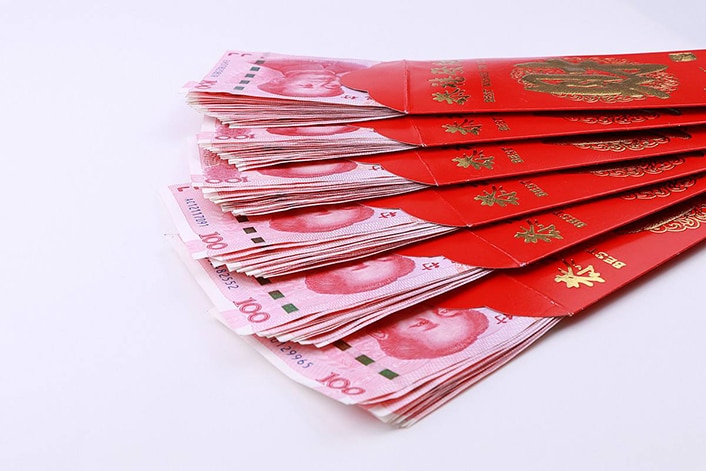
这些吉利数字也影响着人们送钱的方式。送红包 红包(hóngbāo)时,大多数人会选择 88、99 或 200 这样的吉利金额。
03 Inauspicious numbers (4, and sometimes 5 and 7)
数字 4
数字 4 四(sì)的发音与 死(sǐ,死)相近。由于与死亡相关联,中国很多建筑干脆没有“四”楼。
门牌号和车牌号里也很少出现这个数字。许多人甚至会尽量避开带 4 的电话号码。
在中国的数字命理中,4 是最不吉利的数字,地位大致相当于许多西方国家的数字 13。

数字 5
The number 5 五 (wǔ) sounds like 呜 (wū), an onomatopoeia for whimpering and crying, so some people see it as a sad number. The taboo is mild, though: 5 is also tied to the Five Elements of Chinese philosophy, and many people treat it as neutral or even lucky.

数字 7
Compared with clearly positive numbers like 8 or clearly negative ones like 4, the number 7 sits on the more neutral side. The Chinese word for 7 七 (qī) echoes positive words such as 齐 (qí; even, uniform), 气 (qì; life force), and 起 (qǐ; to rise). It also has a romantic side, because Qixi, often called Chinese Valentine’s Day, falls on the seventh day of the seventh lunar month.
不过,它也有阴暗的一面。鬼节 鬼节(Guǐjié)在农历七月,而且 7 还与 欺(qī,欺骗)谐音。

04 中文数字手势
你知道吗?用一只手就能比出从一到十的所有数字。在商店或菜市场和摊贩讨价还价时,看懂这些手势非常重要。
下面的视频会逐一演示这些单手数字手势。学会它们,就能为你的基础中文工具箱快速增添一项实用又地道的技能。

05 数字与中文网络用语
Because of the sheer number of homophones in Chinese, many expressions of Chinese internet slang are built entirely from numbers. This practice is called 数字谐音 (shùzì xiéyīn; “number homophones”).
以下是你在网上最常遇到的一些例子。
1. 二百五 (èr bǎi wǔ; 250)
数字 250 基本上就是“傻”或“半疯”的意思。关于它的来历,有好几种不同的说法。
One traces it to the old coin system, where 1,000 coins were grouped on a string called a 吊 (diào). A 半吊子 (bàndiàozi; half a string, or 500 coins) became a mildly insulting word for a dabbler with half-baked knowledge, and half of that, 250, became a stronger insult.
另一种说法是,钱以 500 枚为一封 一封(yīfēng,一封)。半封,即 250 半封(bànfēng),无论在普通话还是粤语中,都与 半疯(bànfēng,半疯)谐音。
不管它源自哪里,二百五(èr bǎi wǔ)大致相当于英语里的“not playing with a full deck”(脑子不太灵光)。
2. 五二零 (wǔ èr líng; 520)
这个数字听起来像我爱你(wǒ ài nǐ,我爱你)。事实上,5 月 20 日(5/20)已经成了非官方的中国情人节。
3. 七四八 (qī sì bā; 748)
This one sounds like 去死吧 (qùsǐba; “Drop dead!” or “Go to hell!”).
4. 五五五 (wǔ wǔ wǔ; 555)
前面提到过,5 听起来像呜,也就是呜咽的声音。因此网友用“555”来表示难过或哭泣。
5. 八八 (bā bā; 88)
这个数字用来代替“拜拜”。
6. 一三一四 (yī sān yī sì; 1314)
Read aloud, 1314 sounds like 一生一世 (yī shēng yī shì; “all my life”), meaning “forever.” Combine it with 99 roses and you have a ready-made marriage proposal.
7. 七四五六 (qī sì wǔ liù; 7456)
这串数字听起来像 气死我了(qì sǐ wǒ le,“气死我了”)。
8. 九九五 (jiǔ jiǔ wǔ; 995)
这串数字听起来像 救救我(jiùjiù wǒ,“救我!”)。
数字还催生了不少游戏。想了解更多,请看我们介绍热门中国十五二十游戏的文章。

06 小写和大写的区别
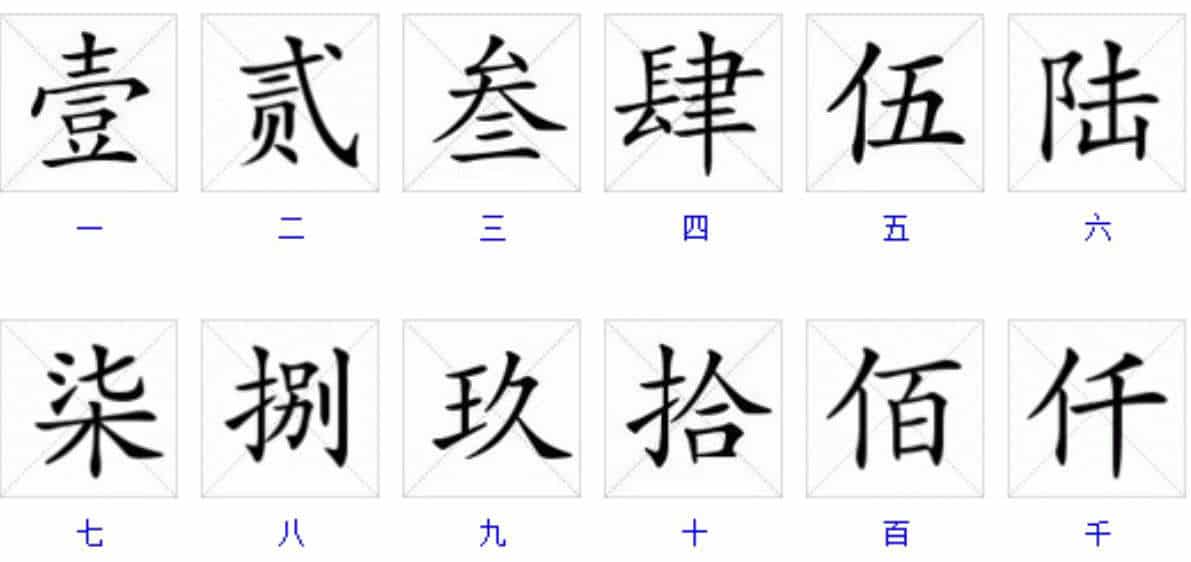
你知道吗?汉语的数字有两套写法。因为汉字可以表示数字,日常生活中会出现两种版本:小写(xiǎoxiě,小写)和 大写(dàxiě,大写)。
小写数字用于日常的一般场合,大写数字则主要用于财务交易。
普通的小写数字笔画简单,也就容易被篡改。为了防止伪造,金融行业改用更复杂的繁体字大写数字。
Complex number forms go back to the Tang dynasty, but the uppercase system became a firm rule during the Ming dynasty, when the Hongwu Emperor Zhu Yuanzhang required it in official accounts. He did so after a major corruption case in 1385, in which officials embezzled huge amounts of state grain.
The guilty officials were executed, and the new rule made written figures much harder to alter. Today, 大写 (dàxiě) is often translated as “banker’s anti-fraud numerals.”
07 小写与大写数字对照
下表列出了日常使用的小写数字及其对应的防伪大写数字。能认得这两套数字,会让你在中国看收据、合同和银行文件时更轻松。
| 中文(小写) | 拼音 | 数字 | 大写(大写) |
|---|---|---|---|
| 零 | 0 | 零 | |
| 一 | 1 | 壹 | |
| 二 | 2 | 贰 | |
| 三 | 3 | 叁 | |
| 四 | 4 | 肆 | |
| 五 | 5 | 伍 | |
| 六 | 6 | 陆 | |
| 七 | 7 | 柒 | |
| 八 | 8 | 捌 | |
| 九 | 9 | 玖 | |
| 十 | 10 | 拾 | |
| 百 | 100 | 佰 | |
| 千 | 1,000 | 仟 | |
| 万 | 10,000 | 万 |
Numbers carry a surprising amount of meaning in Chinese. Now that you know the meanings behind them, you can use them to decode slang, choose lucky dates, and even win a few drinking games.
08 常见问题
为什么在中国数字4被认为是不吉利的?
数字 4 四(sì)的发音与 死(sǐ,死)几乎一样。这种与死亡的联系,使它成为中国文化中最被忌讳的数字。
为什么数字8被认为是幸运数字?
数字 8 八(bā)的发音与 发(fā)相近,后者是“发财”一词的一部分。因此,8 与财富和兴旺紧密相连。
520 在中文里是什么意思?
520 这几个数字听起来像我爱你(wǒ ài nǐ,“我爱你”)。因此,5 月 20 日成了一个非正式的浪漫节日。
小写和大写数字有什么区别?
小写(xiǎoxiě)是日常使用的简单数字,而大写(dàxiě)是金融领域使用的复杂防伪写法。大写数字更难涂改,有助于防止伪造。
红包应该包多少钱?
选择以吉利数字为主的吉祥金额,比如 88、99 或 200,避免含有 4 的金额。具体数额要视场合以及你与收礼人的关系而定。
09 结语
Most of Chinese numerology comes down to sound: a number is lucky or unlucky because of the word it resembles. Once you know the main pairs, such as 4 and death or 8 and wealth, slang like 520 and 88 makes sense too.
For learners, this pays off quickly, because it explains why a friend turns down a phone number with a 4 in it or picks a wedding date with a 9.