

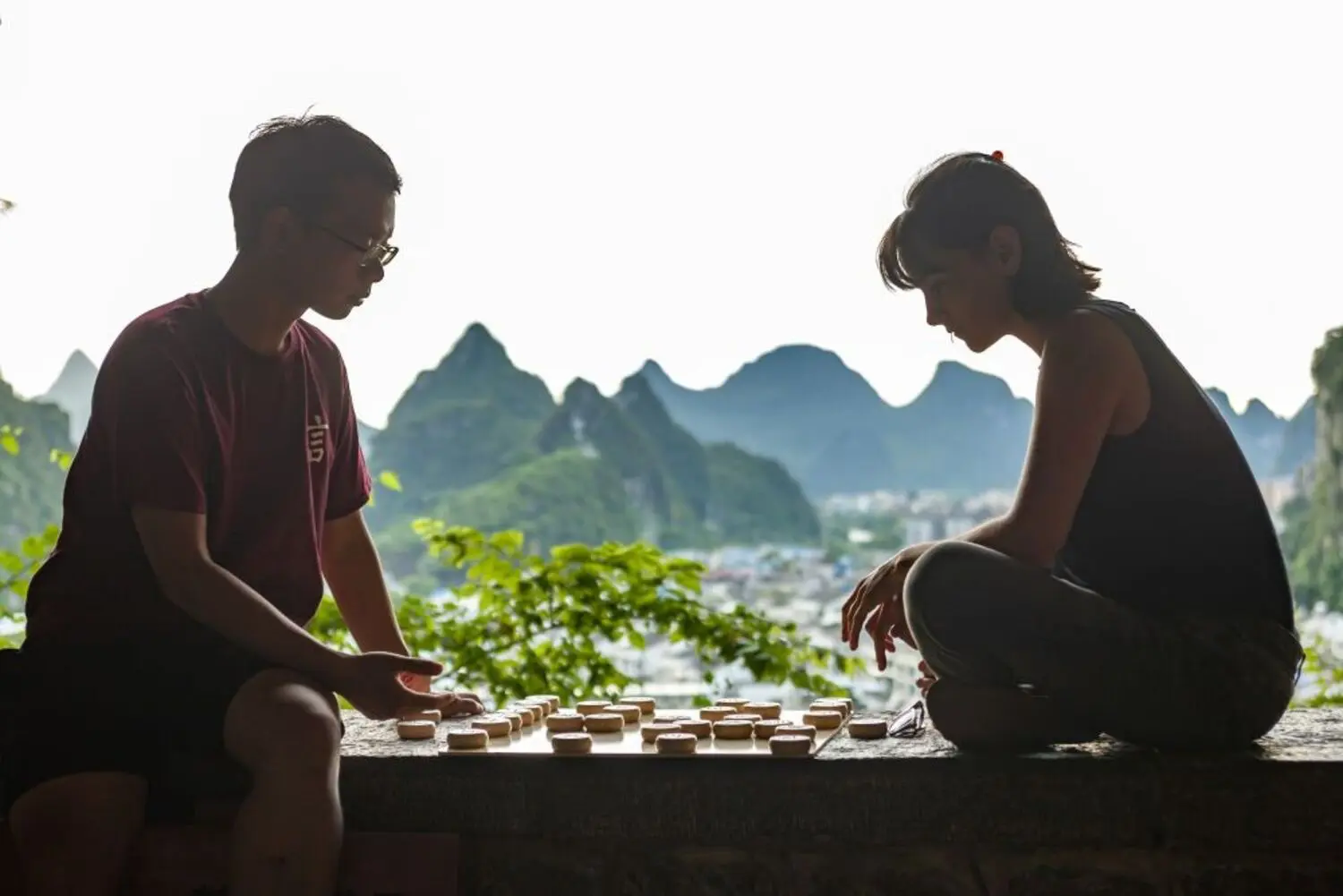
- Chinese chess (象棋, xiàngqí) is played in public all over China, and the crowds gathered around street boards are open to anyone who wants to stop and watch.
- For a board game, xiangqi is loud and fast — pieces are slammed down, moves are shouted, and a full game is often over in about ten minutes.
- Anyone who already plays international chess can pick up the basics quickly, since the pieces and much of the strategy will feel familiar.
- Stopping to watch a game is one of the easiest ways to start a conversation with locals, which makes it a natural fit for students who learn Chinese in China and want real speaking practice outside the classroom.
Guilin is bubbling over with cultural experiences, and each experience is open for foreign students to observe and even take part in.
There are ayi (阿姨, āyí, "aunties") line-dancing in city plazas each night; there are Mahjong (麻将, májiàng) parlors where people gamble and gossip late into the evening; there are philosophical discussions over tea ceremonies in local tea houses.
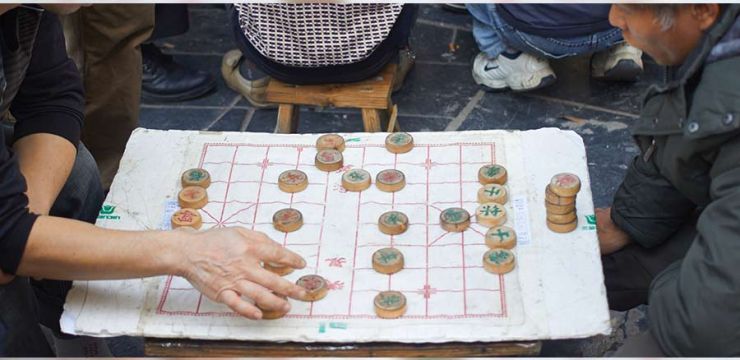
Participating in cultural activities like these is a great way for CLI students to meet new people, practice their spoken Chinese, and interact with Chinese culture.
In this post, Bradford Fried shares a recent cultural experience and the language opportunity and friendship it provided.
01 Chinese Chess on the Streets of Guilin
By Bradford Fried, Co-founder of CLI
A Crowd Around the Board
On a beautiful day in Guilin, I went for a bike ride around the city and into the countryside. Just like any other day, I passed numerous groups of Chinese men standing in a circle intensely focused on what was happening at the center.
Many newcomers to China are surprised to discover these onlookers are actually observing a fascinating aspect of Chinese culture: Chinese chess. I am a big fan of board games, so I decided to stop and watch.
This small crowd had five people watching and two men playing. Some of the onlookers were strangers to the players, others friends, but all in attendance were eager to provide suggestions for the players' next move.
There is a well-known Chinese saying about watching chess: 观棋不语真君子 (guān qí bù yǔ zhēn jūnzǐ), "a true gentleman watches the game without speaking." As anyone who has stood around a street board can tell you, it is advice that almost nobody follows.
Why Chinese Chess Is Louder Than You Expect
For a board game, Chinese chess is surprisingly loud and energetic. Players slam pieces down with conviction while shouting out their actions.
Although the game doesn't involve a timer, it is fast and aggressive. Most players only think for a few seconds between each move, and games are finished in around ten minutes.
02 What Is Chinese Chess? Xiangqi (象棋) Explained
How Old Is Chinese Chess?
Chinese chess has been played in China for well over a thousand years. That long history is part of why the game still turns up on street corners, in parks, and outside shop fronts across the country today.
How Chinese Chess Compares to International Chess
Chinese chess can quickly be picked up by anyone who knows how to play international chess. The rules are similar enough to feel familiar, as are many of the pieces and much of the strategy.
03 How a Game of Chinese Chess Becomes Mandarin Practice
From Onlooker to Player
As one of the oldest cultural activities in China, Chinese chess is a great way for CLI students to immerse themselves in Guilin's local community.
Within a few minutes of stopping to watch the game, I was talking with the onlookers and players, giving my own suggestions of moves to make, and asking why one of the players didn't take an obvious capture.
When the game ended, I was invited to play against the winner — and I was soon left wondering how I was defeated so quickly (but I think I put up a good fight).
If you want to join in, 我可以下一盘吗?(wǒ kěyǐ xià yì pán ma?) means "Can I play a game?" Note the measure word 盘 (pán), which is the one used for a round of a board game.
Trying Matters More Than Winning
Everyone I spoke with was eager to share their knowledge of Chinese chess with me, and they asked me lots of questions about my experiences in Guilin. Chess is not the only game locals will happily teach you either — the drinking game 猜码 (cāimǎ) is another one you will run into quickly.
The game I played is a great example of an opportunity where trying is more important than winning, and there's lots to try in Guilin!

Study Chinese in Guilin or Start Online
CLI offers personalized Chinese instruction built around your goals. Join our Immersion Program in Guilin or begin from anywhere with a free Chinese lesson .
04 Chinese Chess Vocabulary in Mandarin
The words below will get you through a game — or at least through a conversation with the crowd watching one. Several of the pieces are also useful practice if you are working on learning Chinese characters, since each piece is marked with a single character rather than a carved figure.
| Chinese | Pinyin | Translation |
|---|---|---|
| 象棋 | Chinese chess | |
| 下棋 | to play chess | |
| 棋盘 | chessboard | |
| 棋子 | chess piece | |
| 将 | general (the black side's king) | |
| 帅 | marshal (the red side's king) | |
| 士 | advisor | |
| 象 | elephant | |
| 马 | horse | |
| 车 | chariot (read jū in xiangqi, not chē) | |
| 炮 | cannon | |
| 兵 | soldier (red side) | |
| 卒 | soldier (black side) | |
| 楚河汉界 | the river dividing the two halves of the board | |
| 将军 | check! | |
| 赢 | to win | |
| 输 | to lose | |
| 麻将 | Mahjong | |
| 广场舞 | plaza dancing | |
| 阿姨 | auntie (a friendly term for an older woman) |