

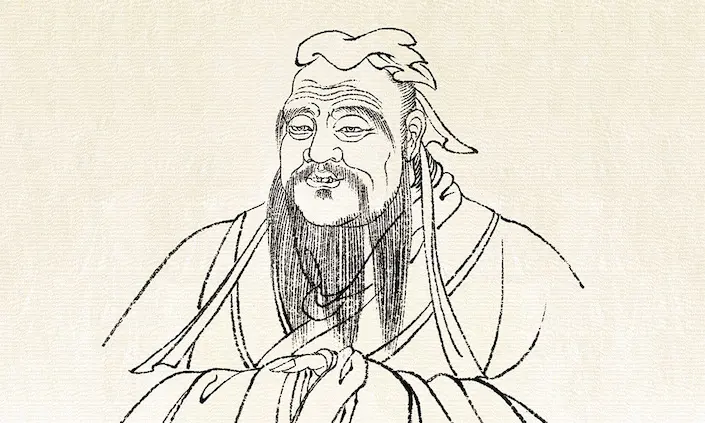
- Confucius (孔子, Kǒngzǐ) was a philosopher, teacher, and political thinker who lived during the Spring and Autumn period (551–479 BCE) and whose ideas became the foundation of East Asian moral and political thought.
- The Analects (论语, Lúnyǔ) — compiled by his disciples after his death — is the most reliable source for authentic Confucius quotes and the best starting point for understanding his philosophy.
- Many widely shared "Confucius quotes" online are actually modern proverbs or paraphrases that were never recorded in the Analects.
- For Chinese learners, studying Confucius is one of the best ways to connect language study with the cultural and philosophical roots that continue to shape Chinese culture today.
If you've ever scrolled through social media or browsed a book of "inspirational wisdom," you've undoubtedly encountered quotes attributed to the ancient Chinese philosopher Confucius. However, Confucius is one of the most misquoted figures in history — many "Confucian" sayings are actually later proverbs, paraphrases, or modern inventions retroactively assigned to him.
In this article, we separate fact from fiction by providing a curated list of authentic Confucius quotes verified in the Analects, while exploring the profound history and philosophy behind his words. Whether you are studying Chinese history or looking to deepen your understanding of the Chinese characters you encounter in classical texts, understanding Confucius is an essential step.
01 Who Was Confucius? The Life of China's Greatest Philosopher
Known in China as Kǒngzǐ (孔子) or Kǒng Fūzǐ (孔夫子), Confucius was a philosopher, teacher, and politician who lived during the Spring and Autumn period (551–479 BCE). Born in the state of Lu — in what is now Shandong Province — he sought to advise rulers on ethical governance during a time of political fragmentation and warfare. Although he died believing his mission had largely failed, his ideas would go on to define Chinese civilization for millennia.

It was only after his death that his disciples compiled his teachings into the Analects (论语, Lúnyǔ). For quotes most securely attributed to Confucius, the Analects is the safest place to start. As the Stanford Encyclopedia of Philosophy notes, the conventional scholarly view holds that the twenty chapters of the transmitted Analects most accurately represent Confucius's original teachings. Unlike the flowery "Internet Confucius" lines about "slowly going" or "finding beauty," the real Confucius was focused on duty, social hierarchy, ritual, and moral discipline.
Confucius lived during a turbulent era when the Zhou Dynasty was in decline and dozens of rival states competed for power. A century earlier, the statesman Guan Zhong (管仲) had made one of those states, Qi, the strongest of its day, and Confucius discusses him several times in the Analects. As Britannica explains, Confucius was emboldened to think he could set things right because he lived at a time when such aspirations were within the reach of men in similar circumstances. His philosophy emphasized restoring the moral ideals of the ancient sage kings, and he believed that virtuous leadership — rather than punishment — was the key to good governance.
The Spring and Autumn period (春秋时代, Chūnqiū Shídài) takes its name from the Spring and Autumn Annals, a chronicle of the state of Lu that tradition attributes to Confucius himself. For a broader look at how this era fits into the sweep of Chinese civilization, explore the Columbia University Asia for Educators timeline.
02 Confucius Quotes About Knowledge and Learning
For Confucius, learning was not just about memorizing facts; it was a lifelong process of self-cultivation. He emphasized the balance between gaining information and applying critical thought — a philosophy that resonates deeply with anyone who has set out to learn Chinese or study another complex subject.
What Does Confucius Say About True Knowledge?
"To know what you know and what you do not know, that is true knowledge."
(Analects 2.17) — Confucius believed that the first step toward wisdom is an honest assessment of one's own ignorance. This principle — intellectual humility — underpins much of his educational philosophy.
Confucius on Learning vs. Thinking
"Learning without thought is labor lost; thought without learning is perilous."
(Analects 2.15) — Study alone isn't enough; one must reflect deeply on what they have learned to avoid confusion. This is one of the most frequently cited passages in the Analects and captures Confucius's belief that true education requires both effort and introspection.
What Can We Learn from Others? Confucius on Everyday Wisdom
"If I am walking with two other men, each of them will serve as my teacher. I will pick out the good points of the one and imitate them, and the bad points of the other and correct them in myself."
(Analects 7.21) — Confucius taught that every social interaction is an opportunity for moral improvement. This passage has inspired many well-known Chinese idioms (成语, chéngyǔ) about the value of learning from those around you.

03 Confucius Quotes About Ethics, Virtue, and Morality
At the heart of Confucianism is the concept of Rén (仁), often translated as "benevolence" or "humaneness." This governed how a Junzi (君子), or "Superior Man," should behave toward others. These ethical teachings are central to understanding religion and philosophy in ancient China, and they continue to shape social norms across East Asia today.
The Golden Rule in Confucianism
"What you do not want done to yourself, do not do to others."
(Analects 15.24) — Often called the "negative golden rule" or the "Silver Rule," this is the core of Confucian ethics, known as Shù (恕). It predates similar expressions found in many other philosophical and religious traditions around the world.
Confucius on Integrity and Taking Action
"A superior man is modest in his speech, but exceeds in his actions."
(Analects 14.27) — Confucius had little patience for those who spoke grandly but failed to act with integrity. For Confucius, actions always spoke louder than words.
Confucius on Moral Courage and Doing What Is Right
"To see what is right and not to do it is want of courage."
(Analects 2.24) — Recognition of truth is meaningless without the bravery to uphold it. This quote is one of the most powerful in the entire Analects and speaks directly to the Confucian ideal of moral action.

04 Confucius Quotes About Leadership and Good Government
Confucius believed that a leader's primary tool should be their own moral example, not laws or punishments. His political philosophy was inseparable from his ethics — a theme that would later be developed by the Tang Dynasty and other great periods of Chinese imperial history, when Confucian ideals became the foundation of the civil service system.
Confucius on Leading by Example and Virtue
"He who exercises government by means of his virtue may be compared to the North Star, which keeps its place and all the stars turn towards it."
(Analects 2.1) — A virtuous leader creates a natural order where people follow out of respect rather than fear. This idea became one of the cornerstones of Chinese political thought.
Confucius on the Responsibility of Rulers
"In a state governed by the Way, poverty and low station are cause for shame; in a state bereft of the Way, wealth and high rank are cause for shame."
(Analects 8.13) — This highlights the leader's responsibility for the economic and moral welfare of the people. A just society, in Confucius's view, was one in which the virtuous could thrive.
Confucius on Preparation and Self-Improvement
"If the mechanic wishes to do his work well, he must first sharpen his tools."
(Analects 15.10) — In context, Confucius uses this as a metaphor for self-cultivation: to improve yourself, seek out worthy people and cultivate virtuous relationships. This proverb is still widely used in modern Chinese and has inspired many popular Chinese proverbs about learning.

Study Chinese in Guilin or Start Online
CLI offers personalized Chinese instruction built around your goals. Join our Immersion Program in Guilin or begin from anywhere with a free Chinese lesson .
05 Fake Confucius Quotes: Misattributed Sayings to Avoid
If you want to be a true scholar of Chinese history, you must be wary of these popular but incorrect attributions. The internet is full of motivational quotes credited to Confucius that appear nowhere in the Analects or any other verified classical source.
"It Does Not Matter How Slowly You Go"
"It does not matter how slowly you go as long as you do not stop." — This line is not found in the Analects and is not reliably attributable to Confucius. It closely resembles the later proverb 不怕慢,就怕站 ("Don't fear being slow; fear standing still"), which is often circulated without a clear ancient source.
"Before You Embark on a Journey of Revenge"
"Before you embark on a journey of revenge, dig two graves." — This is widely treated as a modern proverb that was later — and incorrectly — attributed to Confucius; its exact origin is uncertain.
"I Hear and I Forget. I See and I Remember."
"I hear and I forget. I see and I remember. I do and I understand." — This popular wording is not a Confucius quote. It is best understood as a modern adage that may have been inspired by ideas found in later texts — including passages attributed to Xunzi — rather than a verbatim line from any single classical source.
Whenever you encounter a Confucius quote online, check whether it includes a specific Analects reference (e.g., 2.17 or 7.21). If no source is cited, the quote is very likely a modern invention. Learning to read the original types of Chinese characters used in classical texts can also help you verify quotes directly.
06 How Confucian Philosophy Shapes Chinese Culture Today
Confucius's real words are often more challenging than the fake ones. They demand constant effort, respect for others, and a commitment to community over the self. By studying the authentic Analects, you gain a direct window into the foundation of East Asian civilization — from the emphasis on family and education to the reverence for ritual and social harmony.
Confucian values continue to influence everyday life across China and much of East Asia. Concepts like filial piety (孝, xiào), respect for teachers, and the importance of education can be seen in everything from holiday traditions to workplace culture. Understanding these values is essential for anyone who wants to learn Chinese in China and connect meaningfully with the people and culture they encounter. For a deeper dive into how these ideas intersect with belief systems, our guide to religion in ancient China covers Confucianism alongside Taoism and Buddhism.
Whether you are interested in Chinese literature or looking to improve your Mandarin grammar, understanding the philosophical roots of the language is a powerful step forward. Want to take your Chinese journey further? CLI offers personalized one-on-one lessons that help you master the language and the culture that shaped it.

07 Chinese Vocabulary for Studying Confucius
The following vocabulary will help you navigate discussions of Confucius and classical Chinese philosophy with more confidence. For help with pronunciation, our guide to pinyin is a great place to start.
| Chinese | Pinyin | Translation |
|---|---|---|
| 孔子 | Confucius | |
| 孔夫子 | Master Kong (formal name for Confucius) | |
| 论语 | The Analects | |
| 儒家 | Confucianism (the Ru School) | |
| 仁 | Benevolence; humaneness | |
| 义 | Righteousness; justice | |
| 礼 | Ritual; propriety | |
| 智 | Wisdom | |
| 信 | Faithfulness; trustworthiness | |
| 孝 | Filial piety | |
| 君子 | Superior Man; gentleman | |
| 恕 | Reciprocity; empathy | |
| 道 | The Way; the right path | |
| 德 | Virtue; moral power | |
| 春秋时代 | Spring and Autumn period | |
| 成语 | Chinese idiom (four-character expression) | |
| 哲学 | Philosophy | |
| 思想家 | Thinker; philosopher |