

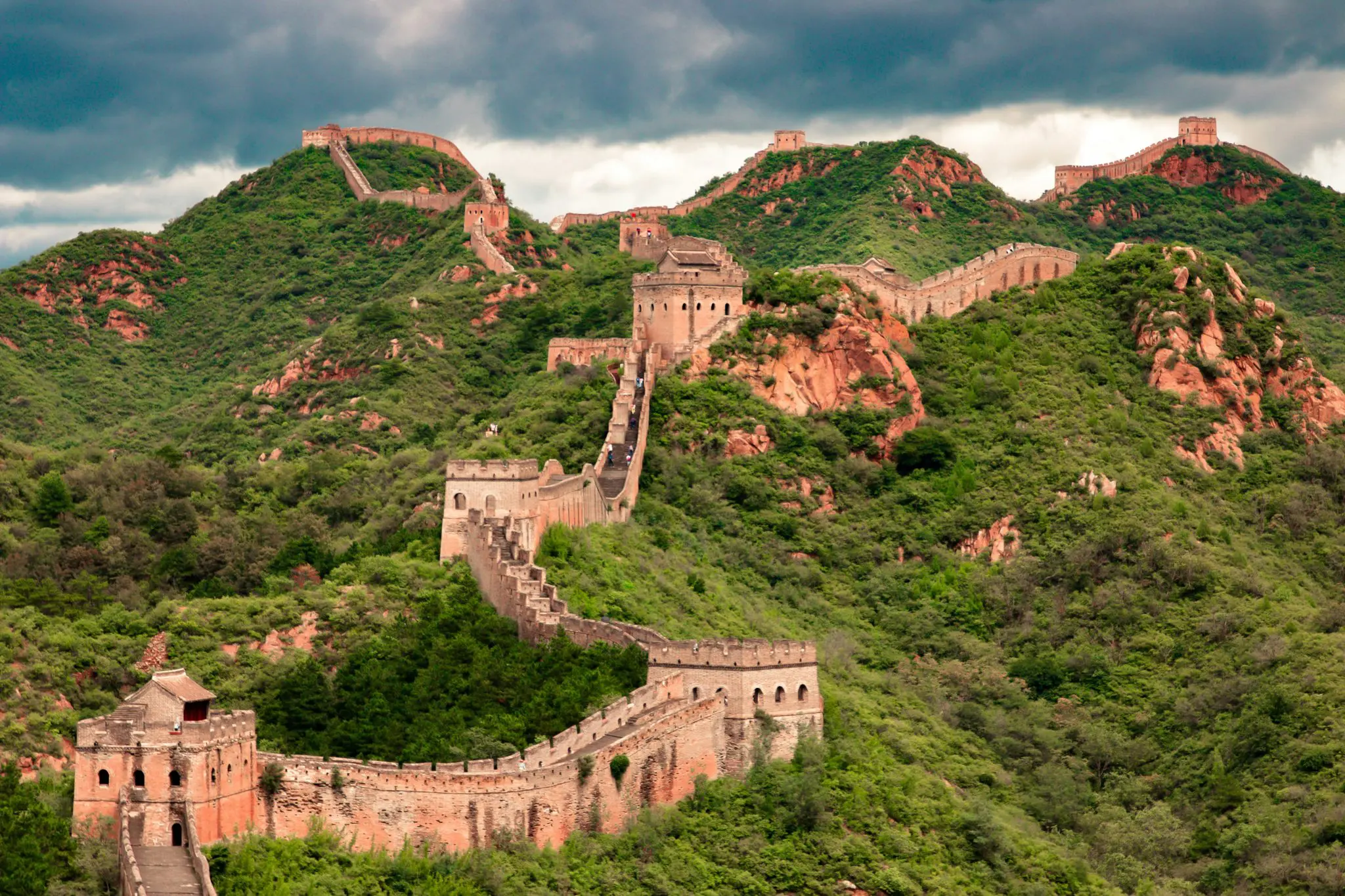
- The Great Wall is not one wall but a network of walls, trenches, passes, and beacon towers built and rebuilt by many dynasties over more than two thousand years.
- China's official survey puts the total length of all surviving sections at 21,196.18 km (13,171 miles). The famous brick-and-stone Ming wall accounts for 8,851.8 km (5,500 miles) of that.
- In Chinese the wall is 长城 (Chángchéng), literally "Long Wall," or 万里长城 (Wànlǐ Chángchéng), "Ten Thousand Li Long Wall" — a figurative name rather than a measurement.
- No, you cannot see it from the Moon, and archaeologists have found no evidence that workers' bodies were used as building material.
- Most visitors reach the wall from Beijing, where sections range from fully restored and crowded to unrestored and genuinely hazardous.
Who actually built the Great Wall of China? Are the stories about workers buried inside it true, and can you really see it from the Moon?
So many myths surround China's 长城 (Chángchéng) that separating fact from folklore takes some work. The name means simply "Long Wall," though English has always called it the Great Wall.
This guide answers the three questions above, sets out what the archaeological record actually shows, and covers how to visit. The short animated lesson below is a good place to start.
01 What Is the Great Wall of China? (长城, Chángchéng)
The single most important thing to understand is that the Great Wall is not one wall. It is a defensive system of separate walls, ditches, garrison forts, fortified passes, and signal towers, built by rival states and successive dynasties across more than two millennia.
Some stretches run parallel to each other. Others overlap, contradict each other, or simply stop where a river or a cliff already did the job.
Britannica describes it as one of the largest building projects ever undertaken, and UNESCO added it to the World Heritage list in 1987. It is also, in places, in poor condition — erosion and human damage remain live conservation problems.
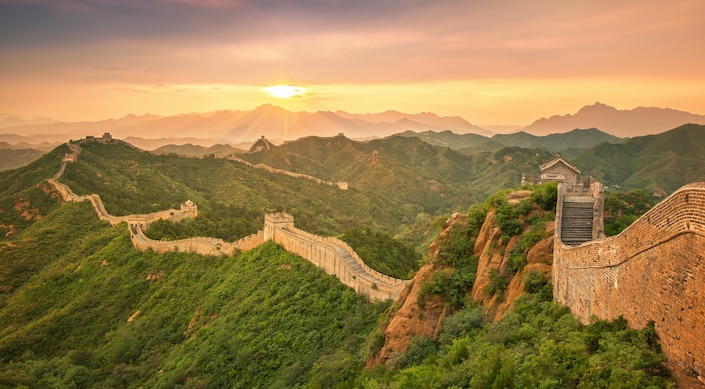
What the Chinese Name Tells You
In Chinese the structure is 长城 (Chángchéng), "Long Wall." The fuller traditional name is 万里长城 (Wànlǐ Chángchéng), usually translated as "Ten Thousand Li Long Wall."
A 里 (lǐ) is roughly half a kilometer, so ten thousand li works out to about 5,000 km. The figure was never meant literally — in classical Chinese, "ten thousand" often just means "countless," and the phrase is closer to "the immeasurably long wall."
Chángchéng uses two second-tone syllables in a row, which trips up most beginners. If the rising tones feel unfamiliar, our guide to pinyin covers how to read and produce them.
02 Who Built the Great Wall of China?
There is no single builder, which is why the question has no tidy answer. Different dynasties built different walls for different enemies, and the wall you photograph today is mostly the youngest layer.
The First Frontier Walls
The earliest walls were raised by competing Chinese states from around the seventh century BCE, during the Spring and Autumn and Warring States periods. These were rammed-earth barriers built against each other as much as against outsiders.
Qin Shi Huang and the First Unified Wall
After unifying China in 221 BCE, the first emperor Qin Shi Huang (秦始皇, Qín Shǐhuáng) ordered existing northern walls linked and extended into a single frontier. Conscripted peasants, soldiers, and convicts did the work, largely in rammed earth rather than brick.
Almost nothing of the Qin wall survives in a form visitors would recognize. To see what that emperor's building programs actually looked like, the Terracotta Army near Xi'an is the far better surviving monument.
Han, Northern Dynasties, and the Long Middle
The Han dynasty pushed walls westward to protect Silk Road trade, and later regimes including the Northern Qi, Sui, and Jin built their own systems. Long stretches of the intervening centuries saw the walls neglected entirely.
Whether to build walls or negotiate with steppe powers was a genuine strategic argument at court, not a settled policy. Chinese dynasties swung between the two for over a thousand years — a thread you can follow through our Chinese history guides.
The Ming Wall: What You Actually Visit
The wall in the postcards is Ming (1368–1644). Building began under the Hongwu Emperor, Zhu Yuanzhang, who founded the dynasty with his capital at Nanjing, and continued for most of the next three centuries.
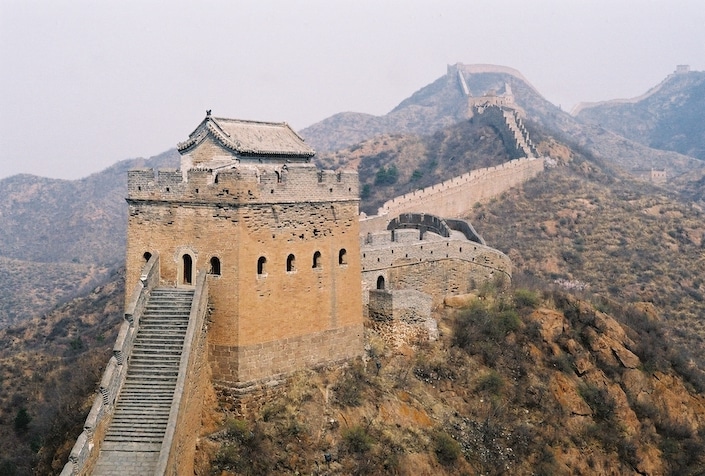
The Ming built in dressed stone and fired brick, with watchtowers, garrison quarters, and integrated beacon systems. This is the layer that produced Badaling, Mutianyu, Jinshanling, and Shanhaiguan.
Curiously, the Ming did not call it 长城. Official documents used 边墙 (biānqiáng), "border barriers," because the older term carried associations with Qin Shi Huang's reputation for tyranny.
When the Wall Stopped Mattering
The wall's military purpose ended abruptly in 1644, when Manchu forces entered through a pass opened to them by a Ming general rather than breaching it. The Qing dynasty that followed ruled both sides of the frontier, leaving the wall strategically pointless.
It spent the next two and a half centuries as a decaying ruin and a quarry for local building stone. Its reinvention as a national symbol and tourist destination is a twentieth-century development.
03 How Long Is the Great Wall of China?
Published lengths vary wildly because sources count different things. The authoritative modern figure comes from a five-year GPS and mapping survey completed by China's National Cultural Heritage Administration in 2012.
| Measurement | Length | Source |
|---|---|---|
| All surviving sections, all dynasties | 21,196.18 km (13,171 miles) | 2012 national survey |
| Ming dynasty wall | 8,851.8 km (5,500 miles) | 2009 announcement |
| — of which constructed wall | approx. 6,259 km | 2009 announcement |
| — of which trenches | approx. 359 km | 2009 announcement |
| — of which natural barriers | approx. 2,233 km | 2009 announcement |
| Sections within Beijing municipality | approx. 573 km | 2012 national survey |
The 2012 survey also catalogued 43,721 individual heritage sites, from wall segments to forts and beacon towers. It was the first systematic measurement of the whole system.
The Ming wall runs from Hushan in Liaoning province in the east to the Jiayuguan pass in Gansu in the west, crossing ten provinces and municipalities. If you have seen a figure like "over 10,000 miles" elsewhere, it is probably a garbled version of either the 13,171-mile total or the "ten thousand li" name.
04 Great Wall of China Myths and Misconceptions
Three claims about the wall circulate more widely than any others. All three are wrong, though each contains a grain of something real.
Myth 1: You Can See the Great Wall From the Moon
You cannot. Britannica notes that Apollo astronauts settled the question directly: no human-made object is distinguishable from lunar distance, where Earth appears as a marble.
The myth is older than spaceflight itself, appearing in an English antiquarian's letter in 1754 and reaching a mass audience through a 1932 Ripley's Believe It or Not cartoon. China's first astronaut, Yang Liwei, was asked in 2003 whether he had seen it from orbit and answered plainly that he had not.
The grain of truth is that the wall is sometimes faintly detectable from low Earth orbit under favorable low-angle sunlight. Even then it is nearly impossible to identify with the naked eye, and photographs have historically confused it with rivers.
Myth 2: Workers Are Buried Inside the Wall
The wall is sometimes called the longest cemetery on earth, and enormous numbers of laborers did die building it. Conscription, exposure, malnutrition, and accidents killed workers across every construction period.
But archaeologists have found no evidence that human remains were used as building material within the wall itself. Those who died were generally buried nearby, not sealed into the masonry.
Myth 3: It Is One Continuous Wall
This is the misconception that most distorts trip planning. There is no single unbroken barrier and no continuous path from one end to the other.
Visitors choose a specific restored section and travel to it. Reading the 13,171-mile total as a hiking trail is the most common way people misjudge a Great Wall day trip.

See China's History With the Language to Match
CLI offers personalized Chinese instruction built around your goals, so sites like the Great Wall come with the context and vocabulary to understand them. Join our Immersion Program in Guilin or begin from anywhere with a free Chinese lesson .
05 How to Visit the Great Wall of China From Beijing
Although the wall can be reached at many points across northern China, most travelers go from Beijing. The city is easy to reach from elsewhere in China by high-speed rail.
Which Section Should You Visit?
The choice of section matters more than anything else about the trip. Each offers a different balance of accessibility, restoration, and crowding.
| Section | Chinese | Best For |
|---|---|---|
| Badaling | 八达岭 (Bādálǐng) | Easiest access and full facilities; also the most crowded |
| Mutianyu | 慕田峪 (Mùtiányù) | Restored wall with cable car and fewer crowds |
| Jinshanling | 金山岭 (Jīnshānlǐng) | Long ridgeline walking and mixed restoration |
| Juyongguan | 居庸关 (Jūyōngguān) | The closest fortified pass to central Beijing |
| Shanhaiguan | 山海关 (Shānhǎiguān) | The eastern terminus, where the wall meets the sea |
| Jiayuguan | 嘉峪关 (Jiāyùguān) | The western end, deep in the Gansu desert |
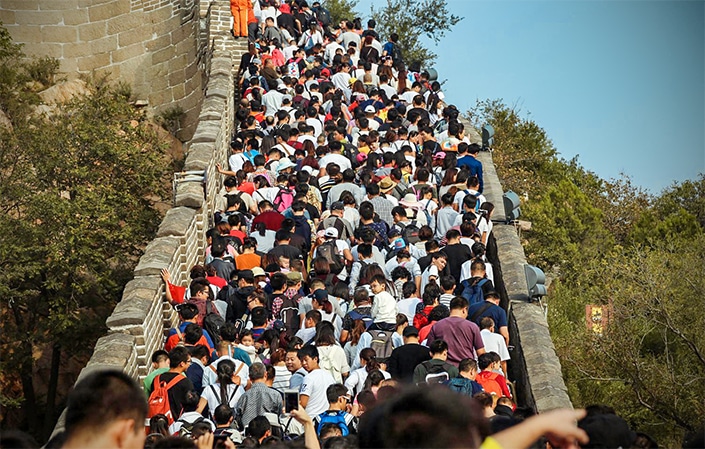
Avoid Golden Week if you possibly can. Badaling during the National Day and Spring Festival breaks is genuinely overwhelming, so check our guide to Chinese holidays before fixing dates.
A Word on the "Wild Wall"
Unrestored sections such as Jiankou attract hikers looking for empty ruins and dramatic photographs. They also involve crumbling steps, loose masonry, and steep unprotected drops.
Access to some unrestored stretches is legally restricted, and rescue is slow where it happens at all. Go with a guide who knows the specific route, or choose a restored section instead.
What Else to See Nearby
Beijing holds far more than the wall alone. The Summer Palace, China's best-preserved imperial garden, is an easy addition to any itinerary.
Before booking, check current entry requirements in our China visa-free travel guide. A handful of Chinese travel phrases will also make buying tickets and finding transport considerably smoother.
06 Great Wall Vocabulary in Mandarin
The words below cover the wall itself, its architecture, and the practicalities of visiting. The last entry is a saying you will see printed on souvenirs at every section.
| Chinese | Pinyin | Translation |
|---|---|---|
| 长城 | the Great Wall ("Long Wall") | |
| 万里长城 | "Ten Thousand Li Long Wall" | |
| 秦始皇 | Qin Shi Huang, the first emperor | |
| 明朝 | Ming dynasty | |
| 城墙 | wall, rampart | |
| 烽火台 | beacon tower | |
| 关 | fortified pass, gateway | |
| 砖 | brick | |
| 世界遗产 | World Heritage | |
| 门票 | entrance ticket | |
| 缆车 | cable car | |
| 爬长城 | to climb the Great Wall | |
| 不到长城非好汉 | "You're no hero until you've reached the Great Wall" |
07 Great Wall of China FAQ
Who built the Great Wall of China?
Many dynasties did, over more than two thousand years. Qin Shi Huang first linked earlier walls into a unified frontier in the third century BCE, but the wall visitors see today was built by the Ming dynasty between 1368 and 1644.
How long did it take to build?
There is no single construction period, because the wall was built, abandoned, and rebuilt repeatedly across roughly twenty centuries. The Ming campaign alone ran intermittently for more than 200 years.
Can you see the Great Wall from space?
Not from the Moon, and not reliably from low Earth orbit with the naked eye. It has occasionally been photographed from the International Space Station using a telephoto lens and favorable lighting.
Are people buried in the Great Wall?
Many workers died during construction and were buried near the wall. There is no archaeological evidence that bodies were used as building material inside it.
Which section of the Great Wall is best to visit?
Mutianyu suits most first-time visitors, offering restored wall and a cable car without Badaling's crowds. Jinshanling is the better choice if you want a longer walk along the ridgeline.
Was the Great Wall actually effective?
Historians debate this at length, and the honest answer is partially. It slowed raids and channeled trade and movement through controlled passes, but it never prevented a determined invasion — in 1644 the Manchus simply came through a gate that was opened for them.
08 Plan Your Visit
Strip away the myths and the Great Wall is still extraordinary — not as a single heroic barrier, but as twenty centuries of accumulated effort along one contested frontier. That is the more interesting story anyway.
Next time you are traveling through China, make time for this marvel of ancient engineering. And if you would like the language to go with the history, come Learn Chinese in China with CLI in Guilin.