


- Mandarin takes about 2,200 class hours, or 88 weeks of full-time study, to reach professional working level, according to the US Foreign Service Institute. At 10 class hours a week, that would be more than four years.
- Basic conversation comes much sooner. By our estimate it takes somewhere between 350 and 700 hours, depending on your goal and on how you study.
- Regular speaking practice with feedback is one of the biggest levers you control, and immersion adds hours of real use on top of your classes.
- The new HSK syllabus officially took effect in July 2026, with nine levels in place of six and more words at the early levels. The tests are still moving over, so check chinesetest.cn for the format on your test date.
- Writing still counts below HSK 5: the syllabus lists 100 characters to write across HSK 1 and 2, then 150 new ones at each of HSK 3 to 6.
How long does it take to learn Chinese? The US Foreign Service Institute puts Mandarin at about 2,200 class hours, or 88 weeks of full-time study, for an English speaker to reach professional working level. That is more than four years at 10 hours a week, but by our estimate basic conversation takes roughly 350 to 700 hours.
You've probably seen the 2,200-hour number already. It is real, but it describes diplomats in full-time training who are aiming at professional use, which is a much higher bar than most beginners have in mind.
01 Quick Answer: How Long Does It Take to Learn Chinese?
If you start from zero, your first goal is survival Chinese, the kind that gets you through a restaurant order or a taxi ride. By our estimate that takes 100 to 200 hours of serious study, so five to ten months at five hours a week, or one to two months in a full-time program.
After that, the timeline depends mostly on how you study. Someone doing five casual hours a week is on a very different clock from someone who has a lesson most days and gets corrected on the spot, so the method matters almost as much as the total number of hours.
It helps to swap the big question for a smaller one: how long until you reach your goal? For some people that means getting around on a trip, and for others it means passing HSK 4 or using Chinese at work.
The 2,200-hour figure causes most of the confusion here, so section 02 looks at what it actually measures.


Want the Fastest Path?
The fastest progress comes from plenty of speaking in class and enough hours each week that last week's words are still fresh.
02 What the 2,200-Hour Number Really Means
The U.S. Foreign Service Institute (FSI), renamed the George P. Shultz National Foreign Affairs Training Center in 2025, trains diplomats for the State Department. Its estimate for Mandarin is about 2,200 class hours, or 88 weeks, for an English speaker, and the number carries weight because it comes from more than 70 years of teaching languages to diplomats.
The figure is easy to misread without the rest of the scale, so here it is.
| FSI Category | Example Languages | Estimated Class Hours | Estimated Weeks (Full-Time) |
|---|---|---|---|
| Category I | Spanish, French, Italian, Portuguese | 552–690 | 24–30 |
| Category II | German, Indonesian, Swahili | 828 | 36 |
| Category III | Russian, Hindi, Greek, Thai | 1,012 | 44 |
| Category IV | Chinese (Mandarin), Arabic, Japanese, Korean | 2,200 | 88 |
FSI puts Mandarin in its hardest group for English speakers, the one it calls “super-hard languages.”
The 2,200-hour figure counts class hours only. A typical FSI week is 23 hours in class plus 17 hours of self-study, so the real workload is closer to a full-time job than the class-hour count suggests.
It also aims high. The target is level 3 on the US government's ILR scale, which FSI has called general professional proficiency: enough to do a diplomat's job in the language, well beyond ordering food or chatting with a taxi driver.
The 2,200 hours, then, measure the distance to professional-level Chinese. Spread over part-time study it looks like this: at 10 class hours a week, 2,200 hours takes about four and a quarter years, and at five hours a week it takes eight and a half. If you want basic conversation or HSK 3, your target is a fraction of that.

03 Realistic Beginner Timelines
A beginner gets more out of milestones than out of one lifetime total, so here are our estimates for four goals, by how you study.
| Goal | Description | Approx. Hours | Self-Study | Tutoring | Immersion |
|---|---|---|---|---|---|
| First survival basics | Greetings, numbers, dates, ordering food, asking simple questions | 100–200 | 5–10 months (5 hrs/wk) |
3–6 months (8 hrs/wk) |
1–2 months (25–35 hrs/wk) |
| Basic conversation | Talk about yourself, family, daily life, likes and dislikes, simple plans | 350–700 | 1.5–3 years (5 hrs/wk) |
10–20 months (8 hrs/wk) |
3–6 months (25–35 hrs/wk) |
| Independent everyday use | Handle travel, errands, social talk, and many familiar daily situations | 700–1,200 | 3–5 years (5 hrs/wk) |
1.5–3 years (8 hrs/wk) |
6–10 months (25–35 hrs/wk) |
| Advanced study or work use | Read widely, discuss abstract topics, follow fast native speech more comfortably | 2,000+ | Many years (5 hrs/wk) |
Several years (8 hrs/wk) |
1.5–3+ years (25–35 hrs/wk) |
These are our rough estimates, and nobody can promise them. You may move faster if you already speak a second language or can study every day, and slower if work gets in the way or most of your study is passive listening.
The pattern is clear enough. Five casual hours a week and thirty focused hours a week lead to very different places after six months, even with the same textbook.
For most beginners, the first milestone that feels like real progress is a short conversation with a stranger where you don't freeze, and that comes far earlier than the scary numbers suggest. One student wrote in their end-of-program evaluation that their teacher's lessons had them speaking Mandarin with native speakers “weeks before I thought it was even worth trying.” Much of the freezing comes from translating in your head, and our beginner’s guide to thinking in Chinese shows how to start cutting that step out.

04 HSK 3.0: What Changed in 2026
The HSK (汉语水平考试, ) is China's official Chinese proficiency exam for non-native speakers. A new syllabus, usually called HSK 3.0, officially took effect in July 2026 and replaces the old six levels with nine, grouped into three stages. It was published in November 2025 by the Center for Language Education and Cooperation and draws on China's 2021 national standard for Chinese proficiency levels (GF 0025-2021), while setting its own word counts.
The tests are catching up in stages. HSK 7–9 already uses the new standard, and Chinese Testing International has announced that the new-format HSK tests start worldwide on 13 December 2026, so check chinesetest.cn for the format that applies on your test date. What matters for a beginner is that the early levels now ask for more words. HSK 3 lists 1,000 words where the old HSK 3 asked for 600, so older blog posts that give study times for HSK 3 are usually working from the old, shorter list.
HSK 3.0 Cumulative Vocabulary Standards
| HSK 3.0 Level | Cumulative Vocabulary | Stage | Rough CEFR Comparison |
|---|---|---|---|
| HSK 1 | 300 words | Elementary | Approx. A1 |
| HSK 2 | 500 words | Elementary | Approx. A1+ |
| HSK 3 | 1,000 words | Elementary | Approx. A2 |
| HSK 4 | 2,000 words | Intermediate | Approx. B1 |
| HSK 5 | 3,600 words | Intermediate | Approx. B2 |
| HSK 6 | 5,400 words | Intermediate | Approx. C1 |
| HSK 7–9 | 11,000+ words | Advanced | Approx. C2 |
“Cumulative” means each level includes the words from the levels below it, so the 2,000 words at HSK 4 include the 1,000 from HSK 1 to 3.
Recognition vs. Writing Under HSK 3.0
The syllabus keeps separate lists of characters to recognize and characters to write, which suits learners who type most of the time. Writing still starts at HSK 1, with 100 characters across the first two levels. The table shows how many new characters each level adds to the writing list.
| Level | Recognition Focus | New Characters to Write (Official Syllabus) |
|---|---|---|
| HSK 1–2 | Yes | 100 |
| HSK 3 | Yes | 150 |
| HSK 4 | Yes | 150 |
| HSK 5 | Yes | 150 |
Beginners need to write a hundred characters by the end of HSK 2, which is a short list, and neat handwriting doesn't come into it. Writing them out by hand still helps them stick, even if you type everything else.

05 What Speeds Up or Slows Down Your Progress
Two beginners can both “study Chinese for a year” and end up at very different levels. These are the six things that usually explain the gap.
1. Study Intensity
A few weeks of concentrated study can move you further than months of light study, as long as most of that time goes on speaking and writing.
Part-time study works too, as long as the hours are focused, because one focused hour is worth far more than one distracted hour.
2. Study Format
- Apps and self-study: Fine for vocabulary review and listening practice, and for building a daily habit, but nobody is there to correct your tones.
- Group classes: You get structure and a teacher expecting you each week, but you share the speaking time with everyone else in the room.
- One-on-one lessons: Especially useful for Mandarin, because your teacher catches every wrong tone and grammar slip as it happens.
- Immersion: Usually the fastest format, because the words you learn in class in the morning are the ones you need at lunch.
3. Consistency
Chinese rewards regular contact. A short session every day keeps tones and characters fresh in a way that one long session on Sunday doesn't, and long gaps make the language feel harder than it is.
4. Environment
Studying in a Chinese-speaking city changes the math, because practice spills out of “study time.” Ordering a bowl of Guilin rice noodles or asking a bus driver where to get off becomes one more repetition, and those add up over a day.
5. Prior Language Experience
If you have already learned another foreign language, you have a real advantage. You know what learning a language feels like, including the plateaus where nothing seems to move for weeks, so they are less likely to put you off.
6. Age and Motivation
Adults are often told they are too old to learn Chinese well, and we think that's wrong. Adults usually bring clearer goals and better study habits. Children may end up with a better accent, but a motivated adult can make quick progress.
06 What Is Usually Hardest for Beginners?
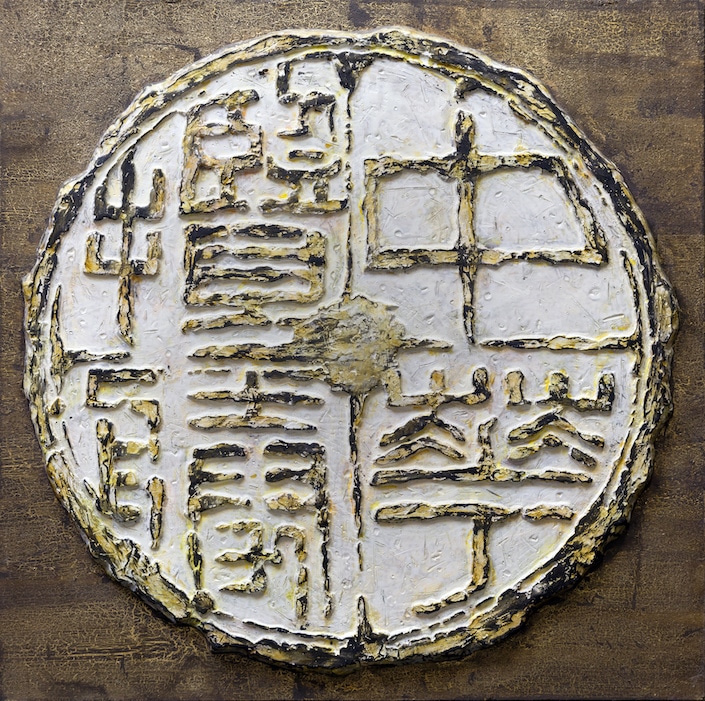
No single part is hardest for everyone, but most English-speaking beginners hit two walls: tones when speaking and characters when reading.
Early on, tones usually feel hardest. Mandarin uses pitch to tell words apart, and English speakers aren't used to hearing or producing those differences, so speaking and listening feel shaky at first.
Over the long run, characters take the most time. Chinese has no alphabet, so you can't sound out a new word from its letters, and reading grows more slowly than speaking. Learning to recognize characters, and later to write them, takes patience.
Your speaking and your reading will grow at different speeds, which is normal: you can be useful in conversation long before you can read a newspaper.
Phones help here. Most everyday writing in China now happens on a phone, where you type pinyin and pick the character from a list, so typing matters more than neat handwriting for most learners. Recognition still matters, because you can't pick the right character if you don't recognize it on the screen.
07 Why Immersion Helps So Much
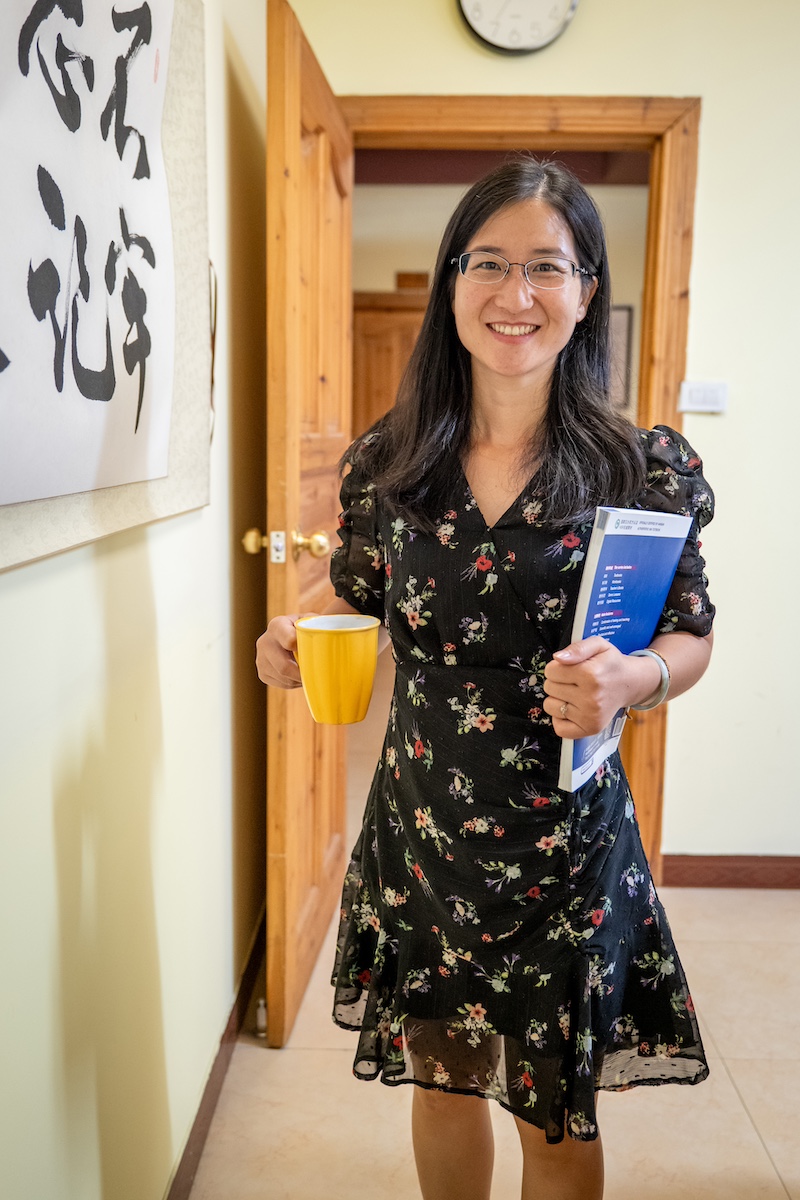
Immersion multiplies the number of times a day you have to use Chinese for something real. Our guide to why learn Chinese in China looks at what that daily contact does for your speaking and listening, and for your confidence.
In a good immersion program you hear Chinese at meals and read it on signs, and when you get something wrong at the market, the stallholder's blank look tells you straight away. That loop makes the language stick faster.
The studies we cite looked at intensity and time abroad. Xu, Padilla and Silva (2014) found that a four-week intensive Chinese course reached the same level as a 22-week semester with about the same class hours, although the semester group spoke more fluently at the end. Serrano and Muñoz (2007), with adults learning English in Spain, found that concentrated hours did better than the same hours spread over months. Wang and Halenko (2024) followed 18 students from a British university through a year in China: both groups' fluency improved, more so for the group that had six hours of training in everyday phrases before they left, and those who used Chinese more each week sped up more. Packing hours together saves calendar time, while fluency seems to need time and real use as well.
One reviewer on Go Overseas, who had worked through an app before coming, put it in concrete terms: “After six weeks at CLI, I could have a small conversation with a person on the street and could explain preferences at stores/restaurants.” That is one person's six weeks, and yours will depend on where you start. One CLI student who arrived with no Chinese at all describes the same effect in The Sport of Linguistics.
Can You Learn Chinese in One Year?
Yes, if by “learn Chinese” you mean a solid beginner or lower-intermediate level. A year at 10 hours a week is about 500 hours, which by the table above puts basic conversation within reach, and a full-time year takes you well past that.
No, if by “learn Chinese” you mean sounding native and reading anything put in front of you. That is a project of many years.
Decide what success means before you start. A year that gets you to comfortable everyday conversation is a very good year, even if it doesn't make you advanced.

08 Does Your Language Background Help?
Sometimes it does, and how much depends on which languages you already speak.
If You Speak a Tonal Language
You may be comfortable with the idea of tone, but Mandarin's tones still take work. Both tone studies we cite found that a tonal first language gave no head start: Cantonese speakers did no better than English speakers in one, and Hmong speakers did worse than English and Japanese speakers in the other, because their own tones got in the way, although six hours of tone training closed that gap.
If You Speak Japanese or Korean
If you learned kanji or hanja, you will recognize many characters, which makes reading feel faster. Pronunciation and speaking still need their own work.
If You Speak English or Another European Language
You share almost no vocabulary or script with Mandarin, which is why FSI gives Spanish 30 weeks and Mandarin 88. That doesn't stop you progressing well, but expect the first months to feel less familiar than they would in Spanish or French.

09 What This Means for You
If you are just starting out, this is how we would think about it.
You do not need to sign up mentally for thousands of hours before you begin. Your first real goal is a few hundred hours away, and travel Chinese or HSK 2 comes long before anything like the FSI benchmark.
The two biggest levers you control are how often you study and how interactive your study is. If your week includes real conversation with feedback, progress feels much faster than it does with apps and listening alone.
Instead of asking how long Chinese takes, ask yourself this:
What level do I want in three months, and in twelve, and which way of studying gives me the best chance of getting there? If a few months of full-time study fits your answer, CLI's Spring Term in Guilin runs 12 weeks to 5 months, with a term plan and a level report at the end.
Once you know the level you want, the hour estimates above tell you roughly how long it will take.

Take the First Step
You can try a free lesson before you commit to anything, or read how our Immersion Program in Guilin works.
| Chinese | Pinyin | Translation |
|---|---|---|
| 汉语水平考试 | HSK; Chinese Proficiency Test | |
| 汉字 | Chinese character(s) | |
| 拼音 | pinyin; Mandarin romanization system | |
| 词汇 | vocabulary |
10 Sources
- U.S. State Department: Foreign language training estimates and the 23-hours-in-class / 17-hours-of-self-study weekly model for hard languages including Mandarin. View source →
- Chinese Tests Service Website: Official HSK overview page describing the new 9-level HSK structure. View source →
- HSK Syllabus (2025-11, effective 2026-07): Official revised HSK syllabus with vocabulary and writing requirements by level. View source →
- National Academies (2020): Report on Foreign Service Institute language assessment and training context. View source →
- Xu, Padilla & Silva (2014): Study comparing intensive and semester-format Mandarin instruction. View study →
- Serrano & Muñoz (2007): Study on time distribution and language-learning outcomes. View study →
- Wang & Halenko (2024): Study on Mandarin fluency development through pedagogic intervention and study abroad. View study →
- Hao (2012): Study on Mandarin tone acquisition by tonal and non-tonal language speakers. View study →
- Wang (2013): Study on the effect of first-language background on Mandarin tone perception. View study →