


- 我爱你 (wǒ ài nǐ) means “I love you.” It carries more weight than the English, and people say it less often, especially to their parents.
- 我喜欢你 (wǒ xǐhuan nǐ), “I like you,” is the usual way to confess your feelings, and 我爱你 comes later.
- With family, love often comes as care: 吃饭了吗 (chīfàn le ma), “have you eaten?”, or 多穿点 (duō chuān diǎn), “wear more layers.”
- 520 (wǔ èr líng) sounds a bit like 我爱你, so in a text it means “I love you,” and 5201314 adds “for a lifetime.”
I love you in Chinese is 我爱你 (wǒ ài nǐ), often typed as wo ai ni, and it’s how you say I love you in Mandarin, the standard Chinese you’ll learn in class. Tap the characters to hear a woman’s voice and the pinyin to hear a man’s. The three words are among the first any learner meets, but the phrase itself is a big one. In a 2013 study by Caldwell-Harris, Kronrod and Yang, university students in Beijing and Shanghai were more reluctant than American students to say “I love you,” above all to their parents. So most of this page is about what people say instead, from the first confession to the way a mom says it without saying it.

There are 24 words and phrases on this page, each with audio. Start with the table if you only need one, or jump to all 24 in one list.
01 How to Say I Love You in Chinese
Which one should I say?
Pick the line that fits the moment. Each one is explained further down.
| When | Chinese | Pinyin | English |
|---|---|---|---|
| You have a crush and want to say so | 我喜欢你 | wǒ xǐhuan nǐ | I like you |
| To your partner, when you mean it | 我爱你 | wǒ ài nǐ | I love you |
| To your partner, at the end of a call | 爱你 | ài nǐ | love you |
| Your partner just said 我爱你 | 我也爱你 | wǒ yě ài nǐ | I love you too |
| Someone you love is far away | 我想你 | wǒ xiǎng nǐ | I miss you |
| A text late at night | 早点睡 | zǎo diǎn shuì | go to bed early |
| To your dad, for all he does | 爸,您辛苦了。 | Bà, nín xīnkǔ le. | Dad, thank you for all you do |
| A text that says it in numbers | 五二零 | wǔ èr líng | 520: I love you |
Wo ai ni (我爱你): what it means and how to say it
我爱你 (wǒ ài nǐ) is 我 (I), 爱 (love) and 你 (you), in the same order as English, and all three are HSK 1 words. It sounds heavier than “I love you” often does in English, where people also say it to their friends and to pizza, so save it for a partner and a moment that matters.
In plain letters it’s wo ai ni, but the tones matter. 我 and 你 are both third tones and 爱 is a fourth. Because 爱 sits between them, neither third tone changes. 我 is a low “half third” that stays down instead of rising at the end, 爱 falls sharply, and 你 ends the phrase low. The pinyin chart lets you hear each syllable on its own, and our guide to tone changes in Mandarin explains when a third tone does change.
爱你 | ài nǐ | love you
Drop the 我 and it gets lighter. 爱你 is the “love you” at the end of a phone call or a text to your partner, and you’ll see it in Dialogue 2 below.
I love you too in Chinese: how to say it back
The answer to 我爱你 is 我也爱你 (wǒ yě ài nǐ), “I love you too.” 也 means “also,” and it goes before the verb, never at the end the way “too” does in English. 我 and 也 are both third tones, so the first one rises and you say wó yě ài nǐ. In a text or a light moment, 我也是 (wǒ yě shì), “me too,” works as well.
02 I Like You in Chinese: 我喜欢你 and the Confession
我喜欢你 | wǒ xǐhuan nǐ | I like you
喜欢 (xǐhuan) means “to like,” and you use it for noodles and basketball too. Said to a person, though, 我喜欢你 means “I have feelings for you,” and it’s the usual way to confess them. 我爱你 comes later, once you’re a couple, so think of 我喜欢你 as the step before it.
表白 | biǎobái | to confess your feelings
表白 is the word for the confession itself, as in “he finally told her how he felt.” It sits in the advanced band of the HSK list (levels 7–9), so textbooks reach it late, but if you’re dating in Chinese you’ll want it much sooner.
Dialogue 1 in section 08 is a whole 表白 in three lines. It ends with 那我们在一起吧 (nà wǒmen zài yīqǐ ba), “then let’s be together,” the line that makes two people a couple.
03 I Miss You in Chinese, and the Texts That Mean I Love You
I miss you: 我想你 and 我好想你
想 (xiǎng) can mean to think, to want or to miss, and with a person after it, it means miss: 我想你 (wǒ xiǎng nǐ), “I miss you.” Put 好 (hǎo) in front of a feeling and it means “so,” which gives 我好想你 (wǒ hǎo xiǎng nǐ), “I miss you so much.” Both work for a partner, a parent or a close friend.
我好想你 is four third tones in a row. Don’t dip on every one of them. Most speakers say something close to wó háo xiáng nǐ, and it should come out smooth.
早点睡 and 路上小心
These are lines you’ll see in a partner’s or a parent’s messages. 早点睡 (zǎo diǎn shuì) means “go to bed early,” and sent late at night it says “I’m thinking of you, now get some sleep.” 路上小心 (lùshang xiǎoxīn), “be careful on the way,” is for someone heading home or setting off on a trip. When a friend or partner leaves your place in the evening, you can add this:
到家了跟我说一声。
Dào jiā le gēn wǒ shuō yī shēng.
Let me know when you get home.
跟我说一声 is literally “say one sound to me”: a quick message, so the other person can stop worrying.
04 Pet Names: Honey, Baby and My Love in Chinese
亲爱的 | qīn'ài de | darling; my love
亲爱的 means “dear,” and it’s the usual way to say “darling,” “honey” or “my love” to a partner. It also opens letters and emails to friends and family, where 亲爱的 and a name works like “Dear …”. A formal letter to someone you don’t know well uses a more respectful opening instead.
宝贝 | bǎobèi | baby
宝贝 literally means “treasure.” Partners call each other 宝贝, and parents say it to small children, so it covers both senses of “baby” in English.
老公 and 老婆
老公 (lǎogōng) and 老婆 (lǎopó) are the everyday words for “husband” and “wife” (dictionaries mark both as colloquial), and married couples also use them as names for each other, the way English speakers say “honey.” Give 公 its full first tone. Read with a neutral tone, the same two characters are an old word for a palace eunuch, which is not what you want to call your husband.
男朋友 and 女朋友
男朋友 (nánpéngyou) is “boyfriend” and 女朋友 (nǚpéngyou) is “girlfriend,” both on the first level of the HSK list. They’re built on 朋友, “friend,” with 男 (male) or 女 (female) in front. Our guide to dating in China covers what comes before and after.
05 Love Without the Words: Family and Care
In many families, love comes out as everyday care instead. These phrases are worth knowing even if you never say 我爱你 to anyone, because you’ll hear them from the people who love you.
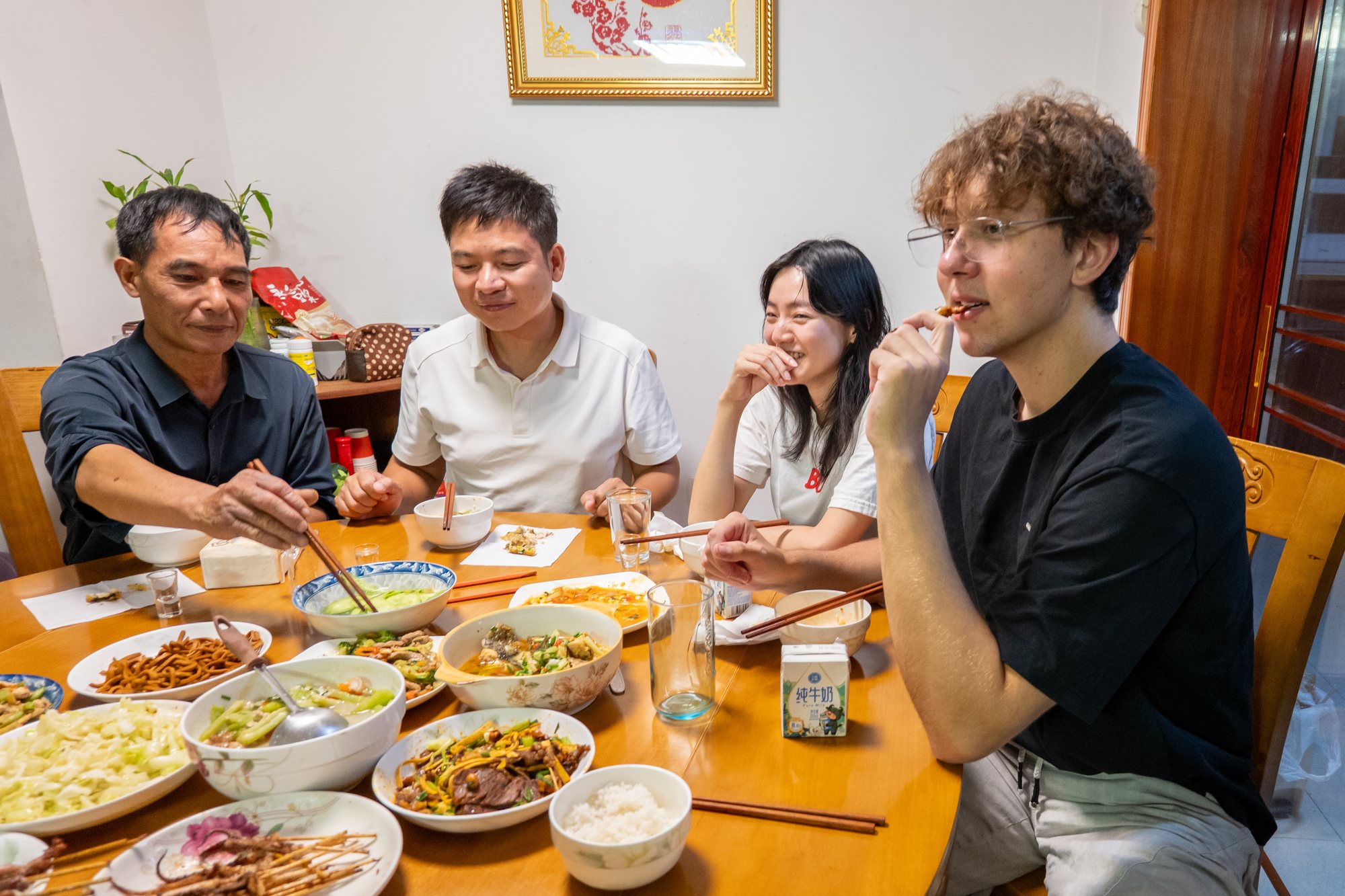
吃饭了吗 | chīfàn le ma | Have you eaten?
This greeting has a history. As The World of Chinese explains, in the past food shortages were common and three meals a day weren’t guaranteed, so asking the shorter 吃了吗 (chī le ma) was a way to show you cared. Today it’s an everyday greeting between people who know each other, especially around mealtimes, and in Dialogue 3 it’s the first thing Mom asks.
多穿点 | duō chuān diǎn | wear more layers
多穿点 means “wear a bit more,” and it’s the kind of thing a parent says as you head out into the cold. In Dialogue 3 it’s how a mom answers 我爱你.
心疼 | xīnténg | to ache for someone
心疼 is 心 (heart) and 疼 (hurt). You feel 心疼 when someone you love is worn out or hurting, and 我心疼你 (wǒ xīnténg nǐ) tells them “it hurts me to see you like this.” It’s a warm thing to hear, and English has no neat word for it.
Saying I love you to Mom and Dad
Here is one line that thanks a parent and says a lot more:
爸,您辛苦了。
Bà, nín xīnkǔ le.
Dad, thank you for all you do.
您 (nín) is the polite “you,” and 辛苦了 means “you’ve worked hard.” You can of course say 妈,我爱你 or 爸,我爱你 as well, and Dialogue 3 shows one way a mom might take it. Our guide to the Chinese family tree has the words for everyone else in the family.

Say It to a Real Person First
Try these phrases out loud in a free 30-minute online lesson with one of our teachers in Guilin, China. Your teacher will tell you which tones need work before you say them for real.
06 520, 5201314 and the Days for Love
五二零 | wǔ èr líng | what 520 means
Read the digits one by one and 520 sounds somewhat like 我爱你. The match isn’t exact, which is part of the fun:
| Number | Sounds like |
|---|---|
| 5, 五 wǔ | 我 wǒ, I |
| 2, 二 èr | 爱 ài, love |
| 0, 零 líng | 你 nǐ, you |
People type 520 in a text to say I love you, and 521 (五二一, wǔ èr yī) works the same way. There’s a code for missing someone, too: 530 (wǔ sān líng) stands for 我想你, “I miss you.” May 20 has turned into a day for couples, and a popular day to register a marriage. China Daily reported that by the first week of May 2026, every slot for May 20 at Guangzhou’s 15 marriage registration offices was booked, and Shenzhen’s were too. Our guide to Chinese Valentine’s Day covers the day itself.
What 1314 and 5201314 mean
一三一四 (yī sān yī sì) sounds like 一生一世 (yīshēng yīshì), “all my life.” Put the two numbers together and you get a whole love letter in seven digits:
五二零一三一四
wǔ èr líng yī sān yī sì
5201314: I love you for a lifetime.
Read as digits, 一 keeps its first tone, yī. In words it changes: 一生一世 is said yìshēng yíshì and 一辈子 yíbèizi, as the tone changes guide explains. Our page on Chinese numerology has more lucky and unlucky numbers.
我爱你一辈子 | wǒ ài nǐ yībèizi | I’ll love you all my life
一辈子 (yībèizi) means “a lifetime,” and it’s the everyday word next to the more poetic 一生一世. 我爱你一辈子 is for an anniversary or a wedding. The proposal itself is 你愿意嫁给我吗? (Nǐ yuànyì jià gěi wǒ ma?), “will you marry me?”, asked by a man, because 嫁 (jià) is what a bride does. Anyone can ask 你愿意和我结婚吗? (Nǐ yuànyì hé wǒ jiéhūn ma?), with 结婚 (jiéhūn), “to get married.” Our page on Chinese wedding customs covers the rest of that day.
情人节快乐 and 七夕快乐
In Chinese, February 14 is 情人节 (Qíngrénjié), and the greeting is 情人节快乐 (Qíngrénjié kuàilè). China also has its own love day, 七夕节 (Qīxījié), on the seventh day of the seventh lunar month, which in 2027 is Sunday, August 8. The greeting then is 七夕快乐 (Qīxī kuàilè). The day comes from the story of 牛郎 (Niúláng), a cowherd, and 织女 (Zhīnǚ), a weaver girl, who may meet only once a year, on a bridge of magpies. Our Chinese Valentine’s Day guide tells the story, and our graded reader retells it in Chinese at HSK 5.
07 The Chinese Character (Symbol) for Love: 爱
The Chinese character for love is 爱 (ài). It means “love” or “to love,” and when people ask for the Chinese symbol for love, this is the one they mean.
How to write I love you in Chinese
爱 has 10 strokes, and 我爱你 takes 24 in all. Tap a character in the table to watch it written stroke by stroke.
| Chinese | Pinyin | English | Strokes |
|---|---|---|---|
| 爱 | ài | love | 10 |
| 我爱你 | wǒ ài nǐ | I love you | 24 |
| 喜欢 | xǐhuan | to like | 18 |
| 想 | xiǎng | to miss; to think | 13 |
爱 is built in three layers: a hand at the top, a cover in the middle and 友 (yǒu), “friend,” at the bottom. The traditional form, 愛, has 13 strokes and keeps 心 (xīn), “heart,” in the middle. When the character was simplified, the heart came out, and critics of simplification have called the new form “heartless” love (Wikipedia covers the debate). Its defenders answer that the change came from the way calligraphers wrote the character long ago. So the 友 at the bottom is really a handwriting shortcut, and it was never meant as the word “friend.” It still makes a handy memory aid: simplified love lost its heart and gained a friend.
Our guide to Chinese stroke order covers the rules, and the guide to simplified Chinese characters explains how the simplified forms came about. Our Radical & Stroke Explorer shows the radical and stroke count of 爱 and of any other character.
08 Practice: Three Short Dialogues and a Quiz
Tap the speaker icon after a line to hear it, then say it yourself.
Dialogue 1: The confession
| Speaker | Chinese | Pinyin | English |
|---|---|---|---|
| He: | 我喜欢你很久了。 | I’ve liked you for a long time. | |
| She: | 真的吗?我也喜欢你。 | Really? I like you too. | |
| He: | 那我们在一起吧! | Then let’s be together! |
在一起 means “together,” and 我们在一起吧 is how two people agree to be a couple.
Dialogue 2: Late-night texts
| Speaker | Chinese | Pinyin | English |
|---|---|---|---|
| She: | 宝贝,想你了。 | Babe, I miss you. | |
| He: | 我也想你。早点睡,别熬夜。 | I miss you too. Get some sleep, don’t stay up late. | |
| She: | 好,爱你,晚安! | Okay, love you, good night! |
熬夜 is “to stay up late,” literally “to endure the night.”
Dialogue 3: Mom calls
傻孩子, “silly kid,” is said fondly. She doesn’t say 我爱你 back. Her answer is the care itself, 记得多穿点, “remember to wear more layers,” and he knows exactly what she means.
Quiz: which would you say?
1. You’ve been on three dates and want to tell them how you feel. What do you say?
(a) 我爱你一辈子 wǒ ài nǐ yībèizi (b) 我喜欢你 wǒ xǐhuan nǐ (c) 老婆 lǎopó
Answer
(b) 我喜欢你 wǒ xǐhuan nǐ. “I like you” comes first, and a lifetime can wait.
2. Your partner texts 我爱你. How do you answer?
(a) 我也爱你 wǒ yě ài nǐ (b) 吃饭了吗 chīfàn le ma (c) 情人节快乐 Qíngrénjié kuàilè
Answer
(a) 我也爱你 wǒ yě ài nǐ, “I love you too.”
3. Your host mom says 多穿点 as you leave the house. What does she mean?
(a) Your outfit doesn’t suit you (b) It’s cold, and she cares about you (c) It’s going to snow
Answer
(b). 多穿点 duō chuān diǎn means “wear more layers.” She cares (and your outfit is fine).
4. Your partner sends 5201314. What does it mean?
(a) A phone number (b) I love you for a lifetime (c) Meet me at 5:20
Answer
(b). 520 is close to the sound of 我爱你, and 1314 to 一生一世 yīshēng yīshì, “all my life.”
5. Your boyfriend is heading home late. What do you tell him?
(a) 路上小心 lùshang xiǎoxīn (b) 我爱你一辈子 wǒ ài nǐ yībèizi (c) 七夕快乐 Qīxī kuàilè
Answer
(a) 路上小心 lùshang xiǎoxīn, “be careful on the way.” Add 到家了跟我说一声。 if you want a message when he gets in.
09 I Love You in Chinese: Vocabulary List
Here are all 24 from this guide, in the order they appear.
| # | Chinese | Pinyin | English | When to use it | HSK |
|---|---|---|---|---|---|
| 1 | 我爱你 | wǒ ài nǐ | I love you | A partner, when you mean it | phrase |
| 2 | 爱你 | ài nǐ | love you | End of a call or text | phrase |
| 3 | 我也爱你 | wǒ yě ài nǐ | I love you too | The reply | phrase |
| 4 | 我喜欢你 | wǒ xǐhuan nǐ | I like you | The confession | phrase |
| 5 | 表白 | biǎobái | to confess your feelings | Talking about the confession | 7–9 |
| 6 | 我想你 | wǒ xiǎng nǐ | I miss you | Partner, family, close friends | phrase |
| 7 | 我好想你 | wǒ hǎo xiǎng nǐ | I miss you so much | When you really miss them | phrase |
| 8 | 早点睡 | zǎo diǎn shuì | go to bed early | Late-night texts | phrase |
| 9 | 路上小心 | lùshang xiǎoxīn | be careful on the way | Someone heading home | phrase |
| 10 | 亲爱的 | qīn'ài de | darling; dear | Partners; letters | phrase |
| 11 | 宝贝 | bǎobèi | baby; darling | A partner or a small child | 5 |
| 12 | 老公 | lǎogōng | husband | Spouses | 5 |
| 13 | 老婆 | lǎopó | wife | Spouses | 5 |
| 14 | 男朋友 | nánpéngyou | boyfriend | Any time | 1 |
| 15 | 女朋友 | nǚpéngyou | girlfriend | Any time | 1 |
| 16 | 吃饭了吗 | chīfàn le ma | Have you eaten? | Family, friends, neighbors | phrase |
| 17 | 多穿点 | duō chuān diǎn | wear more layers | A parent, on a cold day | phrase |
| 18 | 心疼 | xīnténg | to ache for someone | Someone tired or hurting | 6 |
| 19 | 五二零 | wǔ èr líng | 520: I love you | Texts; May 20 | phrase |
| 20 | 一三一四 | yī sān yī sì | 1314: forever | Texts, after 520 | phrase |
| 21 | 一生一世 | yīshēng yīshì | all my life | Romantic, a little poetic | not listed |
| 22 | 我爱你一辈子 | wǒ ài nǐ yībèizi | I’ll love you all my life | Anniversaries, weddings | phrase |
| 23 | 情人节快乐 | Qíngrénjié kuàilè | Happy Valentine’s Day | February 14 | phrase |
| 24 | 七夕快乐 | Qīxī kuàilè | Happy Qixi | Qixi (August 8, 2027) | phrase |
Levels are from HSK 3.0 (7–9 is the advanced band). “Phrase” means the list has no entry for the whole phrase, and “not listed” means the word isn’t on it.
10 FAQ About I Love You in Chinese
How do you say I love you in Chinese?
Say 我爱你 (wǒ ài nǐ), often typed “wo ai ni.” For a lighter “love you” at the end of a call or a text, say 爱你 (ài nǐ).
Do Chinese people say I love you?
Yes, though less readily. A 2013 study found Chinese university students more reserved than American students about saying it, especially to their parents. Families often show it through care instead, with lines like 吃饭了吗 (chīfàn le ma, “have you eaten?”) and 多穿点 (duō chuān diǎn, “wear more layers”).
What is the difference between 我喜欢你 and 我爱你?
我喜欢你 (wǒ xǐhuan nǐ) means “I like you,” and it’s the usual way to confess your feelings. 我爱你 (wǒ ài nǐ) is deeper and usually comes later, once you’re a couple.
How do you reply to 我爱你?
Say 我也爱你 (wǒ yě ài nǐ), “I love you too,” or more casually 我也是 (wǒ yě shì), “me too.”
What do 520 and 5201314 mean?
520 (wǔ èr líng) sounds close to 我爱你, so in a text it means “I love you,” and May 20 has become a day for couples. 1314 sounds like 一生一世 (yīshēng yīshì), “all my life,” so 5201314 means “I love you for a lifetime.”
How do you say I love you in Cantonese?
In traditional characters it’s written 我愛你, and in Cantonese it’s read ngo5 oi3 nei5 in Jyutping, the usual romanization for Cantonese. Wiktionary notes that in Cantonese the phrase is considered too formal for everyday use. Our guide to Mandarin vs Cantonese explains how the two differ.
11 Keep Going
Start with 我爱你 and 我喜欢你, then pick one care phrase for someone you love: 早点睡 for a partner, or 多穿点 for a parent on a cold day. If you’re new to Chinese, our free Chinese course has six short Mandarin lessons for complete beginners. To try these lines on a real person first, book a free 30-minute trial lesson with one of our teachers.
And if you’d like to hear 多穿点 from a host family yourself, come and study with us in Guilin on our Immersion Program.