

- Chinese numerology is shaped largely by homophones, the way a number sounds like another, more meaningful word.
- The numbers 2, 8, and 9 are widely seen as auspicious 吉利 (jílì), while 4 is considered inauspicious 不吉利 (bù jílì) and 5 and 7 get mixed views.
- The number 4 is the most avoided number in China because it sounds like the word for death.
- Numbers power a whole layer of Chinese internet slang, where digits stand in for full phrases.
- Two written number systems exist: everyday lowercase 小写 (xiǎoxiě) and anti-fraud uppercase 大写 (dàxiě).
In China, many numbers carry a lucky or unlucky meaning, and it affects real choices: which phone number to buy, which floor to live on, and how much money to put in a red envelope. Knowing the main superstitions helps you follow these customs, from gift-giving to choosing a wedding date.

This guide explores the meaning behind lucky and unlucky numbers, the hand gestures used to count to ten, and the playful number slang found all over the Chinese internet. If your goal is to Learn Chinese in China, this background will help you understand why people joke about some numbers and quietly avoid others.
01 The meaning behind the numbers
Chinese homophones have a profound influence on Chinese culture. In numerology, certain numbers are considered auspicious 吉利 (jílì) or inauspicious 不吉利 (bù jílì), mainly because of how they are pronounced.
In traditional Chinese culture, almost every number carries some kind of special meaning. Many people regard 2, 8, and 9 as very auspicious and treat 4 as unlucky, while 5 and 7 have both good and bad associations.
This way of thinking sits alongside other symbolic systems in Chinese life. Ideas about lucky timing also appear in the traditional Chinese lunar calendar and in the principles of feng shui, where arrangement and balance are believed to influence fortune.
02 Auspicious numbers (2, 8, and 9)
The number 2
According to Chinese numerology, pairs are auspicious. This helps explain why you often see 双喜 (shuāngxǐ; “double happiness”) on wedding couplets and decorations.
The same idea appears during Chinese New Year, when people decorate their homes by hanging couplets on both sides of their doors. Pairing for good luck is also common in Chinese wedding customs, where matched objects and symmetrical arrangements signal harmony.

The number 8
The auspicious number 8 八 (bā) sounds like 发 (fā). That word appears in 发财 (fācái; to get rich), giving 8 strong associations with wealth and prosperity.

The number 9
The number 9 九 (jiǔ) sounds like 久 (jiǔ), meaning a long duration of time. As a result, it represents longevity and eternity.
Thanks to this symbolism, Chinese couples often weave the number into romantic gestures. Common examples include getting married on September 9th or offering 99 roses during an engagement.
Most of the main gates of the Forbidden City carry 81 nails, arranged in a 9×9 grid, reflecting the imperial importance of the number 9.

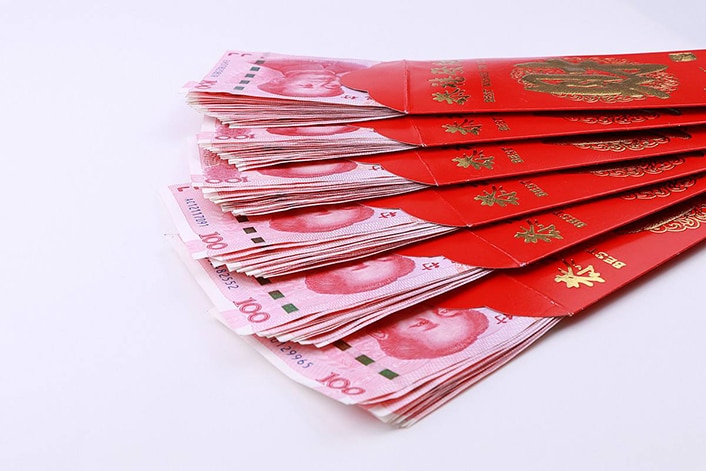
These lucky numbers also shape how people give money. When offering red envelopes 红包 (hóngbāo), most people choose auspicious amounts such as 88, 99, or 200.
03 Inauspicious numbers (4, and sometimes 5 and 7)
The number 4
The number 4 四 (sì) sounds like 死 (sǐ; to die). Because of this connection with death, many buildings in China skip the “fourth” floor entirely.
The number is also unlikely to appear on house numbers or car license plates. Whenever possible, many people will even avoid telephone numbers that contain a 4.
In the world of Chinese numerology, 4 is the most unlucky number of all. Its role is roughly equivalent to that of the number 13 in many Western countries.

The number 5
The number 5 五 (wǔ) sounds like 呜 (wū), an onomatopoeia for whimpering and crying, so some people see it as a sad number. The taboo is mild, though: 5 is also tied to the Five Elements of Chinese philosophy, and many people treat it as neutral or even lucky.

The number 7
Compared with clearly positive numbers like 8 or clearly negative ones like 4, the number 7 sits on the more neutral side. The Chinese word for 7 七 (qī) echoes positive words such as 齐 (qí; even, uniform), 气 (qì; life force), and 起 (qǐ; to rise). It also has a romantic side, because Qixi, often called Chinese Valentine’s Day, falls on the seventh day of the seventh lunar month.
There is a darker side, though. The Ghost Festival 鬼节 (Guǐjié) falls in the seventh month of the lunar calendar, and 7 also sounds like 欺 (qī; to deceive).

04 Chinese number gestures
Did you know you can count all the way to ten in Chinese using just one hand? Understanding these gestures is essential when bargaining with vendors at shops or vegetable markets.
The video below walks through each of the one-handed signs. Practicing them is a quick way to add a useful, very local skill to your basic Chinese toolkit.

Learn Chinese with Cultural Context
CLI offers personalized Chinese instruction built around real language and culture. Join our Immersion Program in Guilin or start online with a free Chinese lesson.
05 Numbers and Chinese internet slang
Because of the sheer number of homophones in Chinese, many expressions of Chinese internet slang are built entirely from numbers. This practice is called 数字谐音 (shùzì xiéyīn; “number homophones”).
Here are some of the most common examples you will run into online.
1. 二百五 (èr bǎi wǔ; 250)
The number 250 basically means “stupid” or “half-insane.” There are a few competing theories about where the phrase comes from.
One traces it to the old coin system, where 1,000 coins were grouped on a string called a 吊 (diào). A 半吊子 (bàndiàozi; half a string, or 500 coins) became a mildly insulting word for a dabbler with half-baked knowledge, and half of that, 250, became a stronger insult.
Another theory says money was grouped in envelopes of 500 一封 (yīfēng; one envelope). Half an envelope, 250 半封 (bànfēng), sounds like 半疯 (bànfēng; half-insane) in both Mandarin and Cantonese.
Whatever its origin, 二百五 (èr bǎi wǔ) lands somewhere near the English “not playing with a full deck.”
2. 五二零 (wǔ èr líng; 520)
This sounds like 我爱你 (wǒ ài nǐ; I love you). In fact, May 20th (5/20) has become an unofficial Chinese Valentine's Day.
3. 七四八 (qī sì bā; 748)
This one sounds like 去死吧 (qùsǐba; “Drop dead!” or “Go to hell!”).
4. 五五五 (wǔ wǔ wǔ; 555)
As noted earlier, 5 sounds like 呜, the sound of whimpering. Netizens therefore use “555” to express sadness or sobbing.
5. 八八 (bā bā; 88)
This stands in for “bye-bye.”
6. 一三一四 (yī sān yī sì; 1314)
Read aloud, 1314 sounds like 一生一世 (yī shēng yī shì; “all my life”), meaning “forever.” Combine it with 99 roses and you have a ready-made marriage proposal.
7. 七四五六 (qī sì wǔ liù; 7456)
This sounds like 气死我了 (qì sǐ wǒ le; “you’re making me furious”).
8. 九九五 (jiǔ jiǔ wǔ; 995)
This one sounds like 救救我 (jiùjiù wǒ; “save me!”).
Numbers also drive plenty of games. See our guide to the popular Chinese 15-15-20 game to learn more.

06 The difference between 小写 and 大写
Did you know there are two sets of characters used for Chinese numbers? Because characters represent numbers, two versions appear in daily life: 小写 (xiǎoxiě; lowercase) and 大写 (dàxiě; uppercase).
The lowercase set is used in everyday general contexts. The uppercase set is reserved mainly for financial transactions.
Standard lowercase numbers are simple, which also makes them easy to alter. To prevent forgery, people in the financial industry use the more complex traditional Chinese uppercase forms instead.
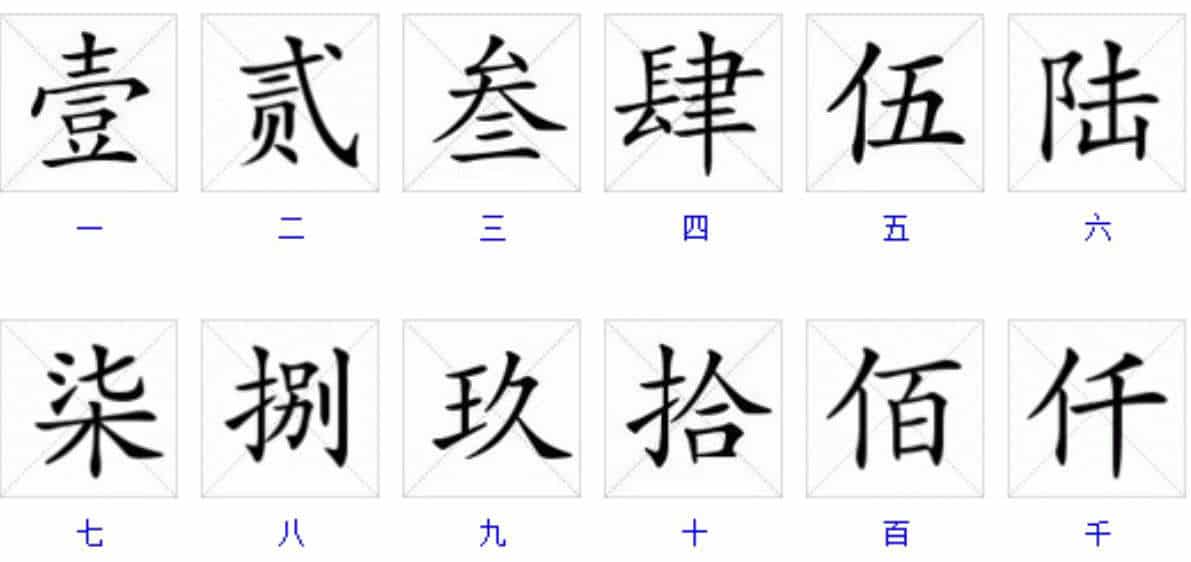
Complex number forms go back to the Tang dynasty, but the uppercase system became a firm rule during the Ming dynasty, when the Hongwu Emperor Zhu Yuanzhang required it in official accounts. He did so after a major corruption case in 1385, in which officials embezzled huge amounts of state grain.
The guilty officials were executed, and the new rule made written figures much harder to alter. Today, 大写 (dàxiě) is often translated as “banker’s anti-fraud numerals.”
07 Lowercase-to-uppercase number conversions
The table below shows the everyday lowercase characters alongside their anti-fraud uppercase counterparts. Learning to recognize both sets will help when you read receipts, contracts, and bank documents in China.
| Chinese (小写) | Pinyin | Number | Uppercase (大写) |
|---|---|---|---|
| 零 | 0 | 零 | |
| 一 | 1 | 壹 | |
| 二 | 2 | 贰 | |
| 三 | 3 | 叁 | |
| 四 | 4 | 肆 | |
| 五 | 5 | 伍 | |
| 六 | 6 | 陆 | |
| 七 | 7 | 柒 | |
| 八 | 8 | 捌 | |
| 九 | 9 | 玖 | |
| 十 | 10 | 拾 | |
| 百 | 100 | 佰 | |
| 千 | 1,000 | 仟 | |
| 万 | 10,000 | 万 |
Numbers carry a surprising amount of meaning in Chinese. Now that you know the meanings behind them, you can use them to decode slang, choose lucky dates, and even win a few drinking games.
08 FAQ
Why is the number 4 unlucky in China?
The number 4 四 (sì) sounds almost identical to 死 (sǐ; to die). This association with death makes it the most avoided number in Chinese culture.
Why is the number 8 considered lucky?
The number 8 八 (bā) sounds like 发 (fā), part of the phrase “to get rich.” Because of this, 8 is strongly linked with wealth and prosperity.
What does 520 mean in Chinese?
The digits 520 sound like 我爱你 (wǒ ài nǐ; “I love you”). May 20th has become an informal romantic holiday as a result.
What is the difference between 小写 and 大写 numbers?
小写 (xiǎoxiě) are the simple everyday number characters, while 大写 (dàxiě) are complex anti-fraud forms used in finance. The uppercase set is harder to alter, which helps prevent forgery.
How much money should I put in a red envelope?
Choose auspicious amounts built around lucky numbers, such as 88, 99, or 200, and avoid amounts containing a 4. The exact figure depends on the occasion and your relationship to the recipient.
09 Final thoughts
Most of Chinese numerology comes down to sound: a number is lucky or unlucky because of the word it resembles. Once you know the main pairs, such as 4 and death or 8 and wealth, slang like 520 and 88 makes sense too.
For learners, this pays off quickly, because it explains why a friend turns down a phone number with a 4 in it or picks a wedding date with a 9.