


Learning Chinese in China can be especially effective because the language no longer ends when class ends. New vocabulary, grammar, tones, and listening skills are tested again during meals, errands, conversations, travel, and the small problems of everyday life. Each encounter gives you another chance to notice a gap, adjust, and try again. Few study environments can reproduce that density of immediate, meaningful practice.
Geography alone is not a teaching method. You can live in China and still spend most of your day speaking English, avoid difficult conversations, or receive little useful correction. The strongest advantage comes from combining good instruction with frequent, attentive use of Mandarin outside class, so the surrounding environment becomes a daily extension of the classroom.
- It shortens the distance between learning a phrase and needing to use it.
- It increases the variety of voices, situations, signs, messages, and follow-up questions you must understand.
- It makes speaking practical rather than optional, which strengthens spontaneous recall and confidence.
- It reveals communication problems quickly, so teachers can give more relevant feedback.
- Its benefits deepen over weeks and months as the program, city, social environment, and your own habits make Chinese part of everyday routines and relationships.
Why can learning Chinese in China work so well?
The main benefit is not simply “more Chinese.” It is a tighter learning cycle. In a classroom-only routine, days may pass between learning a structure and using it in a real conversation. In China, the same cycle can happen several times before dinner.
Imagine learning how to order a dish and ask whether it contains peanuts. At lunch, you use the phrase, but the server answers with a question you do not understand. You point, guess, and complete the order. Back in class, you explain what happened. Your teacher supplies the missing vocabulary, corrects the tone that caused confusion, and role-plays the exchange with you. The next day, you try again.
This loop combines four ingredients: input, output, interaction, and feedback. Input is what you hear and read. Output is what you say and write. Interaction forces you to respond to another person rather than recite a memorized line. Feedback helps you refine pronunciation, grammar, word choice, and social appropriateness.
Those ingredients can exist outside China, and a strong domestic intensive program can produce excellent results. China’s distinctive advantage is their density and continuity: the next meaningful encounter is often only a few minutes away, and the cycle can repeat throughout the day. For a more detailed framework for comparing program structures, see CLI’s guide to how to compare Chinese immersion programs.
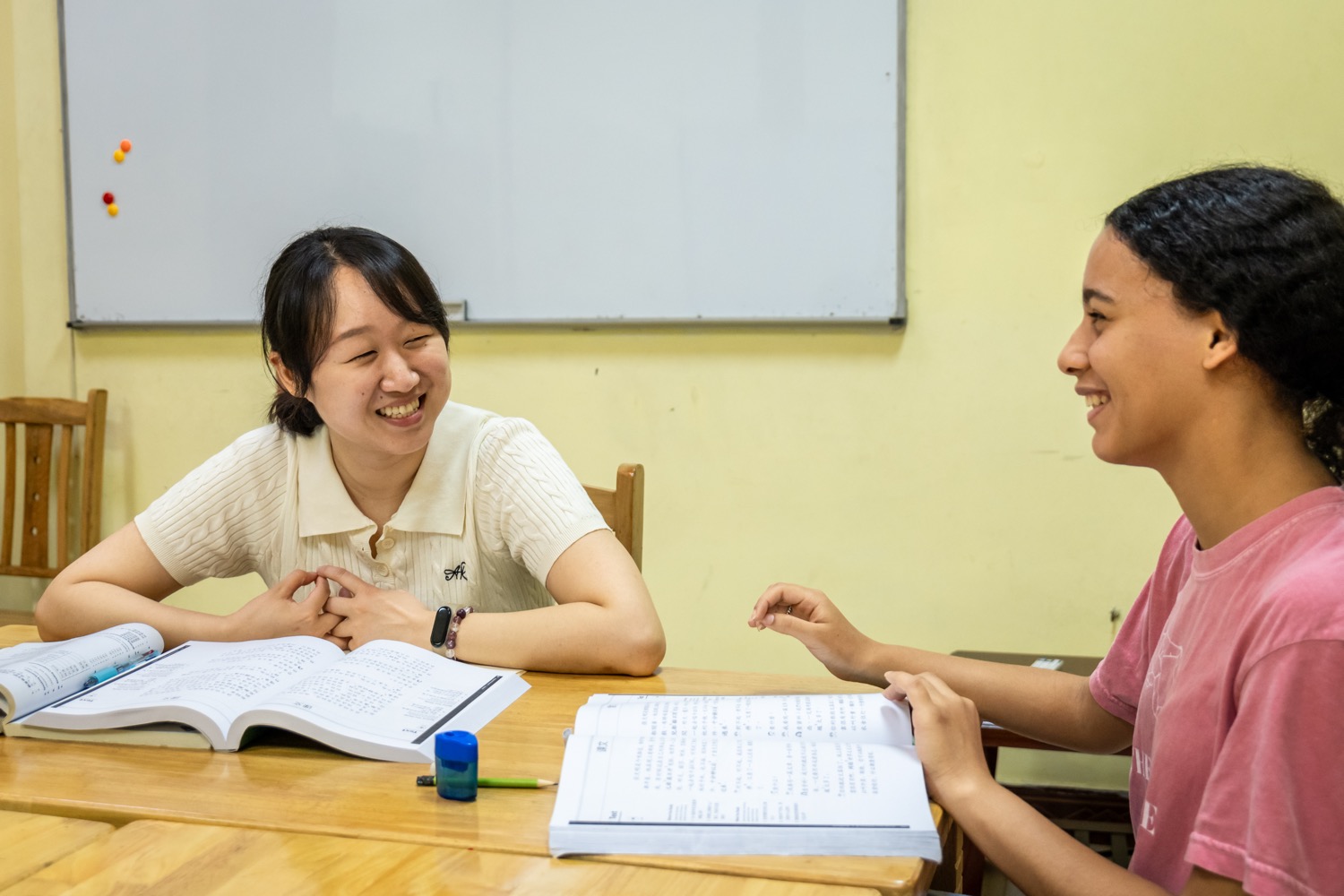
What changes during an ordinary day?
At home, Chinese may occupy a clearly defined block: a lesson, an app session, a podcast, or an hour with a textbook. In China, the language repeatedly interrupts the neat boundary between “study” and “life.” A payment screen asks a question. A driver calls to confirm your location. A menu uses a character you studied last week. A neighbor makes a comment you almost understand.
Not every encounter automatically becomes a lesson. The value comes from paying attention, attempting to respond, saving useful language, and reviewing what happened. Passive exposure can make sounds and characters more familiar, but active engagement turns the environment into practice. As days become weeks, familiar places, recurring people, and repeated tasks give you new chances to use better Chinese in situations that once felt difficult.
Small conversations build spontaneous speaking
Speaking confidence rarely arrives as a single breakthrough. It grows through dozens of low-stakes successes: asking for a bag, changing a train ticket, explaining that you do not eat a certain ingredient, or keeping a short conversation going for one more turn.
These interactions train retrieval. You begin moving from “I know this word when I see it” to “I can find this word while another person is waiting.” That shift matters because conversational ability depends not only on knowledge, but also on accessing knowledge quickly enough to participate.

Your ear adjusts to real Mandarin
A teacher and a polished recording usually speak clearly, select familiar vocabulary, and give you time to process. Everyday speech is less cooperative. People shorten sentences, change direction, speak over noise, use regional pronunciation, or assume shared context that you do not yet have.
That difficulty is useful when it is manageable. Over time, you learn to catch key words, infer meaning from context, ask someone to repeat or rephrase, and continue after missing part of a sentence. The goal is not to understand every speaker perfectly. It is to become more capable when speech is imperfect, fast, or unfamiliar.
Mandarin also varies across China. You may hear local accents, regional vocabulary, dialect influence, and speakers who do not sound like a textbook recording. A well-designed program helps you build a stable foundation in standard Mandarin while learning how to navigate natural variation rather than treating every difference as an error.
Fast correction makes mistakes more informative
Real conversations often tell you that something went wrong, but not why. The listener may look confused, answer a different question, or simply complete the interaction without correcting you. This is where instruction matters.
Research on classroom corrective feedback has found meaningful, durable benefits for language development. In practice, useful feedback does more than announce that an answer is wrong. It helps you hear the contrast, produce a better version, and apply it in a new sentence. One-on-one and very small-group formats can be particularly efficient because the teacher has time to identify your specific pattern and make you try again. Group classes still offer structure, peer learning, and social practice; the tradeoff is that individual speaking and correction time is divided among more learners.
Vocabulary becomes tied to lived experience
Compare memorizing the word for “pharmacy” on a flashcard with recognizing it on a sign, asking where the pharmacy is, explaining what you need, and hearing the word repeated in the answer. The second experience attaches the vocabulary to a place, a purpose, and a result.
Context does not replace systematic review. It gives review more to work with. Instead of recalling an isolated translation, you can recall the person, task, misunderstanding, or successful exchange in which the word mattered.
How do language and culture begin to make sense together?
Knowing the dictionary meaning of a sentence is not the same as knowing how it lands. Learners also need to understand how people soften requests, address older people, decline indirectly, show hospitality, change tone in formal settings, and signal that a conversation is ending.
This practical social knowledge is sometimes called pragmatic competence. It answers questions such as: Is this request too direct? Does this title sound respectful or distant? Is the speaker refusing, hesitating, or inviting further persuasion? A word-for-word translation from English may be grammatically understandable yet feel awkward because the social move is different.
A study of 129 Chinese learners during a 15-week program in China found improvement in both general proficiency and pragmatic production. The two areas did not develop in lockstep, which is an important qualification: becoming better at vocabulary and grammar does not automatically teach every social convention. Learners still benefit from observation, explanation, reflection, and feedback.

Cultural context becomes concrete, not complete
Living in China can make food etiquette, forms of address, family relationships, holidays, digital payments, messaging habits, hospitality, and regional differences easier to understand because you encounter them in context. You stop learning only that a custom exists and start noticing when it appears, how people interpret it, and where exceptions arise.
Even a short stay can make cultural patterns more concrete, but no stay by itself makes anyone an expert on “Chinese culture.” China is internally diverse, and the behavior of one family, city, generation, or social group should not be treated as a national rule. The more realistic benefit is increased context: you learn to ask better questions, recognize variation, and understand why a perfectly literal translation may miss the point.
Independence builds earned confidence
There is a difference between feeling encouraged and knowing you can complete a task. Navigating a station, making a purchase, meeting a friend, asking for help, or fixing a minor problem in Chinese provides evidence that your language works.
Confidence does not require perfect accuracy. You can communicate successfully while making tone, grammar, and vocabulary mistakes. What changes is your willingness to remain in the conversation, repair a misunderstanding, and keep using Chinese instead of switching immediately to English.
Daily life clarifies what you need to learn next
Real use quickly separates high-priority language from material that is merely interesting. You discover which pronunciation problems repeatedly obstruct understanding, which topics you actually discuss, and whether your immediate goals are social, academic, professional, travel-related, or practical.
That information can make lessons more purposeful. A learner who keeps struggling with delivery calls needs a different next lesson from one preparing for a university seminar. Immersion gives both the learner and the teacher better evidence about what should come next.
How does structured immersion compare with studying at home?
The fairest comparison is not “good immersion” versus “bad online learning.” High-quality online or domestic study has real strengths: lower cost, continuity, flexibility, familiar routines, and access for learners who cannot travel. For learners who can spend time in China, structured immersion offers a density and continuity of practice that is difficult to reproduce around an otherwise non-Chinese-speaking daily life.
| Dimension | Classroom or online study at home | Structured immersion in China | Important qualification |
|---|---|---|---|
| Exposure | Mostly scheduled and selected by the learner or teacher. | Chinese appears repeatedly in errands, transport, signs, messages, meals, and social life. | Exposure is most useful when the learner pays attention and responds. |
| Speaking | Can be concentrated in lessons, but easy to postpone between sessions. | Daily needs create more reasons to retrieve language spontaneously. | International social circles can still allow heavy English use. |
| Listening | Clear recordings and familiar teachers make difficulty easier to control. | More voices, speeds, accents, background noise, and unplanned responses. | Beginners need enough support to keep difficulty productive rather than overwhelming. |
| Feedback | Can be excellent during live lessons, especially one-on-one. | Real interactions reveal problems that can be taken back into class quickly. | People outside class do not always correct mistakes or explain misunderstandings. |
| Vocabulary | Easy to organize by curriculum, frequency, or test goal. | Words become tied to places, people, needs, and consequences. | Context does not replace systematic review. |
| Social language | Can be taught explicitly through examples and role-play. | Learners observe how requests, refusals, titles, humor, and politeness change by situation. | Observation alone can be misinterpreted; teacher explanation helps. |
| Convenience | High. Study can fit around work, family, and an existing degree. | Lower. Travel, cost, unfamiliar systems, and schedule changes require commitment. | The most effective format is one the learner can realistically sustain. |
| Continuity | Easy to maintain for months or years without relocation. | A focused stay can create rapid momentum; several weeks or months allow routines, relationships, and independence to compound. | Online lessons can prepare learners and preserve momentum after returning home. |
This is why the strongest plan is often a sequence rather than a single method: build a foundation at home, spend a sustained intensive period in China to multiply interaction and feedback, then continue with lessons, reading, media, and conversation after returning.
The benefits are real, but not automatic
China creates exceptional access to Mandarin, but a learner can still attend lightly structured classes, spend nearly all social time with other international students, rely on translation tools, avoid uncomfortable interactions, and assume that passive exposure will do the work. The opportunity pays off when the learning routine changes along with the address.
Study-abroad research supports a positive overall picture while repeatedly finding wide variation. A multi-level meta-analysis in the 2024 issue of Language Teaching Research combined 42 primary studies and 283 effect sizes and reported a medium-to-large pooled effect for study-abroad language programs. The analysis examined variation related to formal coursework, accommodation, proficiency, and length of stay; longer programs were positively associated with greater gains in the pooled data. That pattern supports viewing time in China not merely as a trip, but as a period in which repeated use can accumulate.
Reviews of the field reach a similar conclusion: study abroad can support many areas of language competence, especially abilities tied to social interaction, but learners do not all gain in the same way. Their goals, willingness to participate, access to local relationships, program design, and reception in the host community all shape what happens.
What the research adds to the decision
The largest source used here synthesized 283 effect sizes, found a positive overall effect, and associated longer programs with greater gains.
A Chinese-specific semester study found gains in proficiency and pragmatic production, while showing that the two develop differently.
One small fluency study underscored that the advantage of being abroad is realized through intensive instruction and sustained target-language use.
That final comparison is useful precisely because it clarifies what makes time abroad pay off, though it involved only 28 French learners. In that study, an intensive domestic immersion group made stronger gains than the study-abroad group on several oral-fluency measures. The domestic group also reported using more French, while the study-abroad group reported substantial English use. Rather than weakening the case for China, the finding strengthens the case for a structured program and a daily routine that keep Chinese in active use.
To capture the full benefit of an in-country experience, avoid:
- choosing a program with little speaking time or individualized feedback;
- spending most social time in an English-speaking bubble;
- avoiding difficult errands and conversations;
- skipping class, review, or sleep because the trip begins to feel like tourism;
- studying material disconnected from immediate communication needs;
- expecting people outside class to act as free language teachers;
- mistaking familiarity with sounds for the ability to understand and respond.
A useful immersion plan therefore creates both opportunity and accountability. It protects substantial class time, encourages meaningful interaction, makes feedback easy to obtain, and helps the learner reflect on what happened outside class. In China, that combination can turn the surrounding language environment into a daily extension of class.
Who benefits most from learning Chinese in China?
Immersion can benefit beginners, intermediate learners, advanced students, and heritage learners, though they use the environment differently. A beginner may focus on pronunciation, survival language, and supported daily tasks. An intermediate learner can expand conversation, listening range, and independence. An advanced learner can work on speed, nuance, professional topics, and socially appropriate expression. With more time, learners can often move from supported exchanges toward more independent relationships and more nuanced use of Chinese.
Immersion is especially likely to accelerate your Chinese when you:
- prioritize speaking and listening;
- want frequent, specific feedback;
- can dedicate concentrated time to Chinese;
- are willing to communicate before you feel fully ready;
- want greater independence in everyday life;
- have plateaued in a low-intensity routine;
- will deliberately build Chinese into meals, errands, friendships, and activities.
Home or online study may be the better immediate fit when you:
- cannot interrupt work, family, health, or degree commitments;
- need a flexible, lower-intensity routine;
- want to build basic pinyin and pronunciation confidence before traveling;
- mainly need test preparation or occasional specialist lessons;
- are not ready for the cost or disruption of an international stay;
- already have strong local access to intensive teaching and Chinese-speaking communities.
Home and online study can be valuable parts of a long-term plan. One-on-one Chinese lessons online can prepare you for China or preserve momentum after returning. When travel is possible, an in-country period gives that foundation far more chances to become spontaneous, practical Chinese.
How long should you study in China?
There is no honest number that guarantees a particular HSK level or degree of fluency. A well-structured short stay can be highly beneficial, but the benefits of immersion tend to compound: routines become more automatic, relationships deepen, recurring situations return, and teachers can address patterns over time. For that reason, several weeks or months usually give immersion more room to produce durable change, while any long stay still depends on strong instruction and habits.
- A short stay can be highly useful for exposing pronunciation problems, building momentum, and showing you what serious immersion feels like.
- Several weeks give daily routines time to form and create repeated chances to return to the same situations with better language.
- Several months allow relationships, listening range, independent life, and repeated cycles of feedback and reuse to develop more fully.
- A longer stay can turn Chinese from a study project into a working part of daily life, provided instruction, interaction, review, and active language use remain strong.
Choose the longest well-structured period you can realistically sustain, then plan around a concrete outcome rather than a vague promise of fluency. You might aim to handle daily errands without English, sustain a 20-minute conversation, improve tone accuracy, prepare for university coursework, or become comfortable discussing your profession. CLI’s guide to realistic Chinese-learning timelines can help you set a broader milestone.
What makes a Chinese language school effective?
The “best” school is not automatically the most famous institution or the one in the biggest city. It is the school whose ordinary week matches your goals. Because a longer stay magnifies both strong and weak program design, ask what you will actually do from Monday morning through Sunday night before comparing branding.
- Meaningful speaking timeHow much of each class requires you to produce Chinese rather than listen to a lecture?
- Instructional formatIs teaching one-on-one, small-group, lecture-style, or a deliberate combination?
- Qualified, coordinated teachersDo instructors understand second-language learning and share information about your progress?
- Timely correctionAre pronunciation, grammar, and word-choice problems addressed while they are still useful?
- Connection to daily lifeCan lessons respond to language you encountered outside class?
- Local language environmentHow easy will it be to default to English in the neighborhood and social circle you are likely to have?
- Community and interactionAre there realistic, respectful ways to meet Chinese speakers and participate in shared activities?
- Housing and routineDoes the living arrangement support rest, study, independence, and Chinese use?
- IndividualizationCan the curriculum adapt to your proficiency, goals, pace, and recurring weaknesses?
- Student supportDoes the school reduce logistical stress without insulating you from daily life?
- TransparencyAre hours, teaching format, costs, inclusions, housing, reviews, and expectations explained clearly?
The city is part of that structure. Local English use, cost, transportation, pace of life, and access to Chinese-speaking relationships affect how easy it is to build Mandarin into the day. Rather than repeating a city-by-city ranking here, use CLI’s guide to compare the best cities for learning Chinese in China.
What does structured immersion look like at CLI?
CLI is one concrete example of a program built around the learning mechanisms described above. As of July 2026, its Immersion Program in Guilin combines four hours of one-on-one Chinese class each weekday with time for review, errands, activities, and independent practice around the city.
The CLI model in practice
- Each student works with three coordinated Mandarin instructors across 20 weekly class hours.
- Lessons are adapted to the learner’s level, goals, pace, and recurring communication problems.
- Daily review and formal assessments help teachers revisit material rather than simply move forward.
- Guilin provides ordinary opportunities to use Chinese in markets, cafés, transport, neighborhoods, and activities.
- Program support handles practical logistics while leaving room for learners to become more independent.
- Students can begin any Monday; short stays can create a focused burst of progress, while several weeks or months allow routines, relationships, and independence to deepen.
This does not mean every learner will progress at the same rate. It means the program deliberately increases speaking time, feedback, repetition, and the connection between class and daily life. Longer stays do not guarantee a specific result, but they give this system more cycles in which gains can accumulate. You can read more about what it is like to study Chinese in Guilin or review the full CLI Chinese Immersion Program.
Is learning Chinese in China worth it?
For a learner who wants concentrated speaking and listening practice, will participate actively in daily life, and chooses a program with strong instruction and feedback, learning Chinese in China is often well worth the cost and disruption.
It is not the only viable path, and it does not replace deliberate study. Its distinctive advantage is that Mandarin becomes the medium through which you solve problems, build relationships, make choices, and move through the day. The language gains weight because it has a job to do, and a stay of several weeks or months gives that advantage time to compound.
The best way to decide is to ask two questions. First: What do I want to be able to do in Chinese that I cannot do now? Second: Will this program and daily environment make me practice that ability often enough, and for long enough, to improve it?
Ready to make Chinese part of your daily life?
CLI’s Chinese Immersion Program combines four hours of one-on-one instruction each weekday with daily Mandarin practice in Guilin. Explore how the program works, review dates and tuition, or ask the CLI team how a short, mid-length, or long-term stay could serve your goals.
Sources
- Tseng, Liu, Hsu, and Chu, “Revisiting the effectiveness of study abroad language programs: A multi-level meta-analysis,” Language Teaching Research. Supports the pooled study-abroad effect, the 42-study and 283-effect-size figures, and the discussion of moderators and length. View study
- Kinginger, “Enhancing Language Learning in Study Abroad,” Annual Review of Applied Linguistics. Supports the emphasis on socially situated abilities, individual variation, local engagement, and program design. View review
- Isabelli-García, Bown, Plews, and Dewey, “Language learning and study abroad,” Language Teaching. Supports the treatment of study abroad as a variable social environment shaped by learner agency, individual differences, and program context. View review
- Yang and Ke, “Proficiency and pragmatic production in L2 Chinese study abroad,” System. Supports the Chinese-specific discussion of 129 learners in a 15-week program and the distinct development of proficiency and pragmatic production. View study
- Freed, Segalowitz, and Dewey, “Context of Learning and Second Language Fluency in French,” Studies in Second Language Acquisition. Supports the limited 28-learner comparison showing that intensive domestic immersion can outperform study abroad when target-language use is greater. View study
- Lyster and Saito, “Oral Feedback in Classroom SLA: A Meta-Analysis,” Studies in Second Language Acquisition. Supports the discussion of the significant and durable effects of oral corrective feedback. View study