

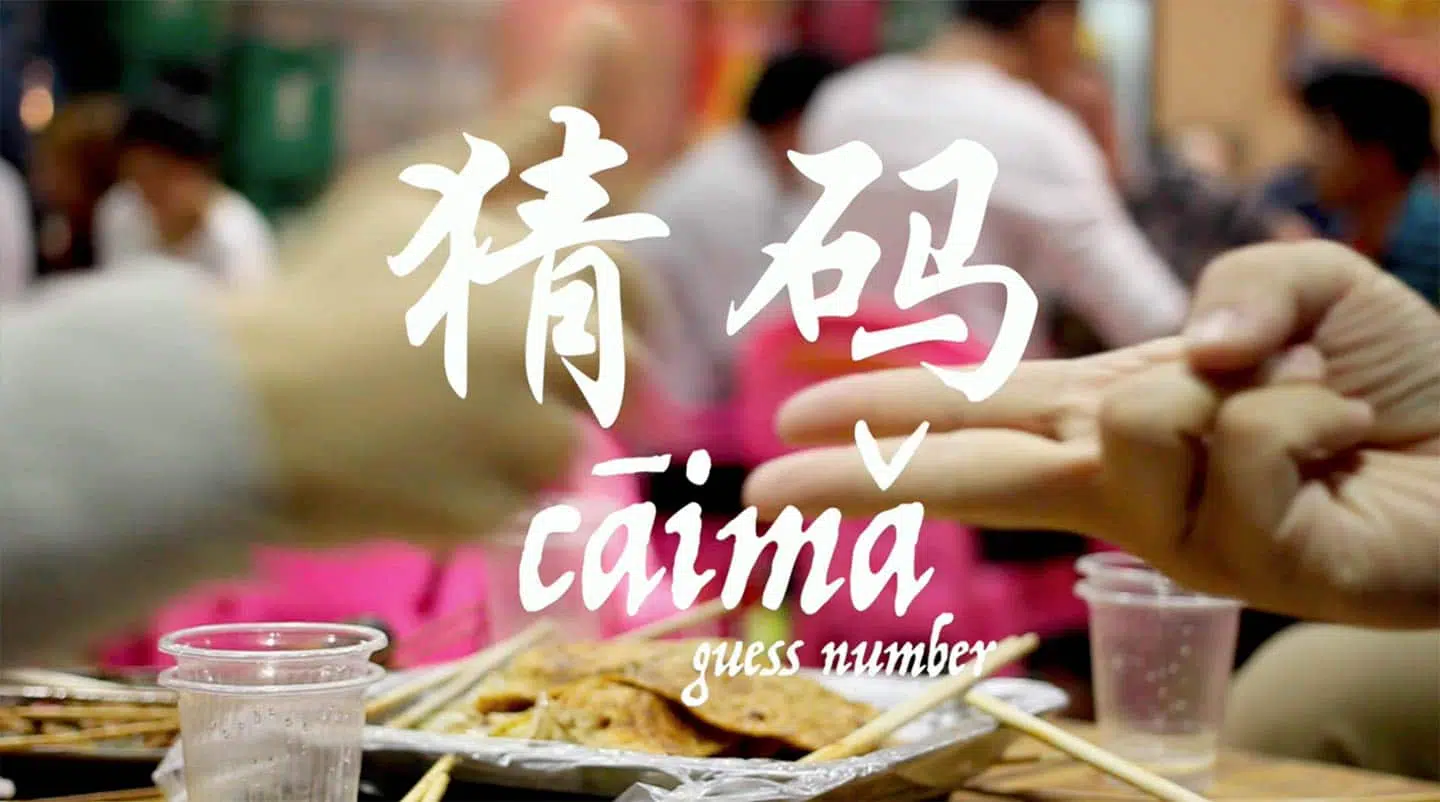
- 猜码 (cāimǎ, literally "guess number") is a hand-gesture drinking game from the Guangxi Zhuang Autonomous Region, played in barbecue joints, restaurants, and bars across the province.
- It works a little like Rock, Paper, Scissors, except each player throws between zero and five fingers and shouts a guess at the combined total, which is always between zero and ten.
- Cāimǎ is traditionally played in Cantonese even in cities where Mandarin dominates, though a Mandarin variation exists for players who prefer it.
- Every number has its own rhythmic phrase — with one famous exception: the number five is never spoken.
The joyous shouts of 猜码 (cāimǎ, literally meaning "guess number") can be heard rumbling through barbecue joints, restaurants, and bars across Guangxi province.
猜码 is a drinking game from the Guangxi Zhuang Autonomous Region that uses hand and finger gestures in a fashion similar to the game Rock, Paper, Scissors (RPS).
01 Why 猜码 Is Traditionally Played in Cantonese, Not Mandarin
猜码 is traditionally played in Cantonese rather than Mandarin, despite the fact that Mandarin is widely used throughout Guangxi Province.
In many cities in Guangxi, the words used in 猜码 are often the only Cantonese phrases players speak on a day-to-day basis. There is also a Mandarin variation of cāimǎ for those who prefer to use China's common language.
02 How to Play 猜码: Rules, Rhythm, and Phrases
Learn Chinese in China and you'll find that playing cāimǎ is a great opportunity for foreign students to interact with local Guilin culture, practice their Chinese, and have a lot of fun!
How 猜码 Differs from Rock, Paper, Scissors
A key difference separating 猜码 from RPS is that in cāimǎ a player can throw between zero and five fingers.
Furthermore, as both players throw their selection they each shout a number attempting to guess their collective sum of revealed fingers. The sum will always be between zero and ten.
Finding the Rhythm: The 猜码 Opening Call
The rhythm to playing 猜码 is similar to RPS's "one, two, three, shoot" cadence.
There is an introductory phrase used before each round to help the game maintain its rhythm. The Mandarin phrase is often 来酒来啊 (lái jiǔ lái ā), while in Cantonese it is 兄弟好啊 (hei'ung dai hou ah — as spoken in the video above).
Additionally, every number has its own special phrase to accompany it and help maintain the rhythm.
猜码 Phrases for Beginners
For beginners, follow the rhythm and start by saying a number followed by 个好啊 gè hǎo ā (literally meaning: a good).
For example: 七个好啊,八个好啊,一个好啊,三个好啊 (qī gè hǎo ā, bā gè hǎo ā, yì gè hǎo ā, sān gè hǎo ā).
It is also okay to just say the Chinese number followed by silence as long as the four-beat rhythm is maintained. For more advanced players, each number can also be accompanied by special Mandarin or Cantonese expressions.
03 猜码 Vocabulary: Number Phrases in Mandarin and Cantonese
Each number from zero to ten has its own set expression. The Mandarin column below is the easier place to start; the Cantonese column is what you will actually hear at most tables in Guangxi.
| Number | Special Mandarin Expression | Special Cantonese Expression |
|---|---|---|
| 0 | 不出 / 对手 | 不出 : mmm chut / 对手 : dui sou |
| 1 | 一点点 | 一点点 : yaht dimdim / 一点钟 : yaht dimzhong |
| 2 | 兄弟好 | 二兄弟 : ni heng dei / 两兄弟 : li'ung hei'ung dai |
| 3 | 三星照 | 三块钱 : sah'm men gei |
| 4 | 四季发财 | 四红 : say hong |
| 5 | The number five is not spoken in 猜码 | |
| 6 | 六六顺 | 六位 : loch wei |
| 7 | 七座桥 | 七桥 : chut q |
| 8 | 八匹马 | 八匹马 : bot pai ma |
| 9 | 酒你喝 | 九九操 : gougou chou |
| 10 | 全来 / 放手 | 放手 : fuong sou |
Watch out for five. Every other number from zero to ten has its own call, but the number five is not spoken in 猜码 — so five is the one guess you simply never make.

Study Chinese in Guilin or Start Online
CLI offers personalized Chinese instruction built around your goals. Join our Immersion Program in Guilin or begin from anywhere with a free Chinese lesson .
04 Now You're Ready to Play 猜码
Now you are ready to play!! Cāimǎ can be played with any beverage including water.
If alcohol is consumed one should always drink responsibly and should never feel pressured to drink — the same courtesy that runs through Chinese table manners more generally.
Happy playing! 玩得开心!