


- Most traditional language classes are built around grammar rules and written tests, which is why so many students can conjugate a verb but freeze in a real conversation.
- Roughly 17% of American adults are multilingual, compared with 59% of Europeans who say they can hold a conversation in a second language — a gap that says more about teaching methods than about talent.
- The most common mistakes are avoidable: front-loading grammar, waiting until you feel "ready" to speak, memorizing word lists in isolation, and studying in occasional bursts rather than every day.
- Language is a tool for communication, so the fastest route forward is to use all four skills — listening, speaking, reading, and writing — with real people, from day one.
Remember those endless hours you spent agonizing over Spanish or French grammar in high school? Or all those late nights drilling Chinese characters onto flashcards?

With all that time invested, you likely did not have many opportunities to actually speak the language you were studying. And a few years later, most of it was gone.
So why do so few people retain what they learn in traditional language classes? Have we been learning foreign languages the wrong way all along?
01 Why Traditional Language Classes Fail
The problem usually is not the student. It is the method.
Most school language programs are descended from the grammar–translation method, an approach originally developed for reading Latin and ancient Greek. It was never designed to produce speakers, because the languages it was built for had no living speakers left to talk to.
That inheritance is still visible in a typical classroom today. Rules are presented first, exercises follow, and the assessment is written.
An article published in Forbes in April 2014 made this case bluntly, arguing that the best way to learn a foreign language is the opposite of the usual way. It was written by Katharine B. Nielson, then chief education officer at the language-learning company Voxy.
"Students are forced to suffer through grammar-focused instruction that makes them adept at conjugating verbs but leaves them mute when they are pressed to have a conversation. What they need instead is the chance to use language the way it was intended, as a tool for communication, not as a complex set of rules to master."
It is worth noting that Nielson was writing as an executive at a company selling an alternative approach. Even so, the underlying observation is one that language teachers and researchers have been making for decades.
02 What the Numbers Actually Show
Nielson cited a striking comparison: roughly 17% of Americans speak more than one language, against 54% of Europeans. More than a decade later, those figures have held up better than you might expect.
The American Academy of Arts and Sciences reports that 17% of American adults were multilingual as of 2021, up from 9% in 1980. The European side, meanwhile, has crept upward.
The 54% figure came from a 2012 EU-wide survey. Its most recent successor, the Europeans and Their Languages Eurobarometer published in 2024, found that 59% of Europeans can hold a conversation in at least one language beyond their mother tongue.
| Measure | Figure | Source |
|---|---|---|
| US adults who are multilingual | 17% (2021) | American Academy of Arts & Sciences |
| US adults who were multilingual in 1980 | 9% | American Academy of Arts & Sciences |
| Europeans who can converse in a second language | 59% (2023 survey, published 2024) | Special Eurobarometer, "Europeans and Their Languages" |
| Europeans aged 15–24 who can do the same | 79% | Special Eurobarometer, "Europeans and Their Languages" |
The gap is not about aptitude. Europeans are not born with a language gene that Americans lack.
What they typically get is earlier exposure, more years of contact, and far more reason to actually use a second language in daily life. In other words, the difference is structural — which is encouraging, because structure is something an individual learner can change.
03 Six Ways Not to Learn a Foreign Language
If there is a wrong way, it helps to name it precisely. Below are the six habits that most reliably stall a learner, along with what to do instead.
1. Front-Loading Grammar
Grammar is a map, not the territory. Studying it before you have any working vocabulary is like memorizing street names in a city you have never visited.
Learn the patterns as you meet them in real sentences. CLI's guide to Chinese grammar is far more useful once you already have a few hundred words you can actually say.
2. Waiting Until You Feel "Ready" to Speak
There is no threshold of preparation that makes speaking comfortable. The discomfort goes away by speaking, not before it.
Start on day one with whatever you have, even if that is only a handful of greetings. Every week you postpone is a week of feedback you did not get.
3. Memorizing Word Lists in Isolation
A word learned as a translation pair is a word you can recognize on a test and nowhere else. A word learned inside a sentence you have actually used is a word you own.
Use spaced repetition to schedule your reviews, but review whole sentences rather than bare vocabulary. CLI's guides to Chinese flashcards and Anki cover how to set this up properly.
4. Only Ever Using Materials Made for Learners
Textbook audio is recorded slowly, clearly, and without interruption, which is to say nothing like real speech. Learners who never leave that environment are repeatedly ambushed by the first real conversation they have.
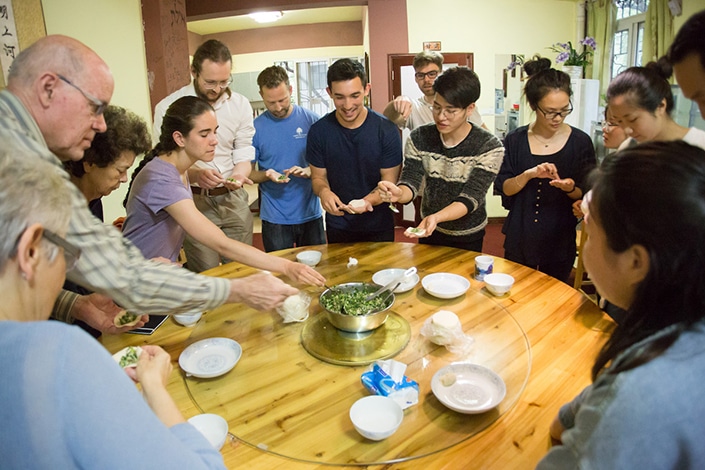
Mix in material made for native speakers as early as you can tolerate it. Chinese TV shows, Mandarin podcasts, and Chinese songs all work, and partial comprehension is still progress.
5. Treating Mistakes as Failures
Errors are not evidence that the method is not working. They are the mechanism by which it works.
The learner who says something clumsy and gets corrected learns faster than the one who stays silent to stay correct. If self-consciousness is your main obstacle, you are in good company — it tops most lists of the biggest challenges in learning Chinese.
6. Studying in Bursts Instead of Every Day
Three hours on Sunday is worth considerably less than twenty-five minutes a day. Language lives in habit and repetition, and long gaps undo quiet progress.
Build a schedule you can actually keep, then protect it. A realistic Chinese study plan beats an ambitious one you abandon in February.
If you only change one thing this week, change the ratio. For every hour you spend studying about the language, spend an hour using it — listening, reading, writing a message, or talking to someone.
04 The Right Way: Listening, Speaking, Reading, Writing
If there is a wrong way, there is also a right way. Language is about communication, so if you are not communicating, you have a long road ahead of you.
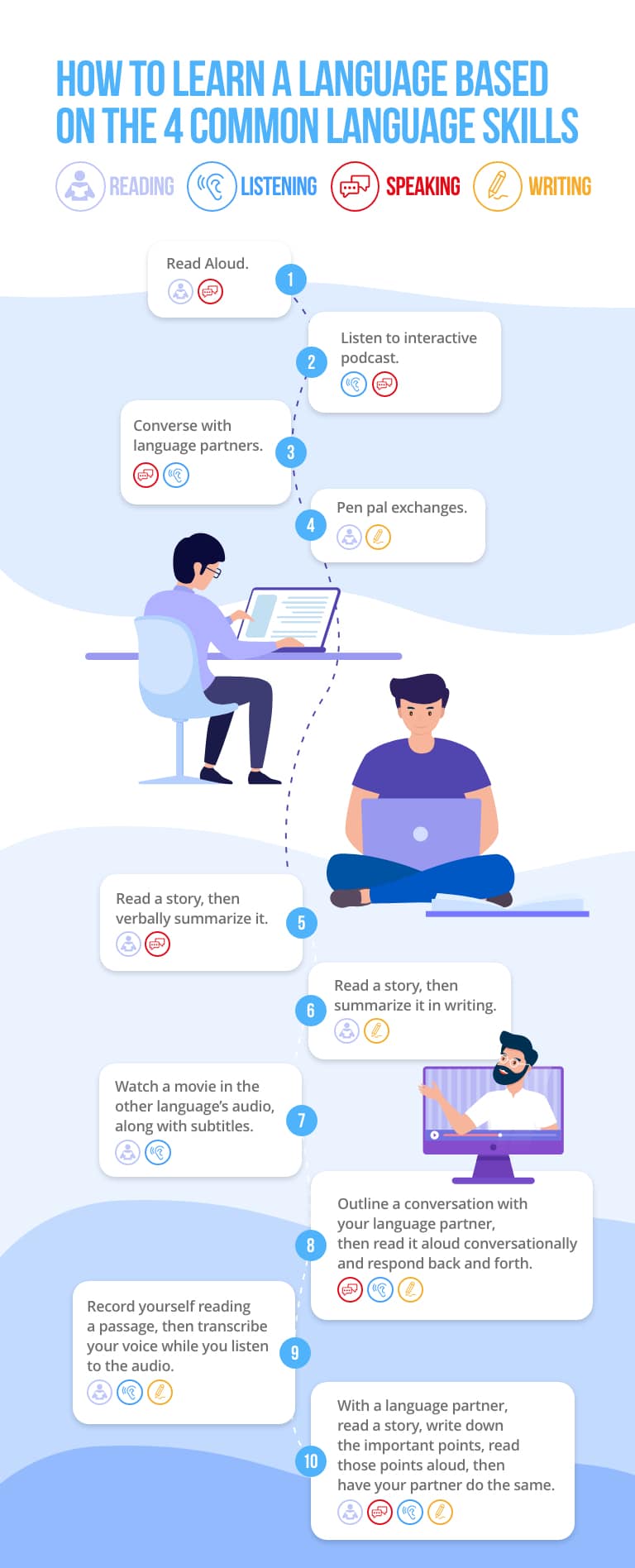
Applied linguists usually divide that communication into four skills, often abbreviated LSRW. Two of them are receptive — you take language in — and two are productive, meaning you put language out.
| Skill | Type | What It Builds |
|---|---|---|
| Listening (听, tīng) | Receptive | Ear training, natural rhythm, tone recognition |
| Speaking (说, shuō) | Productive | Fluency, pronunciation, real-time recall |
| Reading (读, dú) | Receptive | Vocabulary depth, character recognition, grammar patterns |
| Writing (写, xiě) | Productive | Precision, sentence structure, character recall |
The classic mistake is to over-invest in the receptive half because it feels safer. Comprehension improves, output does not, and the learner ends up understanding a great deal while still unable to say much.
Balance matters more than intensity here. A learner who works all four skills for thirty minutes a day will overtake a reading-only learner within months.
Start With Listening
Listening is the skill that carries the others, particularly in Mandarin, where tones do the work that stress and intonation do in English. You cannot produce a distinction your ear cannot yet hear.
Put Chinese audio into the parts of your day that are already occupied — commuting, cooking, walking. Our guide to improving your listening comprehension has specific techniques for making that time count.
Make Speaking Non-Negotiable
Speaking is the skill learners skip most and need most. It is also the only one that requires another person, which is precisely why it gets postponed.
Schedule it rather than hoping for it. Whether that means a language exchange partner, a tutor, or an online Chinese teacher, the point is to make conversation a fixed appointment instead of an occasional accident.
Let Reading and Writing Reinforce Each Other
Reading builds the vocabulary you will later reach for in conversation, and writing forces you to retrieve it. Graded readers are useful precisely because they sit just above your current level.
For characters specifically, handwriting still helps recall even in an age of pinyin input. CLI's guide to learning Chinese characters covers how to approach them without drowning.
05 What This Means If You're Learning Chinese
Mandarin rewards the communicative approach more than most languages, and punishes the grammar-first approach less obviously. Chinese has no verb conjugation, no cases, and no plural agreement, so the grammar drills that consume years of French or Spanish study simply have less to bite on.
That is good news and a trap at once. Because the grammar is comparatively light, learners often conclude that the hard part must be characters and pour their hours into writing practice instead of speaking.
The real difficulty in Mandarin sits in the parts you can only develop through use: tones, listening at natural speed, and the enormous distance between textbook phrasing and how people actually talk. None of that is fixable at a desk.
The Immersion Advantage
This is the argument for immersion in a sentence: it removes the option of not using the language. When ordering lunch, asking directions, and chatting with your homestay family all happen in Mandarin, you accumulate more real practice in a week than a semester of classes provides.
It is also why so many students choose to Learn Chinese in China rather than study from home indefinitely. The environment does half the work of building the habit, because the language stops being a subject and becomes the medium of your day.
Structured one-on-one instruction accelerates the same effect. There is good evidence that individualized teaching outperforms classroom instruction by a wide margin, largely because every minute is spent on what you specifically need.
If you are weighing where to do this, our comparison of one-on-one versus group Chinese classes and our guide to the best city to learn Chinese in China are good places to start.

Study Chinese in Guilin or Start Online
CLI offers personalized Chinese instruction built around your goals. Join our Immersion Program in Guilin or begin from anywhere with a free Chinese lesson .
06 Useful Study Vocabulary
The following words come up constantly once you start talking about your own learning in Chinese. They are worth knowing early.
| Chinese | Pinyin | Translation |
|---|---|---|
| 学习 | to study; to learn | |
| 练习 | to practice | |
| 复习 | to review | |
| 听 | to listen | |
| 说 | to speak | |
| 读 | to read | |
| 写 | to write | |
| 听力 | listening comprehension | |
| 口语 | spoken language | |
| 语法 | grammar | |
| 词汇 | vocabulary | |
| 生词 | new word | |
| 发音 | pronunciation | |
| 声调 | tone | |
| 汉字 | Chinese characters | |
| 拼音 | pinyin (romanization system) | |
| 母语 | native language; mother tongue | |
| 外语 | foreign language | |
| 交流 | to communicate; exchange | |
| 流利 | fluent | |
| 错误 | mistake; error | |
| 沉浸 | to immerse; immersion | |
| 坚持 | to persevere; to keep at it | |
| 加油 | keep going; you can do it! |
07 Start Communicating Today
The single biggest predictor of whether you will still be learning a language in a year is not talent, method, or budget. It is whether you are using it with other people.
Everything else — the textbook, the app, the flashcard deck — is scaffolding around that one activity. Useful scaffolding, but scaffolding all the same.
Challenge yourself to think and communicate only in Chinese for an entire day. This is true Chinese language immersion, and there is simply no better way to improve — 加油!(Jiāyóu! — keep going!)