
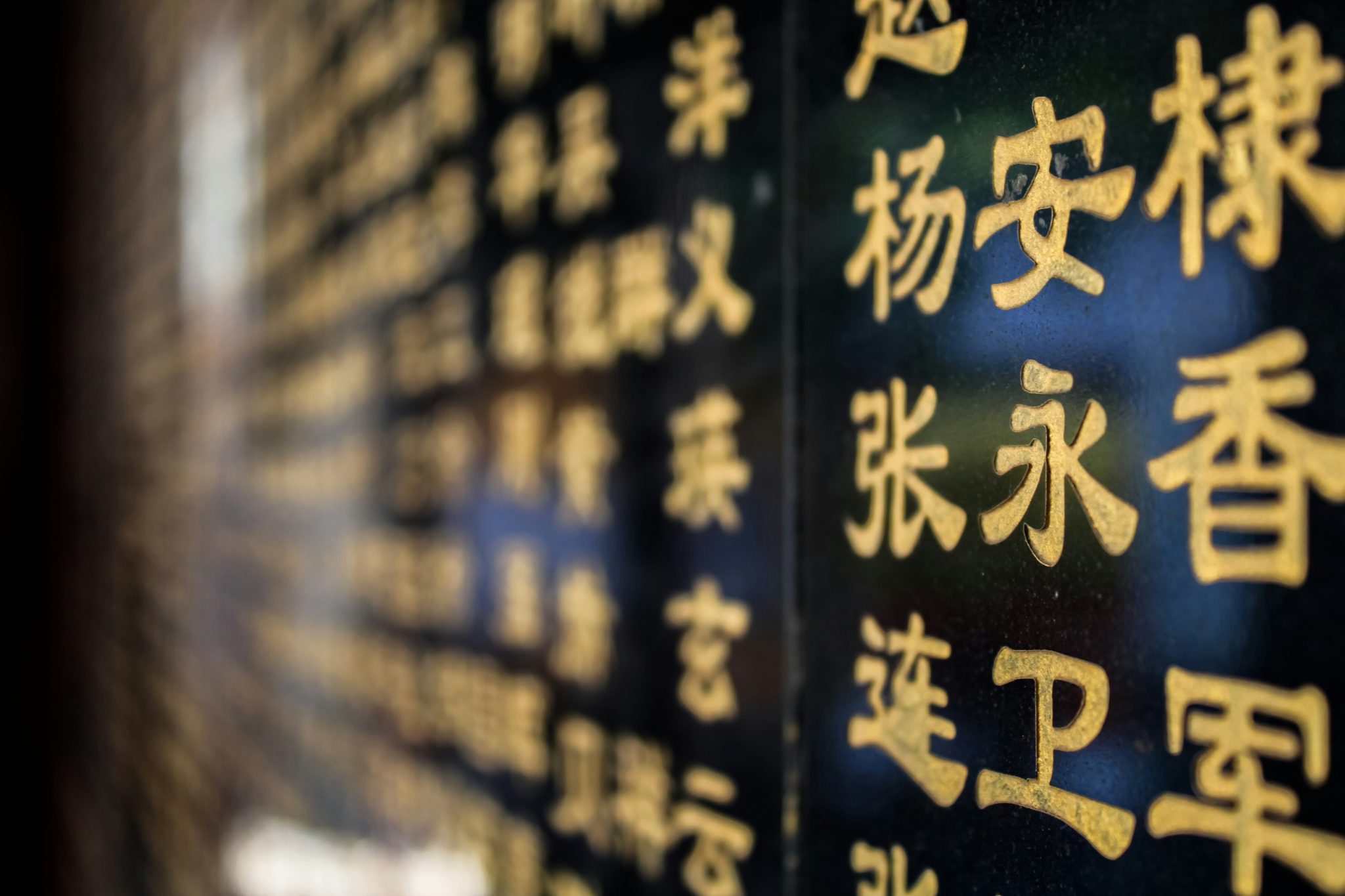
- More than 100,000 Chinese characters have existed across history, but only a few thousand are in everyday use today.
- The largest Chinese dictionary ever compiled, Taiwan's 2004 異體字字典 (Yìtǐzì zìdiǎn), records 106,230 characters and variants.
- China's 2013 standard lists 3,500 characters as essential, and most learners only need around 3,000 characters to read comfortably.
- The new HSK 3.0 exam requires about 3,000 characters at its highest band, replacing the old six-level test.
- Chinese has no alphabet, so characters are classified by strokes and by radicals instead of letters.
How many Chinese characters are there? Pinning down an exact number is impossible, but reliable estimates exist for both ancient Chinese (古代汉语, gǔdài hànyǔ) and modern Chinese (现代汉语, xiàndài hànyǔ).
The short answer is that more than 100,000 distinct characters have appeared throughout Chinese history. The far more useful answer, especially if your goal is to Learn Chinese in China, is that you only need a small fraction of them to read and communicate.
01 How many Chinese characters are there?
The number of unique Chinese characters used through the ages is unknown, but it is safely in excess of 100,000. Only a subset of these characters remains in regular use today.
The largest figure ever recorded in a single dictionary is 106,230. That total comes from the Taiwan Ministry of Education's 2004 Dictionary of Chinese Character Variants (異體字字典, Yìtǐzì zìdiǎn), which catalogues characters alongside their many historical variants.
How many Chinese characters are used today?
Far fewer characters are needed for daily life. The 2016 edition of the Modern Chinese Dictionary (现代汉语词典, xiàndài hànyǔ cídiǎn) includes only around 13,000 characters, because it focuses on words and characters still in common use.
For everyday reading, the working number is smaller still. Most fluent readers rely on a core of roughly 3,000 to 4,000 characters, a point we return to below.
02 How many Chinese characters do you need to know?
This is the question most learners actually care about. The good news is that the practical target is far lower than 100,000, and even lower than the 13,000 in a modern dictionary.
The 3,500 standard characters every student learns
In 2013, the Chinese government published the Table of General Standard Chinese Characters, an 8,105-character list divided into three levels. The first level contains the 3,500 most essential characters.
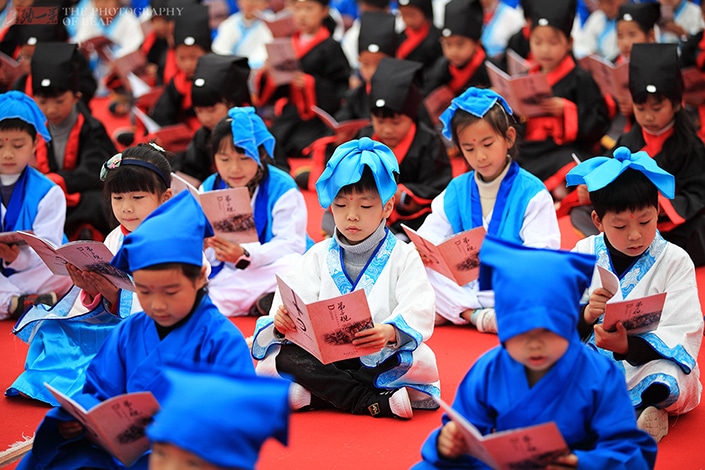
Chinese schoolchildren are expected to learn all 3,500 at a minimum. Many graduate knowing 5,000, 6,000, or more, but the first 3,500 cover the overwhelming majority of everyday text.
How many characters do you need for the HSK?
The HSK (汉语水平考试, hànyǔ shuǐpíng kǎoshì) is China's official Chinese proficiency exam for non-native speakers. The character requirement depends on which version of the test you take.
Under the older six-level HSK, the top level (HSK 6) required roughly 2,663 individual characters. The newer HSK 3.0 system, rolling out worldwide in 2026, expands the exam to nine levels.
At its highest band (levels 7–9), HSK 3.0 expects mastery of about 3,000 characters and more than 11,000 words. If you are deciding how to prepare, it is worth understanding what the HSK is before choosing a target level.
How many Chinese characters do you need to be fluent?
For comfortable, real-world reading, most learners need about 3,000 characters to reach fluency. You can read a surprising amount of daily material with far fewer than that.
The exact number you need also depends on your goals. Reading newspapers, academic texts, and classical literature pushes the requirement higher, while everyday signs, menus, and messaging need far less.
03 The history of Chinese characters: from oracle bones to today
The Chinese writing system has a long and complex history spanning more than 3,000 years. From inscriptions on bone fragments to typing on smartphones, the quantity and form of Chinese characters has evolved continuously.
What are oracle bones?
The oldest surviving examples of Chinese writing appear on oracle bones unearthed in Henan province. These inscriptions were made around 3,200 years ago during the Shang dynasty.
Far fewer characters existed when these early scribes etched messages into ox and turtle bones. The video below offers a short overview of how Chinese characters evolved from oracle bone script to their modern forms.
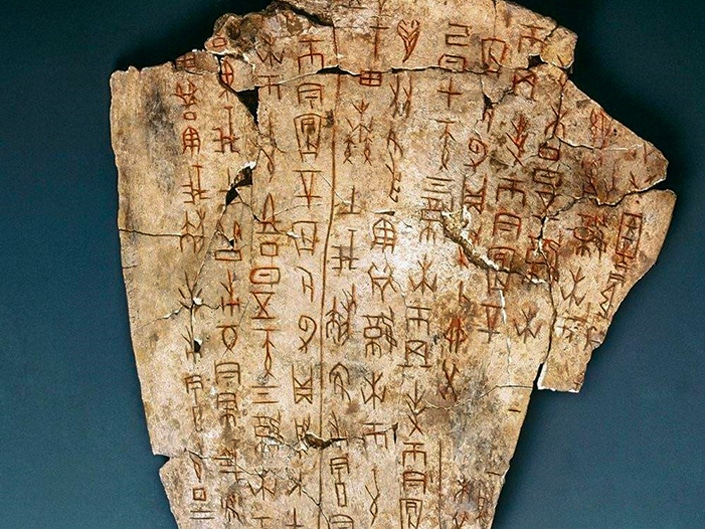
How Chinese characters have changed over time
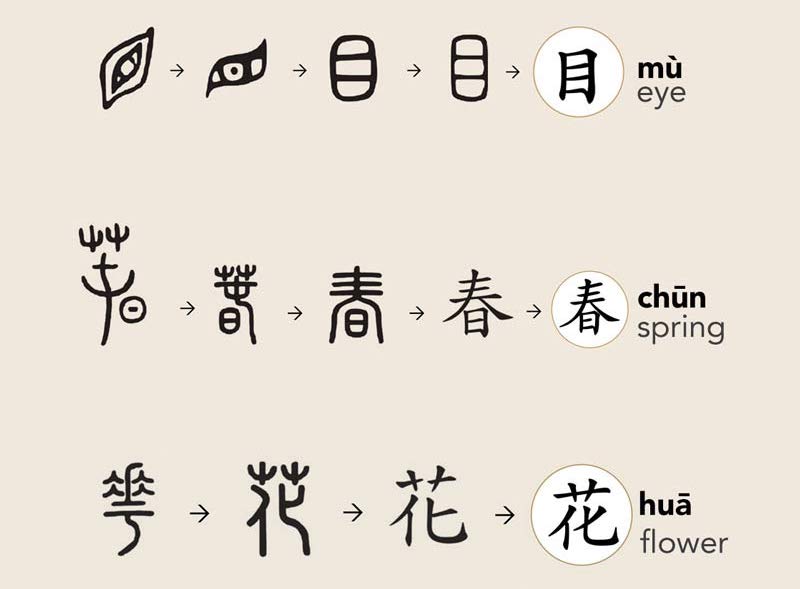
Many characters in use today developed from pictographic ancestors over two thousand years ago. In some cases the modern form is completely different from the original, while in others it remains strikingly similar.
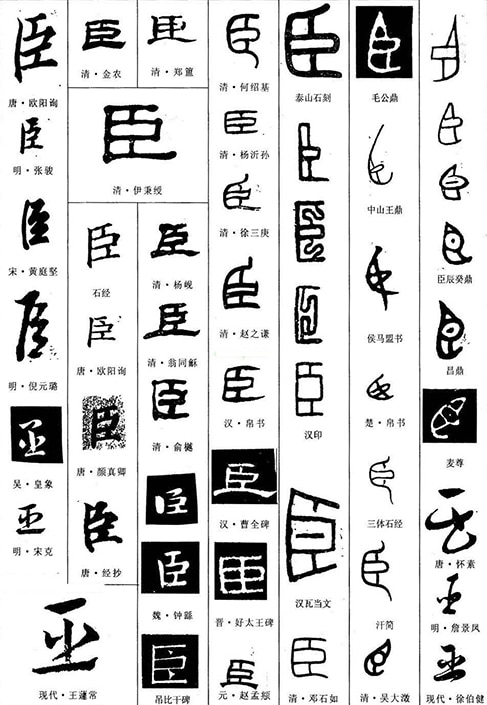
This long evolution is why a single character can have several historical written forms. Tracing that development is the focus of Chinese etymology, and it helps explain the six types of Chinese characters linguists recognize.
Simplified vs. traditional Chinese characters
One of the most significant recent changes was the introduction of simplified characters around the middle of the 20th century. The goal was to raise literacy by making characters faster and easier to write.
The 1986 Complete List of Simplified Characters (简化字总表) standardized 2,235 simplified forms. These replaced many of the more complex traditional Chinese characters in mainland use.
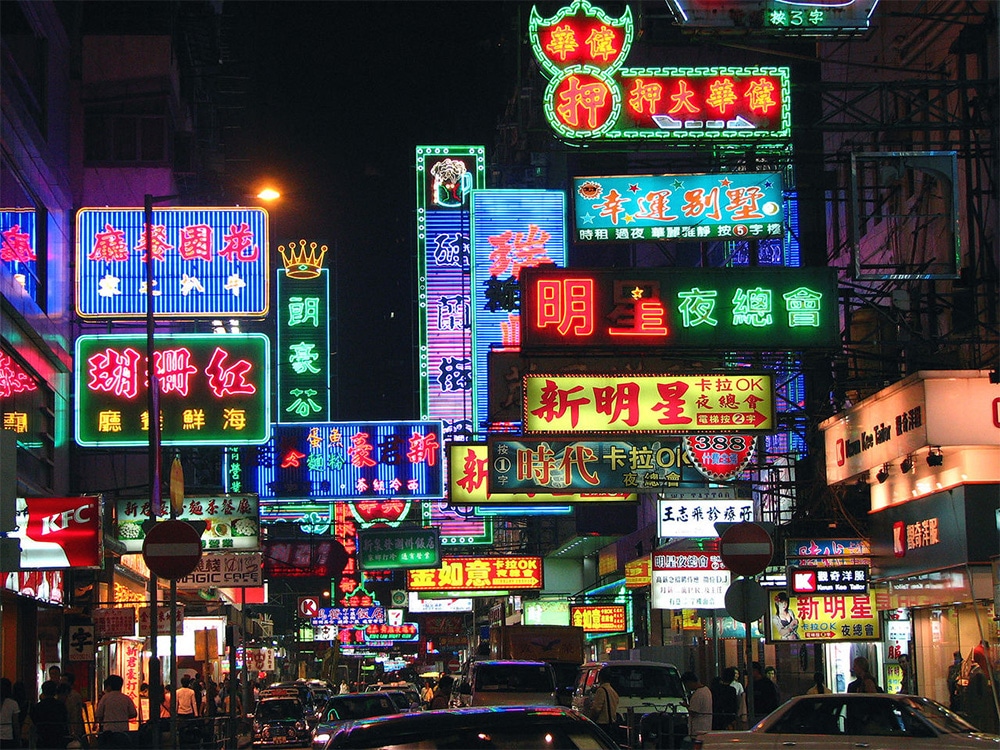
Traditional characters are still standard in Hong Kong, Taiwan, and several overseas Chinese communities. Simplified characters are now standard in mainland China, though many people there can still read traditional forms.
Number of Chinese characters over time
The character count recorded in major dictionaries rose steadily for centuries before dropping sharply in modern reference works. The table below shows the approximate number of characters in several landmark dictionaries.
| Dictionary | Year | Approx. characters |
|---|---|---|
| Shuowen Jiezi (说文解字) | c. 100 CE | 9,353 |
| Kangxi Dictionary (康熙字典) | 1716 | 47,035 |
| Zhonghua Da Zidian (中华大字典) | 1915 | ~48,000 |
| Hanyu Da Zidian (汉语大字典) | 1989 | 54,678 |
| Zhonghua Zihai (中华字海) | 1994 | 85,568 |
| Dictionary of Chinese Character Variants (異體字字典) | 2004 | 106,230 |
| Modern Chinese Dictionary (现代汉语词典, 7th ed.) | 2016 | ~13,000 |
So why does the count climb past 100,000 and then fall to roughly 13,000? The answer is in the name of the 2016 dictionary: it is a "modern" reference focused on characters and words still in common use.
The older dictionaries are character-only and far more inclusive. They retain many obsolete characters found only on ancient scrolls or carvings, along with multiple variant forms of the same character across different historical styles.

Learn Chinese with Cultural Context
CLI offers personalized Chinese instruction built around real language and culture. Join our Immersion Program in Guilin or start online with a free Chinese lesson.
04 What counts as a Chinese character?
With over 100,000 characters in existence, linguists and dictionary authors give varying answers to this question. The core difference comes down to how Chinese works compared with alphabetic languages.
Chinese is very different from phonetic languages like English, French, and Spanish, which build words from a fixed set of letters. Chinese instead uses thousands of individual characters, each carrying one or more meanings of its own.
This is the key contrast with Western letters, which carry only a sound and no meaning on their own. Some characters, like 你 (nǐ, "you"), can stand alone as a word, while others, like 们 (men), must be paired with another character to form one.
Does Chinese have an alphabet?
Not in the conventional sense. Because Chinese has no letters, it also has no alphabet of the kind used in European and Middle Eastern languages.
However, Chinese does have components that serve a broadly similar organizing purpose. The two most important are strokes and radicals, which are also used to learn and look up characters.
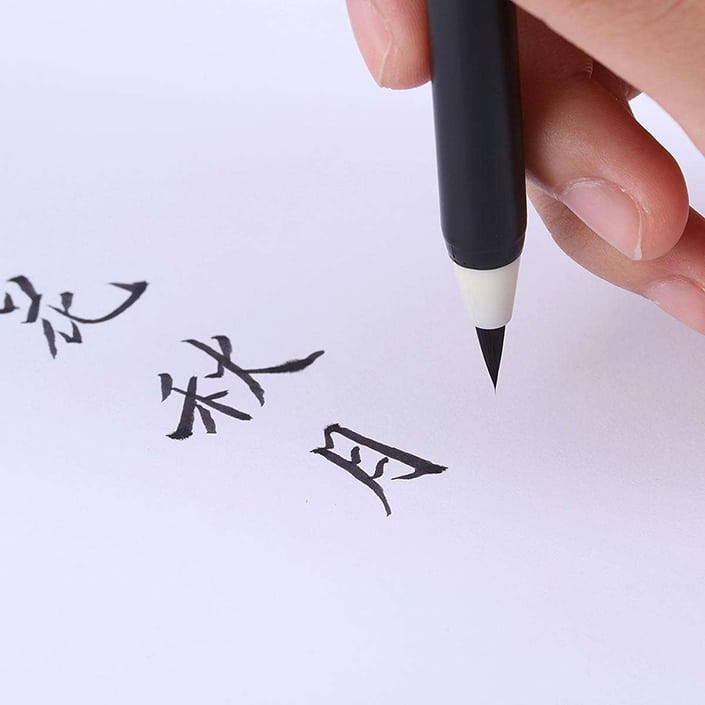
How Chinese characters are built from strokes
Every modern Chinese character is built from a number of strokes of the pen or brush. Characters can be classified by how many strokes they contain, and the strokes themselves come from a small, clearly defined pool.
Most systems recognize roughly 10 basic strokes plus about 25 more complex strokes. You could think of strokes as the building blocks that stroke order rules arrange, though unlike letters, no specific sound is tied to each stroke.
What are Chinese radicals?
Characters can also be classified by their radical, a recurring component that is simpler than the whole character but often looks like a small character itself. Some radicals can stand alone as characters, and others cannot.
Take 渔 (yú), meaning "fishery" or "fishing." It splits into two radicals: the left one means "water" and is not a standalone character, while the right one, 鱼, is the word for "fish" and is also pronounced yú.
Adding the water radical to the character for fish produces a character meaning fishing or fishery. The classifying radical hints at meaning, and a second component often hints at pronunciation.
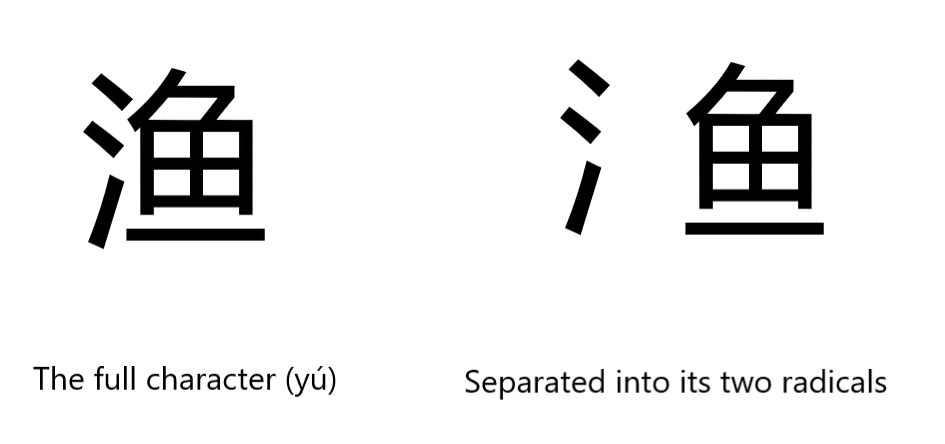
The most common system is the set of 214 Kangxi radicals, used in many dictionaries by native speakers. Each radical is used to build many different characters.
Is Chinese a phonetic language?
Contrary to popular belief, Chinese is not purely pictographic. Because some radicals signal pronunciation, the script also has phonetic elements, even if it is not phonetic in the way English is.
Consider characters that share the component 羊 (yáng). In the examples below, that component contributes little to meaning but clearly points to a similar pronunciation.
| Character | Pinyin | Meaning |
|---|---|---|
| 洋 | ocean; vast | |
| 样 | appearance; type | |
| 养 | to raise; to nourish | |
| 氧 | oxygen | |
| 痒 | itchy |
Because characters are assembled from "meaning radicals" and "sound radicals," these components act as a kind of alphabet for building the written language. Chinese writing is therefore best described as logographic rather than purely pictographic.
05 FAQ
How many Chinese characters are there in total?
More than 100,000 Chinese characters have appeared throughout history. The largest single dictionary, the 2004 Dictionary of Chinese Character Variants, records 106,230 characters and variants.
How many Chinese characters do you need to know?
About 3,000 characters are enough for comfortable everyday reading. China's official standard lists 3,500 characters as essential for students.
How many characters do you need for the HSK?
The old HSK 6 required roughly 2,663 characters. The new HSK 3.0 expects about 3,000 characters at its highest band (levels 7–9).
How many simplified Chinese characters are there?
The 1986 Complete List of Simplified Characters standardized 2,235 simplified forms. These are now standard in mainland China.
Does Chinese have an alphabet?
No. Chinese has no letters or alphabet, so characters are organized and looked up by their strokes and radicals instead.
06 Can you learn Chinese characters?
You should now have a clearer picture of how many Chinese characters exist, where they came from, and how the writing system developed to meet changing needs. The total may run past 100,000, but the practical goal is far smaller.
If you only need about 3,000 characters to read fluently, the task is very achievable. Learning Chinese is rarely as hard as it first appears, especially with consistent practice and good guidance.