

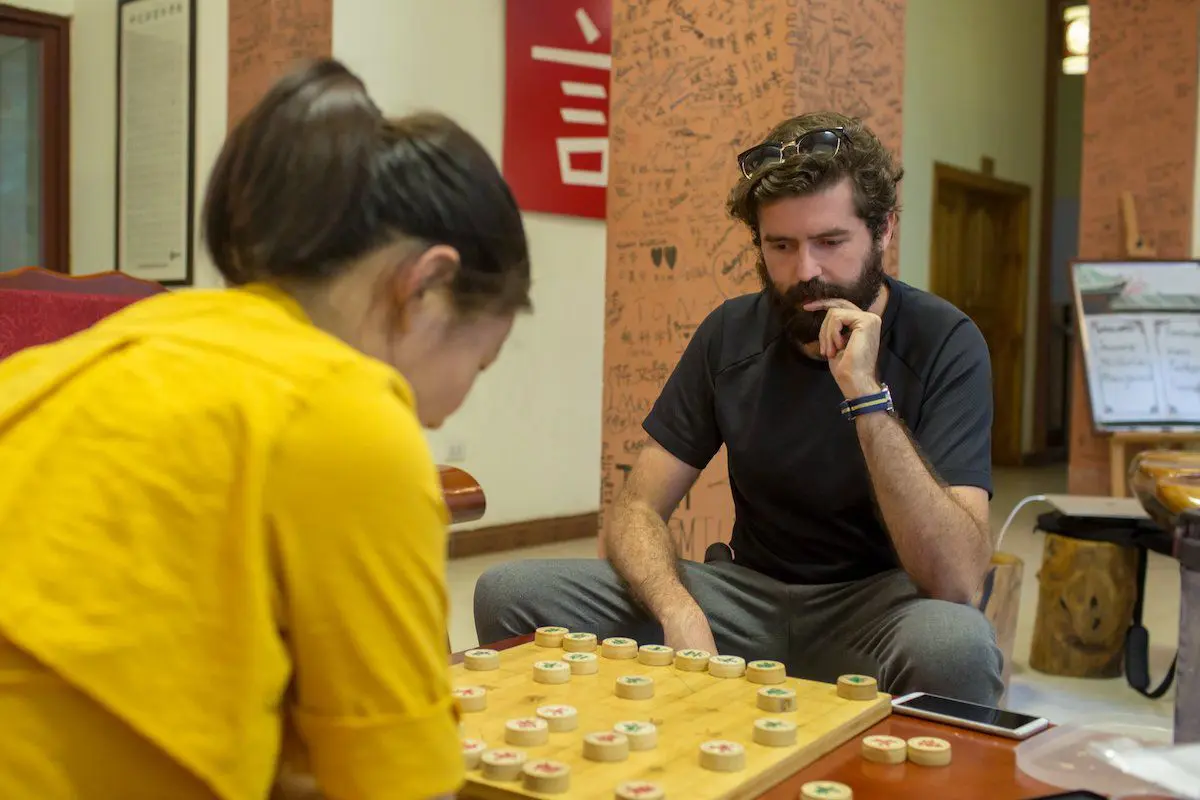
- The FSI's 2,200-hour estimate describes diplomats in near-perfect study conditions targeting professional proficiency — most learners hit useful milestones far sooner.
- Chinese is genuinely challenging in specific, well-defined ways: tones require real-time human feedback, and characters demand sustained review with smart tools.
- Chinese grammar is dramatically simpler than European languages — no conjugation, no gender, no plurals, no articles.
- How you study matters as much as how long — research shows classroom instruction alone hits a ceiling that immersion and one-on-one feedback can break through.
- The HSK framework provides staged, concrete milestones that turn "learn Chinese" into a series of achievable steps.
If you've researched learning Chinese, you've met the same intimidating number: the U.S. Foreign Service Institute estimates Mandarin requires roughly 2,200 class hours to reach professional proficiency — three times Spanish, in the FSI's hardest category alongside Arabic, Japanese, and Korean.
It's a real number, but it describes a very specific learner: a career diplomat studying full-time, 25 hours a week, in what the FSI calls near-perfect conditions.
The target is ILR Level 3 — roughly a high B2 or low C1 on the CEFR scale. That means professional precision, not conversational fluency.
How hard Chinese actually feels depends far more on your goals, study method, and target skills than on any single number.

01 The 2,200-Hour Question
The FSI's rankings are the most widely cited benchmark for how long English speakers need to learn different languages:
| FSI Category | Example Languages | Estimated Class Hours | Estimated Weeks (Full-Time) |
|---|---|---|---|
| Category I | Spanish, French, Italian, Portuguese | 600–750 | 24–30 |
| Category II | German, Indonesian, Swahili | 900 | 36 |
| Category III | Russian, Hindi, Greek, Thai | 1,100 | 44 |
| Category IV | Chinese (Mandarin), Arabic, Japanese, Korean | 2,200 | 88 |
The Defense Language Institute corroborates this independently: its intensive Mandarin program runs 64 weeks at seven hours a day, five days a week — about 2,240 hours.
But the FSI's subjects are full-time students with trained instructors and daily immersion, not part-time learners fitting study around jobs.
ILR Level 3 is also far above what most people actually need. If your goal is comfortable conversation, independent travel, or everyday reading, you'll reach those milestones well before 2,200 hours.
The data also shows Chinese sits in the same tier as Japanese and Korean — the DLI gives all three the same 64 weeks — though the specific challenges differ considerably.
Chinese takes meaningfully longer than European languages, but 2,200 hours is a benchmark, not a life sentence. What matters most is how you spend those hours. One CLI student who already spoke five languages based on Latin describes starting over with Chinese in The Key to Cracking the Puzzle.
02 What Makes Chinese Genuinely Difficult
Some aspects of Chinese really are unlike anything in English or common European languages.
The good news: these challenges are well-studied and predictable, and each one has strategies that work.
Tones — The Challenge Everyone Warns You About
Mandarin is tonal: the pitch pattern of a syllable changes the word's meaning entirely.
There are four main tones (声调 ) plus a neutral tone:
| Tone | Pinyin Mark | Pattern | Example |
|---|---|---|---|
| 1st tone | High, flat | 妈 (mother) | |
| 2nd tone | Rising | 麻 (hemp) | |
| 3rd tone | Dipping | 马 (horse) | |
| 4th tone | Falling | 骂 (to scold) |
In English, pitch carries emotion — decorative, not structural. In Chinese, pitch is structure.
Say 买 (, 3rd tone) and you're saying "buy." Shift to 卖 (, 4th tone) and you've said "sell."
The research is more encouraging than the warnings suggest.
A 2012 Journal of Phonetics study found Cantonese (tonal L1) learners didn't outperform English speakers overall.
Both groups struggled most with Tone 2 (rising) vs. Tone 3 (dipping) — a confusion rooted in the tones' acoustic similarity, not language background.
A 2024 Frontiers in Psychology study confirmed the hierarchy (Tone 1 easiest, Tone 3 hardest) for both native children and adult L2 learners.
A 2021 plasticity study went further: advanced learners who combined classroom study with study-abroad immersion perceived tones as accurately as native speakers. Classroom-only study, by contrast, hit a ceiling after the first month.
The difficulty distinguishing Tone 2 from Tone 3 is a universal hurdle — not a sign your ears aren't "wired" for tones. Even speakers of other tonal languages don't get a free pass. The challenge is inherent to the tones' acoustic properties, not to the learner.
The practical lesson: tones are hard but learnable.
They don't require a "good ear" — they require consistent practice with real-time correction from someone who can hear what you're producing.
For how tones interact in natural speech, see CLI's guide to tone changes in Mandarin.
Characters — The "Leaky Bucket" Problem
Chinese characters (汉字 ) look most forbidding from outside. There's no alphabet — you can't sound out an unknown word like you can in Spanish.
David Moser's 1991 essay "Why Chinese Is So Damn Hard" described character retention as filling a leaky bucket: new characters learned while old ones drain away.
Moser wasn't wrong. But he wrote before SRS software, popup dictionaries, and handwriting recognition. The bucket still leaks — modern tools just plug many of the holes.
How many characters do you need? Fewer than expected:
| Characters Learned | What It Gets You |
|---|---|
| ~500 | Basic daily life: menus, street signs, simple text messages |
| ~1,500 | Comfortable with most everyday reading: news headlines, social media, short articles |
| ~2,500 | Functionally literate: novels, news articles, professional correspondence |
| ~3,000–3,500 | Near-complete coverage of modern written Chinese (~98–99% of text) |
Character frequency is heavily skewed in learners' favor. The most common few hundred appear far more often than the rest, so early learning produces outsized returns.
Over 80% of characters are phono-semantic compounds (形声字 ), built from two parts: a semantic radical (meaning hint) and a phonetic component (pronunciation hint).
Take 妈 (, mother): 女 (woman) + 马 () — woman + sounds-like-mǎ.
For more, see CLI's guide to the six types of Chinese characters.
The pattern is everywhere once you see it.
The water radical 氵 links 河 (river), 湖 (lake), 洗 (wash), 汤 (soup). The tree radical 木 links 林 (forest), 桌 (table), 椅 (chair).
The radical often narrows the meaning before you reach a dictionary.
An analysis of 18,000 characters by educator Olle Linge (Hacking Chinese) found phonetic components aren't very useful for the first ~1,000 characters — most early ones are basic pictographs learned individually. After that threshold, new characters become increasingly predictable from their components. The first thousand are the steepest climb; after that, you're working with a system.
Modern tools accelerate this.
SRS apps like Anki and Pleco's flashcards hit characters just before you'd forget them. Popup dictionaries let you read authentic text from early on.
Pinyin input lets you type any character you can pronounce without recalling every stroke.
None of this makes characters easy. But it makes them systematically learnable in a way that wasn't true a generation ago.

Reading — When Listening Outpaces Literacy
A challenge unique to Chinese (and Japanese): the gap between listening and reading ability.
In Spanish, if you can say a word, you can usually read it. In Chinese, no such bridge — every character must be learned or looked up.
It's normal to follow conversations comfortably but stumble on a news article.
The gap closes with dedicated reading practice. If reading fluency matters to you — and for most serious learners it does — budget time for character recognition, not just speaking and listening.
03 What Most People Don't Realize Is Easy
Several aspects of Chinese are genuinely simpler than European languages — and not in trivial ways.
These advantages are structural; they benefit you from day one.
Grammar That Gets Out of Your Way
If you've wrestled with French conjugation, German gender, or Spanish subjunctive, Chinese grammar (语法 ) will feel like a relief.
Chinese verbs don't conjugate. 吃 (, eat) stays 吃 regardless of subject or tense.
Time is carried by context and time words: 昨天 (yesterday), 现在 (now), 明天 (tomorrow).
"I ate" is 我昨天吃了 — "I yesterday eat" plus 了 for completion. The verb itself never changes.
Nouns have no gender (no le/la, no der/die/das).
No plurals — 一本书 is "one book," 五本书 is "five books," 书 stays 书.
No articles, no cases, no subject-verb agreement.
A French verb has about 90 forms across its tenses; a Chinese verb has one.
| What You Learn in French or Spanish | What You Learn in Chinese |
|---|---|
| Verb conjugations across ~16 tenses | One verb form — always |
| Grammatical gender for every noun | No gender |
| Plural forms and agreement rules | No plurals |
| Articles (definite and indefinite) | No articles |
| Subject-verb agreement | No agreement rules |
Chinese has its own quirks.
Measure words (量词 ) pair with nouns: 三本书 (three books), 三个人 (three people), 三张票 (three tickets).
Aspect particles 了, 过, and 着 mark time relations that don't map neatly onto English tenses.
And Chinese is topic-prominent: 那本书我看了 ("that book, I read") is natural in Chinese, odd in English.
But the overall load of forms and rules to memorize before building a sentence is dramatically lighter than any major European language.
CLI's Chinese grammar guide covers the core structures.

Words That Build Themselves
Chinese builds vocabulary (词语 ) by combining characters whose meanings you already know, rather than borrowing from Latin and Greek the way English does:
| Characters | Literal Meaning | English Word |
|---|---|---|
| 电话 | electric + speech | telephone |
| 火山 | fire + mountain | volcano |
| 电脑 | electric + brain | computer |
| 手机 | hand + machine | mobile phone |
| 大学 | big + study | university |
| 牙刷 | tooth + brush | toothbrush |
| 火车 | fire + vehicle | train |
| 中文 | middle + writing/language | Chinese (written) |
This is a real learning advantage.
Knowing "telephone" in English tells you nothing about "volcano" or "computer."
Knowing 电 (electric) in Chinese instantly connects 电话, 电脑, 电视 (television), and dozens more.
Vocabulary accelerates as your character base grows. By 2,000–3,000 characters, you can often guess unfamiliar compounds correctly.
Pronunciation You Can Count On
Tones aside, pronunciation is remarkably consistent.
Each character has one pronunciation — no silent letters, no "cough/through/though/thought" chaos.
Pinyin (拼音) provides a complete, reliable phonetic map from day one.
Mandarin has only about 1,300 distinct syllables including tone variations.
Pinyin is also the main method for typing Chinese: type the pinyin, pick the character.
Digital literacy doesn't require writing characters from memory — just recognizing them.
04 Is Chinese Harder Than Japanese or Korean?
All three sit in FSI Category IV at ~2,200 hours, and the DLI gives each the same 64 weeks.
But they challenge English speakers in fundamentally different ways:
| Feature | Chinese (Mandarin) | Japanese | Korean |
|---|---|---|---|
| Writing system | ~3,000–3,500 characters (one system) | 3 systems: hiragana, katakana, ~2,000 kanji | Hangul alphabet (learnable in days) |
| Grammar difficulty for English speakers | Most intuitive — SVO word order, analytic structure, no conjugation | Complex — SOV word order, verb conjugation, multiple politeness levels | Complex — SOV word order, conjugation, honorific system |
| Pronunciation challenge | 4 tones (the main hurdle) | Pitch accent (subtle, less immediately disruptive) | 3-way consonant distinction (tense/aspirated/plain) |
| Biggest early win | Grammar is immediately accessible | Pronunciation is approachable from day one | Hangul is fast to learn |
| Long-term challenge | Characters and reading fluency | Kanji + 3 scripts, grammar complexity | Grammar, honorifics, sound distinctions |
Chinese has the most approachable grammar (SVO, no conjugation) but the steepest initial barriers in tones and characters.
Korean has the easiest writing system (Hangul, learnable in days) but demanding grammar and phonology.
Japanese falls between — gentler pronunciation, but three scripts used simultaneously.
If grammar frustrates you more than memorization, Chinese may feel more approachable than its Category IV peers suggest.
See CLI's Chinese vs Korean and Chinese vs Japanese comparisons for a fuller breakdown.

05 How You Study Changes How Hard Chinese Is
"How hard is Chinese?" is inseparable from "how are you studying it?"
The 2021 plasticity study found that classroom instruction alone improved tone perception for about a month, then plateaued. Immersion broke through the ceiling.
Your study format doesn't just change how quickly you learn — it changes what you can learn at all.
Different approaches handle different challenges:
- Self-study (apps and textbooks): strong for vocabulary and character recognition with SRS tools; weak for tones because apps test recognition, not production.
- Group classes: good for structure and accountability, but limited speaking time per student caps how much pronunciation feedback you receive.
- One-on-one tutoring: real-time tone correction every minute of class. Research on individual instruction consistently shows it outperforms group formats, especially for skills requiring immediate feedback.
- Immersion: combines formal instruction with authentic input that pushes past classroom ceilings. Characters stop being abstract shapes once you use them on signs, menus, and messages every day.
Most learners mix approaches.
Tones need real-time feedback. Characters need spaced repetition and real-world exposure. Reading needs volume.
Match format to challenge, and 2,200 hours feels less like a wall.

Study Chinese the Way the Research Says Works
CLI's programs combine one-on-one instruction with full immersion in Guilin, China — the combination that pushes learners past the classroom ceiling.
06 Making Chinese Manageable — The HSK Roadmap
One useful mental shift: you don't need to "learn Chinese." You need to reach HSK 1, then HSK 2, then HSK 3.
The HSK (汉语水平考试 ) is China's standardized proficiency test, recognized internationally by universities and employers.
It turns "learn Chinese" into concrete, staged targets:
| HSK Level | Vocabulary Required | What You Can Do |
|---|---|---|
| HSK 1 | 150 words | Handle very basic exchanges: greetings, introductions, simple questions |
| HSK 2 | 300 words | Manage routine daily tasks: ordering food, shopping, giving directions |
| HSK 3 | 600 words | Communicate in familiar situations: travel, work basics, personal interests |
| HSK 4 | 1,200 words | Discuss a range of topics with reasonable fluency |
| HSK 5 | 2,500 words | Read Chinese newspapers and give organized speeches |
| HSK 6 | 5,000 words, ~2,663 characters | Comprehend complex written and spoken Chinese with ease |
HSK 1's 150 words is reachable in weeks.
HSK 3 gets you functional in everyday situations; HSK 4–5 opens professional and academic contexts.
A revised nine-level HSK 3.0 is in development, but the staged-target principle stays the same.
For level-by-level detail, see CLI's HSK levels guide and the complete HSK exam preparation guide.
Instead of 2,200 hours as one intimidating block, you're working toward the next 150 words, then 300, then 600 — with a certificate at each step.

07 So, Is Chinese Hard to Learn?
Yes — but with caveats that change the picture.
Chinese is hard in specific ways.
Tones need real-time feedback. Characters need long-term investment. Reading builds more slowly than in alphabetic languages.
The FSI's 2,200 hours reflects real difficulty.
But it's also easier than its reputation in ways that rarely make headlines.
Grammar is leaner than any European language. Vocabulary compounds transparently. Pronunciation (tones aside) is regular. And the HSK framework keeps you oriented.
Learning Chinese is difficult, but not in the way people think. Learning Chinese doesn't require talent, high intelligence, a good ear for tones or anything like that, but it does require persistence.— Olle Linge, Hacking Chinese
Chinese isn't impossibly hard — it's persistently hard.
The learners who succeed show up consistently, study strategically, and get the right support at the right time.
If you're considering Chinese — the language, the culture, the career opportunities, or all three — CLI's immersion programs in Guilin and online one-on-one lessons combine structured instruction, personal feedback, and real-world practice.
Reach out to the CLI team to talk about where you're starting and where you want to go.
08 Frequently Asked Questions About Learning Chinese
How long does it take to learn basic Chinese?
Basic conversational ability — enough for introductions, daily tasks, and simple topics — typically takes 3–6 months of consistent study, roughly HSK 2–3 (300–600 words).
The FSI's 2,200 hours targets professional diplomatic proficiency, a much higher bar than most learners need.
Can you learn Chinese without learning characters?
You can learn to speak Chinese with just pinyin, and many beginners start this way.
But skipping characters locks you out of signs, menus, and text messages — and it breaks the compounding logic that makes vocabulary accelerate as your base grows.
Most serious learners introduce characters early, even if reading fluency develops gradually.
What's the hardest part of learning Chinese?
Tones and characters.
Tones because they're a new pronunciation dimension; characters because they require sustained memorization.
Both have proven strategies. Tones respond to deliberate practice with real-time correction; characters respond to spaced repetition and consistent reading exposure.
Is Chinese grammar easy?
Morphologically, yes — no conjugation, gender, plurals, articles, or cases.
But Chinese has its own nuances: measure words, aspect particles, and topic-prominent structure all take time.
"Much easier than French or German" is accurate; "easy" without qualification overstates it.
The morphological simplicity still gives a real head start early on.
| Chinese | Pinyin | Translation |
|---|---|---|
| 声调 | tone | |
| 汉字 | Chinese character(s) | |
| 买 | to buy | |
| 卖 | to sell | |
| 形声字 | phono-semantic compound | |
| 语法 | grammar | |
| 吃 | to eat | |
| 昨天 | yesterday | |
| 现在 | now | |
| 明天 | tomorrow | |
| 了 | aspect particle (completion / change of state) | |
| 量词 | measure word | |
| 书 | book | |
| 本 | measure word for books | |
| 个 | general measure word | |
| 张 | measure word for flat objects | |
| 过 | aspect particle (experiential) | |
| 着 | aspect particle (ongoing state) | |
| 词语 | compound word / vocabulary | |
| 电 | electric / electricity | |
| 话 | speech / words | |
| 电话 | telephone | |
| 火 | fire | |
| 山 | mountain | |
| 火山 | volcano | |
| 电脑 | computer | |
| 手机 | mobile phone | |
| 大学 | university | |
| 牙刷 | toothbrush | |
| 火车 | train | |
| 中文 | Chinese (written language) | |
| 电视 | television | |
| 火锅 | hotpot | |
| 拼音 | pinyin (romanization system) | |
| 汉语水平考试 | HSK (Chinese Proficiency Test) | |
| 妈 | mother | |
| 麻 | hemp | |
| 马 | horse | |
| 骂 | to scold | |
| 女 | woman / female | |
| 河 | river | |
| 湖 | lake | |
| 洗 | to wash | |
| 汤 | soup | |
| 林 | forest | |
| 桌 | table (furniture) | |
| 椅 | chair | |
| 票 | ticket | |
| 人 | person / people |
09 Sources
- U.S. Foreign Service Institute — "Languages" (Archived) — FSI classification data and Category IV designation for Chinese
- U.S. Department of State — "Foreign Language Training" (January 2026) — Current FSI page confirming language difficulty classifications
- Defense Language Institute Foreign Language Center — "Language Schools" — DLI's 64-week Mandarin program and equal time allocation across CJK languages
- Hao, Yen-Chen (2012) — "Second language acquisition of Mandarin Chinese tones," Journal of Phonetics — T2/T3 confusion finding, tonal vs. non-tonal L1 speaker comparison
- Frontiers in Psychology (August 2024) — "Enhancing lexical tone learning" — Tone difficulty hierarchy: Tone 1 easiest, Tone 3 hardest
- PMC (2021) — "Plasticity in second language learning: Mandarin tones" — Classroom ceiling effect, advanced learners achieving native-like tone perception
- Moser, David (1991) — "Why Chinese Is So Damn Hard" — "Leaky bucket" characterization of character retention
- Linge, Olle (2022) — "Phonetic components, part 1," Hacking Chinese — Analysis of 18,000 characters, phonetic component utility after ~1,000 characters
- Linge, Olle (2023) — "Is Chinese difficult to learn?" Hacking Chinese — Quote on persistence vs. talent in Chinese learning
- FSI-language-courses.org — "FSI language difficulty" — Characterization of FSI study conditions as near-perfect learning environments