

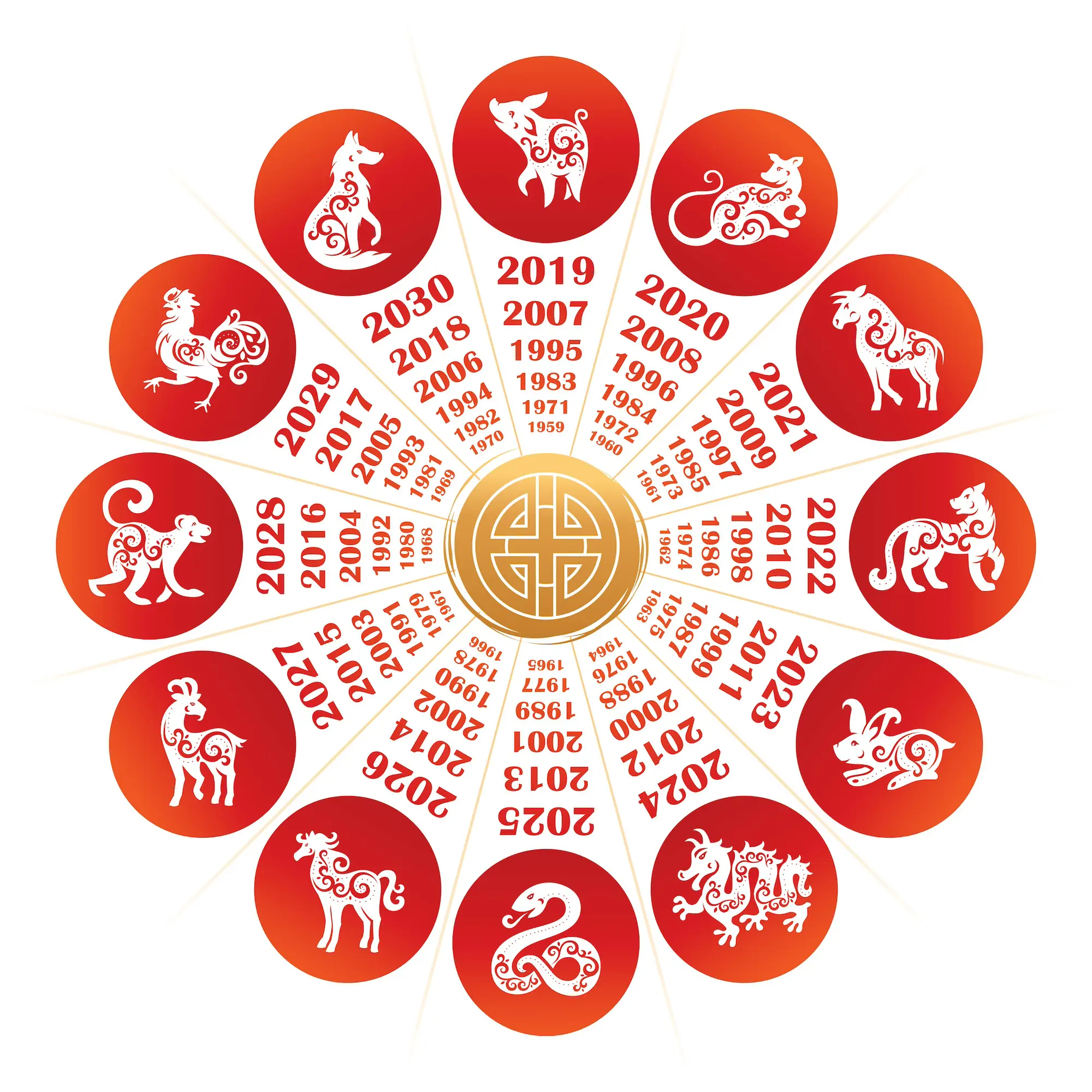
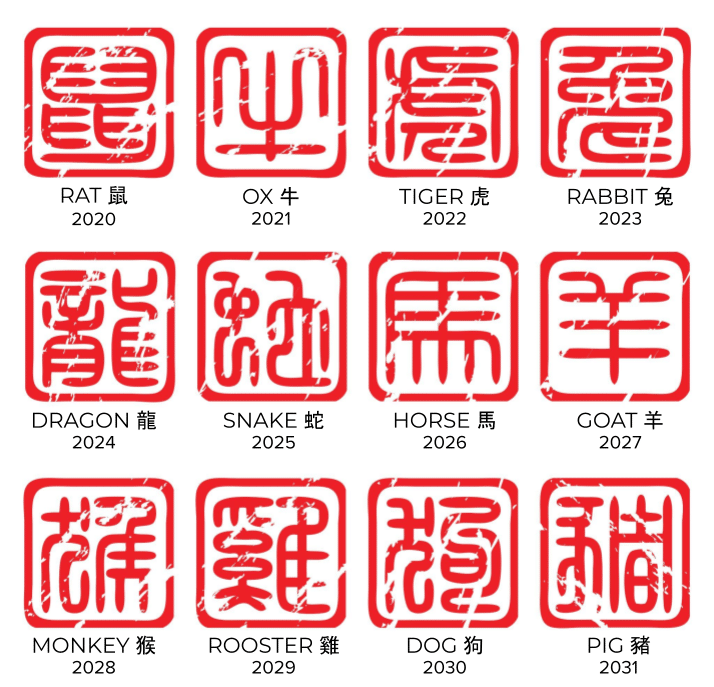
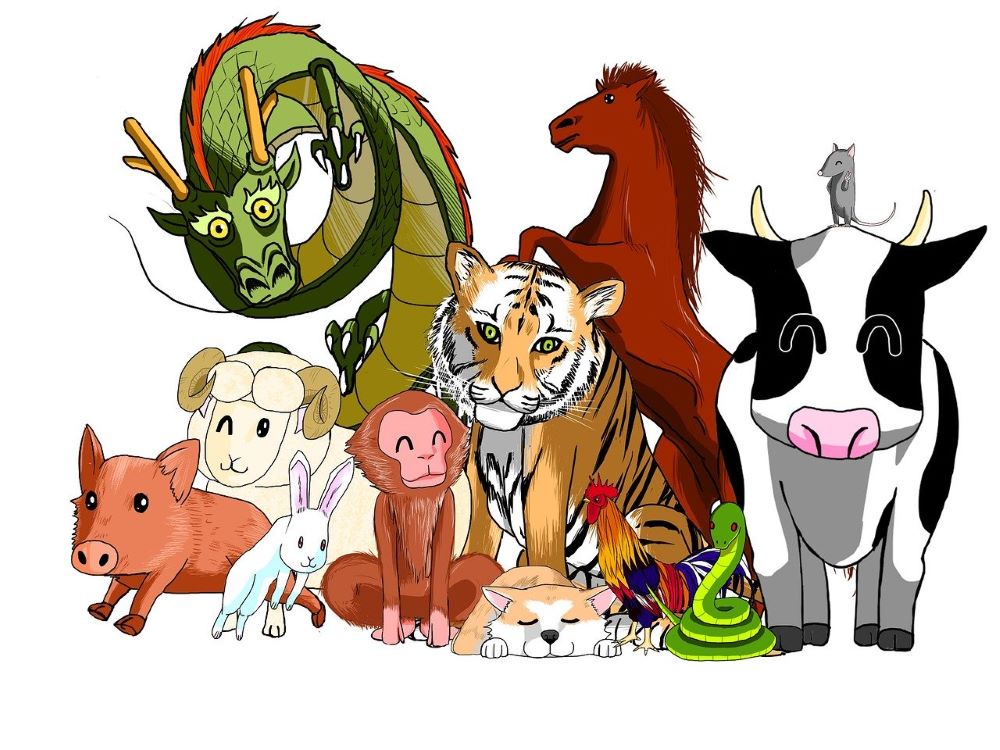
- The Chinese zodiac (生肖, shēngxiào) assigns one of twelve animals to each year in a repeating twelve-year cycle, in the fixed order Rat, Ox, Tiger, Rabbit, Dragon, Snake, Horse, Goat, Monkey, Rooster, Dog, Pig.
- Zodiac years turn over at Chinese New Year, not on January 1 — so anyone born in January or early February needs to check the exact date for their birth year.
- Each year also carries one of the five phases (wuxing) in a yin or yang aspect, producing a sixty-year cycle. 2026 is the year of the Yang Fire Horse.
- Compatibility folklore groups the animals into "triangles" four positions apart and treats signs six positions apart as clashing.
- The zodiac is one of the friendliest entry points into Chinese culture for language students, and a conversation topic you can use from your first week of study.
What does your birth year say about you? The Chinese zodiac has offered an answer for roughly two thousand years, and it remains a live part of everyday conversation in China today.
With each Chinese New Year — the holiday known in China as Spring Festival — the zodiac animal advances one place in the twelve-year cycle. This guide covers all twelve signs, how to find yours, what the five phases add, and where the compatibility beliefs come from.
It is also useful vocabulary. Asking someone 你属什么? (Nǐ shǔ shénme, "What's your zodiac animal?") is a normal, low-stakes question that will get you talking with almost anyone.
01 What Is the Chinese Zodiac? (生肖, Shēngxiào)
The Chinese zodiac is a twelve-year cycle in which each year is represented by an animal, called 生肖 (shēngxiào). Many people treat it as a lens on personality, destiny, and life patterns rather than a strict predictive system.
The cycle runs on the traditional Chinese lunisolar calendar, which is why the boundary between one animal and the next moves each year. That single detail causes more confusion than anything else about the zodiac.
Why Birth Year Matters More Than Birth Month
Western astrology puts the weight on the day and month of birth. The Chinese system puts it on the year.
A person's temperament and the major turns of their life are traditionally read against the animal governing their birth year. Where a Western horoscope would ask your star sign, a Chinese conversation asks your animal.
Why the Zodiac Is Worth Learning
For students of Chinese, the zodiac is a rare topic that is both culturally deep and immediately usable. It pairs naturally with the wider cycle of Chinese holidays you will encounter during a year in the country.
It also opens onto the belief systems underneath it, from religion in ancient China to cosmology and divination. If you would like to read about the animals in Chinese, our graded reader on Chinese zodiac animals covers the vocabulary at an intermediate level.
If you were born in January or early February, do not assume your sign from the Gregorian year. Check when Chinese New Year fell that year, because the zodiac animal changes on that date and not on January 1.
02 Chinese Zodiac Origins: History and Legends
Scholars generally place the origins of the zodiac in the Warring States period (475–221 BCE), or 战国时代 (Zhànguó Shídài). The system then spread widely under the Han dynasty (206 BCE–220 CE).
The Lunheng (论衡), a first-century CE work by the Han scholar Wang Chong, is often cited as the earliest text that names the twelve animals as we know them today. The cycle is older than that, though. Qin bamboo slips from a tomb at Shuihudi, sealed in 217 BCE, already record an animal cycle, and it differs in places: a deer stands where the Horse is now, and a horse where the Goat is.
The Silk Road Theory
One popular theory says Indian Buddhists brought the animal cycle to China along the Silk Road. The dates work against it, because Buddhism reached China in the first and second centuries CE, long after the Qin slips were written.
The Jade Emperor's Banquet
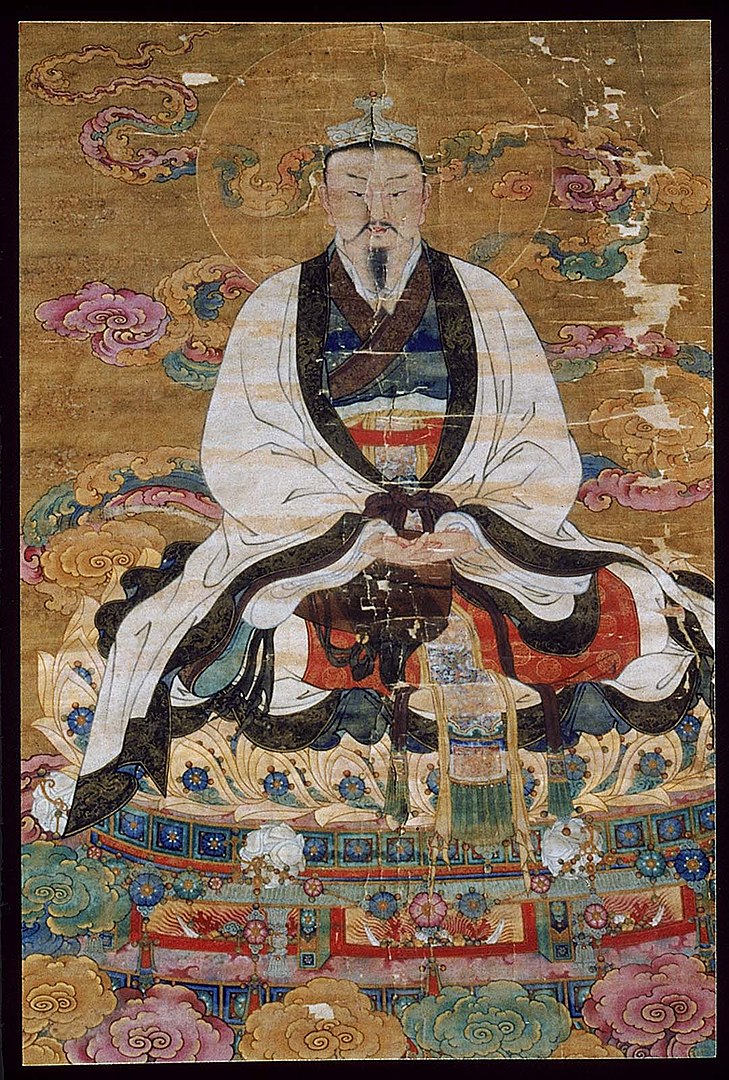
The most widely told story features the Jade Emperor, who invited all the world's animals to a banquet. Only twelve arrived, so he honored each by dedicating one year of the calendar to it.
The Great Race
A third account turns the gathering into a race. In the most common telling the Jade Emperor calls it, as in the animation below, but another version credits the Buddha. Either way, the first twelve animals across the finish line each earned a year, in the order they arrived.
The race version is the one most often taught to children, because it explains the order. It also accounts for the Rat's first-place finish, usually by having it ride on the Ox's back and jump off at the finish line.
The 12 Chinese Zodiac Animals in Order
The sequence never varies. It runs as follows:
The short animation below walks through one popular version of the origin myth.
03 Find Your Chinese Zodiac Sign by Birth Year
Match your birth year to the animal below. Remember the caveat: if your birthday falls in January or early February, verify the Chinese New Year date for that year first.
| Animal | Chinese | Birth Years |
|---|---|---|
| Rat | 鼠 (shǔ) | 1948, 1960, 1972, 1984, 1996, 2008, 2020, 2032 |
| Ox | 牛 (niú) | 1949, 1961, 1973, 1985, 1997, 2009, 2021, 2033 |
| Tiger | 虎 (hǔ) | 1950, 1962, 1974, 1986, 1998, 2010, 2022, 2034 |
| Rabbit | 兔 (tù) | 1951, 1963, 1975, 1987, 1999, 2011, 2023, 2035 |
| Dragon | 龙 (lóng) | 1952, 1964, 1976, 1988, 2000, 2012, 2024, 2036 |
| Snake | 蛇 (shé) | 1953, 1965, 1977, 1989, 2001, 2013, 2025, 2037 |
| Horse | 马 (mǎ) | 1954, 1966, 1978, 1990, 2002, 2014, 2026, 2038 |
| Goat | 羊 (yáng) | 1955, 1967, 1979, 1991, 2003, 2015, 2027, 2039 |
| Monkey | 猴 (hóu) | 1956, 1968, 1980, 1992, 2004, 2016, 2028, 2040 |
| Rooster | 鸡 (jī) | 1957, 1969, 1981, 1993, 2005, 2017, 2029, 2041 |
| Dog | 狗 (gǒu) | 1958, 1970, 1982, 1994, 2006, 2018, 2030, 2042 |
| Pig | 猪 (zhū) | 1959, 1971, 1983, 1995, 2007, 2019, 2031, 2043 |
If your own animal year comes around again, you are in your 本命年 (běnmìngnián). Tradition holds that this year carries elevated risk, which is why people often wear something red throughout it — a belief connected to the wider world of Chinese numerology and luck.
04 The Five Elements of the Chinese Zodiac (五行, Wǔxíng)
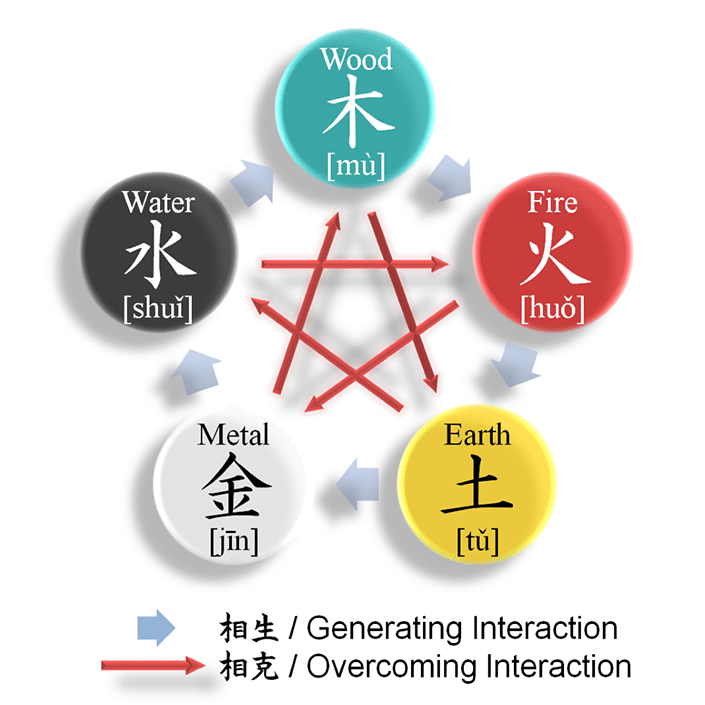
Alongside its animal, each year carries one of five phases: wood, fire, earth, metal, and water. Britannica notes that specialists usually render 五行 (wǔxíng) as "five phases" rather than "five elements," since these were understood as dynamic processes rather than fixed substances.
Each phase appears in a yang and a yin aspect, giving ten combinations. Paired against the twelve animals, that produces the full sixty-year cycle used in traditional Chinese timekeeping.
The phases sit within the interplay of yin and yang, the two complementary forces of classical Chinese cosmology. The same framework underpins feng shui and traditional Chinese medicine.
What Each Element Represents
In popular zodiac interpretation, the five phases are associated with the following qualities. These readings are folk attributions rather than claims found in the classical philosophical texts.
- Wood — warmth, elegance, sensitivity, and generosity
- Fire — decisiveness, innovation, dynamism, and joy
- Earth — honesty, prudence, and hard work
- Metal — independence, ambition, and strength
- Water — flexibility, diplomacy, kindness, and persuasiveness
Recent and Upcoming Zodiac Years With Their Elements
The table below pairs each recent year with its animal and phase. 2026 is the year of the Yang Fire Horse, written 丙午 (bǐng wǔ) in the traditional stem-and-branch system.
| Year | Animal | Element and Aspect | Stem-Branch |
|---|---|---|---|
| 2020 | Rat | Yang Metal | 庚子 (gēng zǐ) |
| 2021 | Ox | Yin Metal | 辛丑 (xīn chǒu) |
| 2022 | Tiger | Yang Water | 壬寅 (rén yín) |
| 2023 | Rabbit | Yin Water | 癸卯 (guǐ mǎo) |
| 2024 | Dragon | Yang Wood | 甲辰 (jiǎ chén) |
| 2025 | Snake | Yin Wood | 乙巳 (yǐ sì) |
| 2026 | Horse | Yang Fire | 丙午 (bǐng wǔ) |
| 2027 | Goat | Yin Fire | 丁未 (dīng wèi) |
| 2028 | Monkey | Yang Earth | 戊申 (wù shēn) |
| 2029 | Rooster | Yin Earth | 己酉 (jǐ yǒu) |
| 2030 | Dog | Yang Metal | 庚戌 (gēng xū) |
| 2031 | Pig | Yin Metal | 辛亥 (xīn hài) |
Read more about the current cycle in our full guide to the Year of the Horse.

Take Your Chinese Beyond the Textbook
CLI offers personalized Chinese instruction built around your goals, so topics like the zodiac become conversation rather than vocabulary lists. Join our Immersion Program in Guilin or begin from anywhere with a free Chinese lesson .
05 Chinese Zodiac Personality Traits and Compatibility: All 12 Animals
Each animal is traditionally associated with both favorable and unfavorable characteristics. People born in a given animal's year are said to share them.
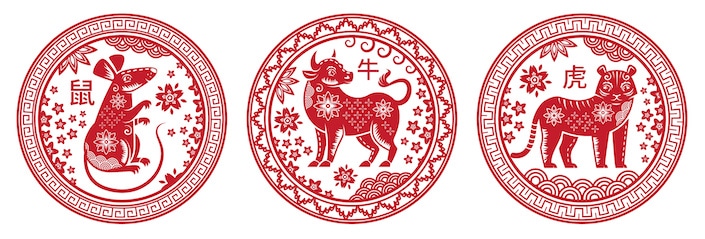
1. Rat (鼠, shǔ)
Positive traits: Smart, curious, clever, persuasive, and generous.
Negative traits: Can be uptight and set in its routines.
Compatibility: Traditionally paired with the Dragon and Monkey. Read more in our guide to the Year of the Rat.
2. Ox (牛, niú)
Positive traits: Reliable, protective, and strongly goal-oriented.
Negative traits: Private, stubborn, and inclined to hold grudges.
Compatibility: Traditionally paired with the Snake and Rooster. Read more in our guide to the Year of the Ox.
3. Tiger (虎, hǔ)
Positive traits: Brave, warm, and a natural leader.
Negative traits: Moody and quick-tempered at times.
Compatibility: Traditionally paired with the Horse and Dog. Read more in our guide to the Year of the Tiger.
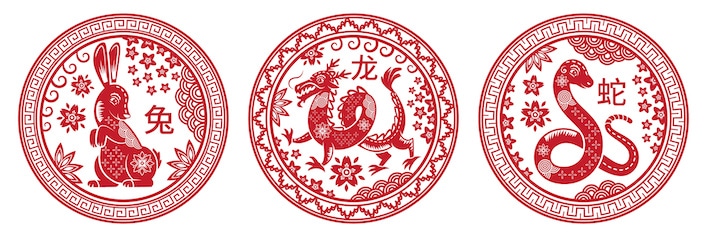
4. Rabbit (兔, tù)
Positive traits: Kind, sensitive, compassionate, and widely liked.
Negative traits: Tends to avoid confrontation.
Compatibility: Traditionally paired with the Goat and Pig. Read more in our guide to the Year of the Rabbit.
5. Dragon (龙, lóng)
Positive traits: Charismatic, powerful, lucky, and commanding — qualities tied to the broader symbolism of Chinese dragons.
Negative traits: Can be self-centered.
Compatibility: Traditionally paired with the Rat and Monkey. Read more in our guide to the Year of the Dragon.
6. Snake (蛇, shé)
Positive traits: Analytical, sharp, and often described as financially shrewd.
Negative traits: Can be distrustful, jealous, or insecure.
Compatibility: Traditionally paired with the Ox and Rooster. Read more in our guide to the Year of the Snake.
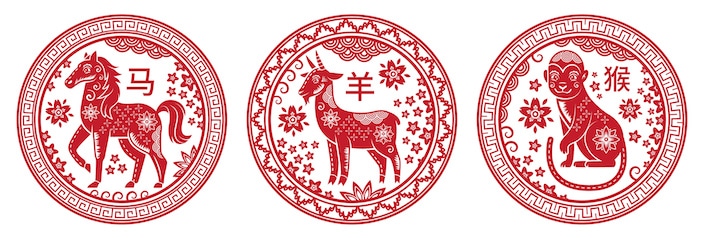
7. Horse (马, mǎ)
Positive traits: Energetic, independent, and drawn to travel.
Negative traits: Can be impatient.
Compatibility: Traditionally paired with the Tiger and Dog. Read more in our guide to the Year of the Horse.
8. Goat (羊, yáng)
Positive traits: Supportive, creative, and gentle.
Negative traits: Can be disorganized or unrealistic.
Compatibility: Traditionally paired with the Rabbit and Pig. Read more in our guide to the Year of the Goat.
9. Monkey (猴, hóu)
Positive traits: Cheerful, energetic, and a genuinely good listener.
Negative traits: Often described as commitment-averse.
Compatibility: Traditionally paired with the Rat and Dragon. Read more in our guide to the Year of the Monkey.
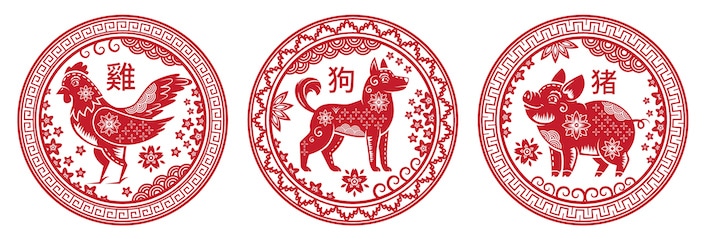
10. Rooster (鸡, jī)
Positive traits: Honest, direct, practical, and detail-oriented.
Negative traits: Can be materialistic.
Compatibility: Traditionally paired with the Ox and Snake. Read more in our guide to the Year of the Rooster.
11. Dog (狗, gǒu)
Positive traits: Loyal, honest, and attentive.
Negative traits: Can be judgmental or emotionally insecure.
Compatibility: Traditionally paired with the Tiger and Horse. Read more in our guide to the Year of the Dog.
12. Pig (猪, zhū)
Positive traits: Polite, intelligent, and tasteful.
Negative traits: Can struggle with difficult decisions.
Compatibility: Traditionally paired with the Rabbit and Goat. Read more in our guide to the Year of the Pig.
06 Chinese Zodiac Compatibility and the Zodiac Clock
Fortune-tellers have used the zodiac for centuries to read the fate of commoners and emperors alike. Those readings extend to relationships, and compatibility beliefs still surface in real decisions — including, occasionally, around Chinese wedding customs.
Compatibility Triangles and Clashes
The animals are grouped into four "triangles of affinity" (三合, sānhé), each made up of three signs sitting four positions apart in the cycle. Signs within a triangle are considered natural allies.
Signs sitting six positions apart are directly opposite one another and are said to clash (六冲, liùchōng). Rat and Horse, Ox and Goat, and Tiger and Monkey are three of the six clashing pairs.
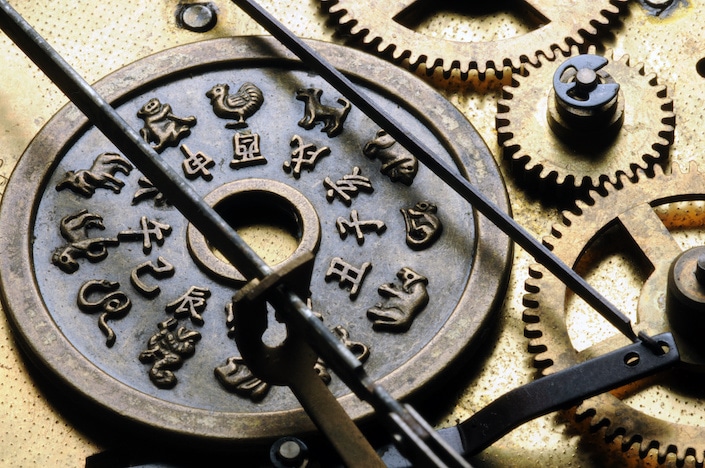
The Chinese Zodiac Clock: 12 Two-Hour Periods
The same twelve signs also divide the day. Each governs a two-hour period, a system still used in classical Chinese medicine and astrology.
- 11:00 PM to 1:00 AM — Hour of the Rat
- 1:00 AM to 3:00 AM — Hour of the Ox
- 3:00 AM to 5:00 AM — Hour of the Tiger
- 5:00 AM to 7:00 AM — Hour of the Rabbit
- 7:00 AM to 9:00 AM — Hour of the Dragon
- 9:00 AM to 11:00 AM — Hour of the Snake
- 11:00 AM to 1:00 PM — Hour of the Horse
- 1:00 PM to 3:00 PM — Hour of the Goat
- 3:00 PM to 5:00 PM — Hour of the Monkey
- 5:00 PM to 7:00 PM — Hour of the Rooster
- 7:00 PM to 9:00 PM — Hour of the Dog
- 9:00 PM to 11:00 PM — Hour of the Pig
Take the Rat as a worked example. Its triangle partners are the Dragon, four positions later, and the Monkey, eight positions later, while its clash partner is the Horse, sitting directly opposite.
07 Chinese Zodiac FAQ
What Chinese zodiac animal is 2026?
2026 is the Year of the Horse, and more precisely the Yang Fire Horse (丙午, bǐng wǔ). It began at Chinese New Year on February 17, 2026.
When does the Chinese zodiac year change?
The zodiac year changes at Chinese New Year, which falls between late January and late February depending on the lunisolar calendar. It does not change on January 1.
How do I find my Chinese zodiac element?
Elements follow a ten-year cycle of five phases in yang and yin aspects, so your element depends on your exact birth year rather than your animal. Use the year-by-year table above, adding or subtracting sixty years to reach older birth years.
What is a běnmìngnián (本命年)?
It is the return of your own zodiac animal, which happens every twelve years. Tradition treats it as an unlucky year, and wearing red is the standard countermeasure.
Do people in China actually believe in the zodiac?
Attitudes vary widely, much as they do toward horoscopes elsewhere. Many treat it as light entertainment and shared cultural shorthand, while some still consult it for major decisions such as timing a wedding or a birth.
How is the Chinese zodiac different from Western astrology?
The Chinese system is organized by birth year on a twelve-year animal cycle, while Western astrology is organized by birth month against twelve constellations. The two systems share a number but very little else.
08 The Legend Lives On
The animal cycle is more than two thousand years old, and it is still in daily use. Each Spring Festival names the new year after its animal, and people often bring up their sign when they talk about age or personality.
For a learner, the twelve animal names lead straight into the lunar calendar, and they make for easy small talk, since asking someone's sign is a friendly way to start a conversation.
We hope you will consider joining us in Guilin to Learn Chinese in China with CLI as your guide. In the meantime, keep studying and keep growing.