

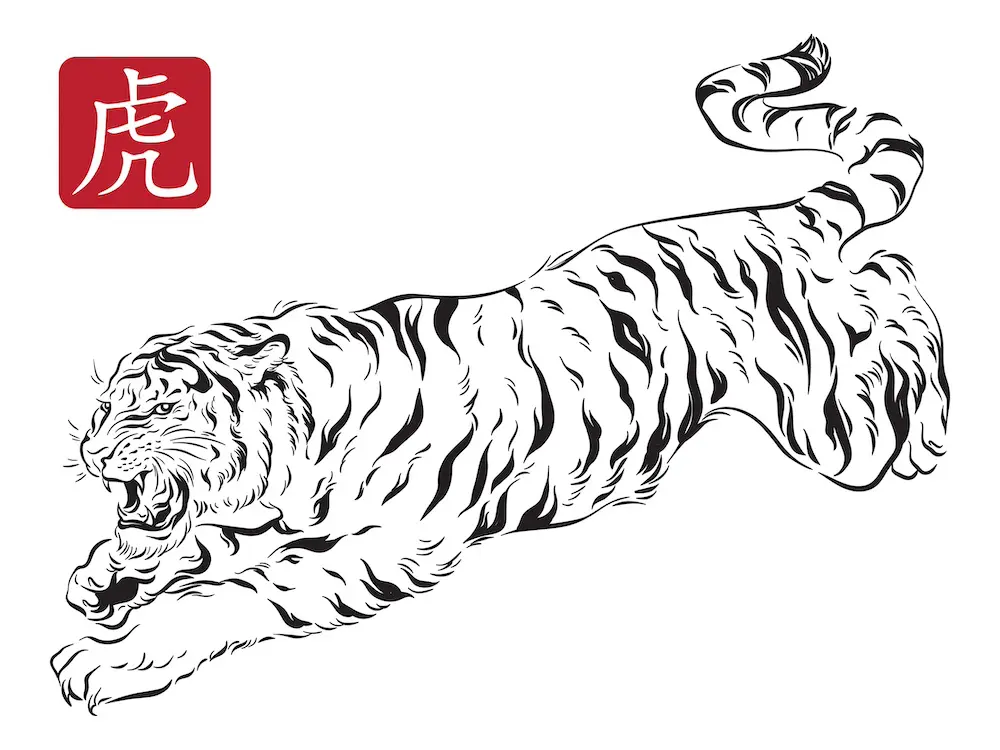
- The Tiger is the third sign in the 12-year Chinese zodiac cycle.
- Recent Tiger years include 1938, 1950, 1962, 1974, 1986, 1998, 2010, and 2022.
- According to the legend of the Great Race, the Tiger placed third by crossing the river with speed and determination.
- Tigers are traditionally seen as bold, confident leaders, though their intensity can also work against them.
- The tiger holds a special place in Daoist mythology and traditional Chinese medicine, and still shapes ideas about lucky numbers, colors, and compatibility today.
An ancient, cross-cultural symbol of ferocity, bravery, and intelligence, the tiger occupies a unique position in traditional Chinese mythology and culture. Join us as we take a winding journey into this astrological world of legend and luck, and get to the bottom of the Year of the Tiger.
For learners, the zodiac is also a meaningful doorway into Chinese culture, since it touches on mythology, language, and everyday customs all at once. This is especially true if your goal is to Learn Chinese in China, where zodiac traditions still shape conversations, holidays, and family life.
01 What is the Chinese zodiac?
Although the Chinese zodiac (生肖 shēngxiào) shares some similarities with the western zodiac, since both are 12-sign cycles tied to a person's birth, it also has a few features that set it apart.
- Instead of being month based, the Chinese zodiac is based on the year of one's birth.
- The signs of the Chinese zodiac have no special relationship to specific constellations.
- All 12 signs of the Chinese zodiac are animals, whereas the western zodiac mixes animals with other symbols.
The Chinese zodiac is based on the 12-sign lunisolar Chinese calendar (农历 nónglì), which assigns an animal sign to each birth year. The 12 signs repeat in a fixed order as the years pass.
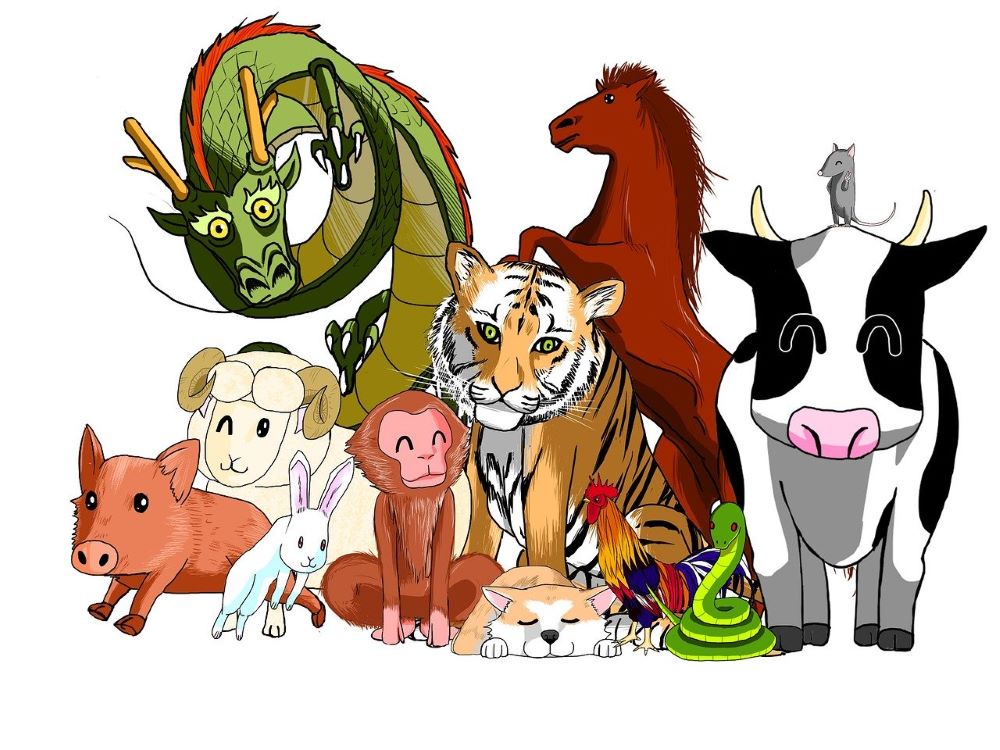
That order runs as follows: Rat (鼠 shǔ), Ox (牛 niú), Tiger (虎 hǔ), Rabbit (兔 tù), Dragon (龙 lóng), Snake (蛇 shé), Horse (马 mǎ), Goat (羊 yáng), Monkey (猴 hóu), Rooster (鸡 jī), Dog (狗 gǒu), and Pig (猪 zhū).
The myth of the Great Race
According to legend, the Jade Emperor (玉皇 Yùhuáng), a heavenly ruler said to preside over all creation, once declared a great race. Animals would compete to cross a wide river, and the first 12 to arrive would each receive one of the 12 zodiac years.
The clever Rat crossed first by riding on the Ox's back, then leaping ahead at the very last moment. The Ox, arriving just behind, took second place.
The Tiger came in third thanks to its competitive nature and raw speed. This secured the tiger's permanent position as the third animal in the Chinese zodiac.
02 Temperament and characteristics
If you were born in 1938, 1950, 1962, 1974, 1986, 1998, 2010, or 2022, you are a Tiger. Much like the animal after which they are named, Tigers are known for bold, potent personalities.
They are strong, brash, impetuous, and above all, self-assured. Tigers are not meek and mild like Goats, nor reticent like Rabbits.
Instead, Tigers are imposing creatures, built of sinew and claws, that inspire fear in their enemies and confidence in their allies. This strength is also their weakness, since Tigers are fundamentally dangerous animals.
As the well-known Chinese idiom puts it, "if you ride a tiger, it's hard to get off" (骑虎难下 qí hǔ nán xià). It's used figuratively to describe the difficulty of stopping once you're already halfway through something.
Renowned for their forceful presence and charm, Tigers are also known for vaulting ambition and unpredictability. They can be mercurial, irritable, and prone to sudden whims.
03 The Tiger in Chinese culture
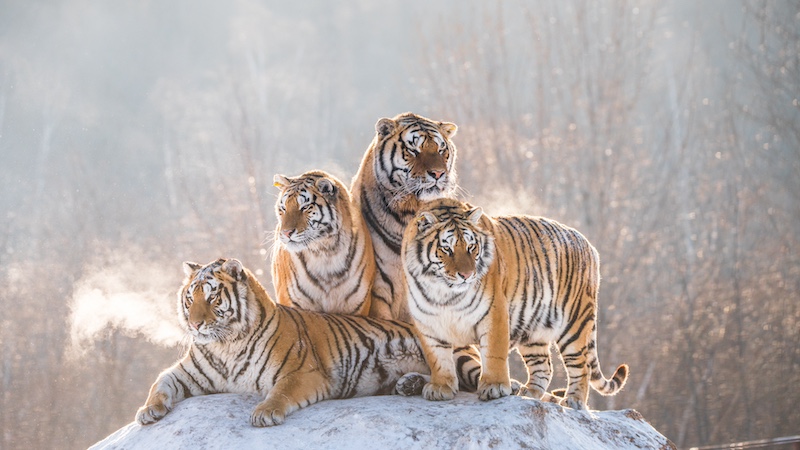
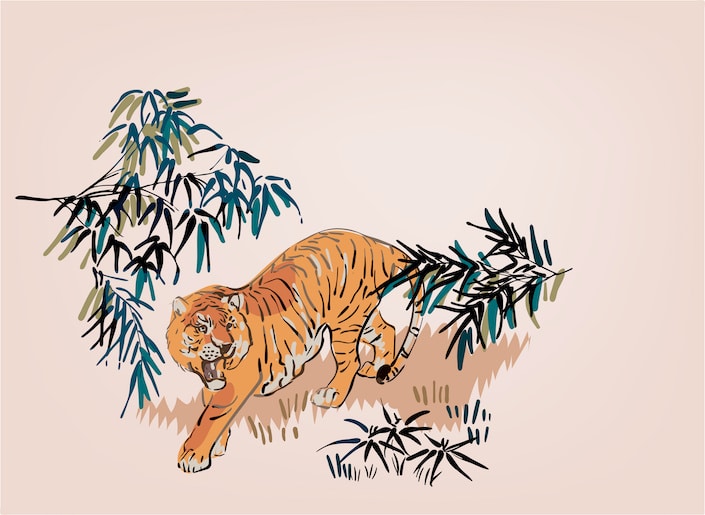
The storied position of tigers in Chinese culture is impossible to miss. From art and architecture to religious parables and bedtime stories, tigers command a position of prominence across Chinese history.
Daoist mythology and tigers
In traditional Daoist belief, tigers act as the avenging servants of justice. They stand in direct opposition to evil spirits and are seen as powerful representatives of divine providence.
Many Daoist tales feature a wicked villain being slain by a roaming tiger. Because of the tiger's association with apotropaic magic, the walls of Daoist temples are often decorated with their nimble forms.
One of the most sacred sites in Daoism is Dragon Tiger Mountain, known in Chinese as 龙虎山 (Lónghǔ Shān). Located in Jiangxi province, it is considered one of the birthplaces of Daoism.

Traditional Chinese medicine and tigers
Since ancient times, the tiger's body has been prized by certain practitioners of traditional Chinese medicine (TCM). Archaeological digs at hunter-gatherer sites show that tiger bones and body parts were already being collected more than 10,000 years ago.
Tiger claws were traditionally turned into amulets, believed to give the wearer the animal's invincible courage. Other body parts were used in remedies thought to work as painkillers or aphrodisiacs.
One unfortunate consequence of these beliefs is that wild tiger populations have collapsed, and extinction remains a real risk. The Chinese government has responded firmly in recent years, and poachers now face steep penalties, though illegal trade continues underground.

Study Chinese in Guilin or Start Online
CLI offers personalized Chinese instruction built around your goals. Join our Immersion Program in Guilin or begin from anywhere with a free Chinese lesson .
04 Tips for Tigers: luck, colors, and compatibility
Career
Tigers, much like their regal cousins the Chinese dragons, are magnetically drawn to leadership roles. Their quick thinking and boldness make them naturally suited to positions of power.
They crave attention and can easily command a room. CEOs, chief marketing officers, actors, comedians, managers, artists, and writers are all likely to have been born in the Year of the Tiger.
Queen Elizabeth II, actress and singer Marilyn Monroe, former Cuban leader Fidel Castro, and champion sprinter Usain Bolt were all born in Tiger years.
Lucky and unlucky numbers
Each sign of the Chinese zodiac is associated with certain lucky and unlucky numbers, and Tigers are no exception. In daily life, Tigers do well to keep an eye on which numbers show up.
Good luck is associated with the numbers 1, 3, and 4, and any combination of these numbers is considered especially auspicious, such as 41 or 31. The numbers 6, 7, and 8 are thought to bring bad luck, and combinations like 67, 78, or 87 are best avoided.
If you are gifting a Chinese hongbao during Chinese New Year, one of the many other Chinese holidays, or a friend's birthday, it's worth keeping these lucky and unlucky numbers in mind.
Lucky and unlucky colors
Tigers and those close to them do best when they welcome auspicious elements while steering clear of unlucky ones. One easy way to do this is by paying attention to color.
Lucky colors for Tigers include blue, gray, and orange. If you're a traditional Tiger, you might consider these tones for a bedroom, a bracelet, or even a laptop case.
This kind of color-based thinking is closely related to feng shui and other Chinese systems of symbolic balance. Tigers have only one unlucky color, brown, which is generally best avoided.
Love me, love me not: compatibility
Love, or 爱情 (àiqíng), is that most mysterious, rewarding, and dangerous of human journeys. Unsurprisingly, the Chinese zodiac has plenty to say about it.
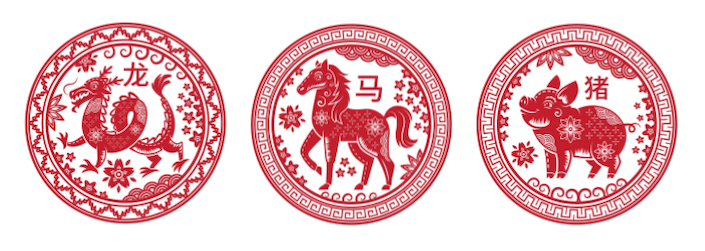
Relationships with those born in the Year of the Dragon, Horse, or Pig represent the Tiger's best bets for lifelong compatibility. Less harmonious pairings are said to include the Ox, a fellow Tiger, the Snake, or the Monkey.
05 Mandarin and the Year of the Tiger
One of the best ways to build a true understanding of the Chinese zodiac is to explore how it's woven into the Chinese language itself. If you want to go deeper, enrolling in online Chinese classes is one of the easiest ways to start.
At CLI, our Chinese language and culture experts can walk you through the nuances of the Year of the Tiger in more depth. You can also follow a structured Chinese study plan to build your vocabulary and cultural knowledge together.
If a fully immersive experience appeals to you, come join us in Guilin for hands-on cultural immersion in the country that gave rise to the Chinese zodiac system. If travel isn't an option right now, you can build the same skills through our online Chinese classes instead.

06 Year of the Tiger vocabulary
The following terms will help you talk about the Tiger, the zodiac, and related traditions in Mandarin.
| Chinese | Pinyin | Meaning | Notes |
|---|---|---|---|
| 生肖 | Chinese zodiac | The 12-animal cycle tied to birth year | |
| 虎 | Tiger | Third animal in the zodiac cycle | |
| 骑虎难下 | "Hard to get off a tiger" | Idiom for being unable to stop once committed | |
| 农历 | Lunisolar calendar | Basis for the Chinese zodiac cycle | |
| 玉皇 | Jade Emperor | Heavenly ruler in the Great Race legend | |
| 龙虎山 | Dragon Tiger Mountain | A sacred Daoist site in Jiangxi province | |
| 爱情 | Love; romance | Often discussed alongside zodiac compatibility |
07 FAQ
Which years are Tiger years?
Recent Tiger years include 1938, 1950, 1962, 1974, 1986, 1998, 2010, and 2022. The cycle repeats every 12 years.
What does the Tiger represent in the Chinese zodiac?
The Tiger represents boldness, confidence, and leadership. It is traditionally seen as a powerful but sometimes unpredictable sign.
Which zodiac signs are most compatible with the Tiger?
The Dragon, Horse, and Pig are traditionally considered the Tiger's best matches. The Ox, Snake, Monkey, and fellow Tigers are seen as less compatible.
What are lucky numbers and colors for Tigers?
Lucky numbers for Tigers are 1, 3, and 4, while 6, 7, and 8 are considered unlucky. Lucky colors include blue, gray, and orange, while brown is best avoided.
Why is the tiger important in Chinese mythology?
In Daoist belief, tigers act as protectors against evil spirits and symbols of divine justice. They also hold a long history in traditional Chinese medicine.
08 Final thoughts
The Year of the Tiger brings together mythology, medicine, language, and everyday superstition in a way few other zodiac signs can match. Understanding it opens a window into how Chinese culture blends ancient belief with modern life.
Whether you're a Tiger yourself or simply curious about the zodiac, these traditions offer a rich starting point for exploring Chinese language and culture more deeply.