


- The Flying Tigers (飞虎队, Fēihǔduì) began as the American Volunteer Group, a force of three squadrons of American pilots who flew for China under Claire Lee Chennault between December 1941 and July 1942.
- Guilin's Yangtang airfield became one of the most important American air bases in China — home to the 23rd Fighter Group, the unit that inherited the Flying Tigers name, from 1943 until the Japanese Ichigo offensive forced its evacuation in 1944.
- The Flying Tiger Heritage Park opened on the old airfield site in March 2015, built with the U.S.-based Flying Tiger Historical Organization and centered on Chennault's wartime command cave.
- For anyone hoping to learn Chinese in China, this history is a reminder that Guilin's story runs far deeper than its karst peaks — and that the two countries have a shared past worth understanding.
Many people don't realize that the U.S. and China were close allies during World War II — and that Guilin played a central role in military cooperation between the two countries.
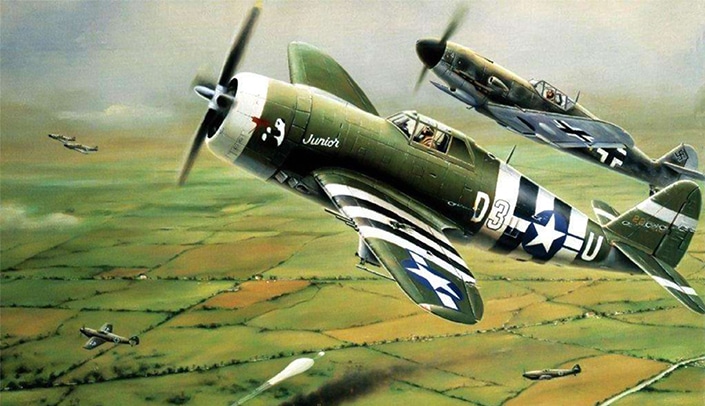
The "Flying Tigers" were a force of American volunteer pilots who fought for China in the opening months of the Pacific war. Officially, they were part of the Chinese Air Force, and their mission was to defend China against the Japanese.
Their story is woven into Guilin's own. The city's wartime airfield became a front-line American base, and today a heritage park on that same ground tells the story to visitors — including students who come to explore Guilin and stay for the history.
01 Who Were the Flying Tigers?
The unit's formal name was the American Volunteer Group, or AVG. It was assembled in 1941 by Claire Lee Chennault, a retired U.S. Army Air Corps officer who had been advising the Chinese government on air defense since 1937.
A Group, Not a Squadron
The AVG was not a single squadron but a group of three: the 1st "Adam & Eves," the 2nd "Panda Bears," and the 3rd "Hell's Angels." Together they numbered roughly 300 personnel, including fewer than a hundred pilots.
Because the United States was still officially neutral when the group was formed, its pilots resigned from the American armed forces and flew on contract. They were nominally part of the Chinese Air Force, paid around $600 a month with a $500 bounty for every Japanese aircraft destroyed.
The Shark's Mouth
The wide mouth full of sharp teeth painted onto the nose of the Flying Tiger planes (pictured above) is one of the most recognizable images of WWII. The design was not original to the group — AVG pilots copied it after seeing a photograph of a Curtiss P-40 flown by No. 112 Squadron RAF in North Africa.
The aircraft itself was the Curtiss P-40, in the export Tomahawk configuration originally built for a British order and diverted to China. It was outclassed in a turning fight by the Japanese fighters it faced, so Chennault trained his pilots to attack in diving hit-and-run passes instead.
The Combat Record
In under seven months of combat, the AVG was officially credited with destroying 296 Japanese aircraft over China and Burma. It lost around a dozen P-40s in air combat in return.
Later historians working from Japanese records have argued the real figure was lower, since more than one pilot could claim the same aircraft. Either way, the group's performance against a far larger opponent was extraordinary, and its propaganda value at a moment when Allied news was almost uniformly bad is hard to overstate.
In Chinese the Flying Tigers are 飞虎队 (Fēihǔduì) — literally "flying tiger team." Chennault himself is known as 陈纳德 (Chénnàdé), a transliteration you will still see on street signs, museum plaques, and memorial halls across southern China.
02 Guilin's Role in the Air War over China
Guilin — then usually written "Kweilin" in English — sat at a strategic crossroads in southern China. Its airfield at Yangtang, northwest of the city in what is now Lingui District, put American fighters within reach of Japanese shipping, railways, and airbases across the region.
The AVG's Final Weeks
The AVG spent most of its short life flying from Burma and from Kunming in Yunnan. It reached Guilin only in the summer of 1942, when Chennault pushed part of his force east to Kweilin and Hengyang.
Some of the group's last combats were fought in those skies, including a major interception over Guilin in June 1942. The AVG was disbanded on 4 July 1942, the same day its final mission was flown.
The 23rd Fighter Group Moves In
The name did not disappear with the unit. On the day the AVG stood down, the U.S. Army Air Forces activated the 23rd Fighter Group, which absorbed its aircraft, some of its pilots, and its nickname.
That successor unit — first under the China Air Task Force, then under Chennault's 14th Air Force — made Guilin its home station from September 1943 to September 1944. This is where Guilin's claim on the Flying Tigers story is strongest, and it is the period most of the physical remains at Yangtang belong to.
Supplied Over "The Hump"
Every gallon of fuel and every round of ammunition used at Guilin had to be flown in. After the Burma Road was cut in 1942, American aircraft supplied China over "the Hump," a punishing air route across the eastern Himalayas from India.
That logistical stranglehold shaped everything about the air war in China, including how often the Flying Tigers could fly. Understanding it explains why a few dozen fighters at a place like Guilin mattered so much.
The 1944 Evacuation
In 1944 the Japanese launched Operation Ichigo, a massive ground offensive aimed squarely at the American airbases in eastern China. The 23rd Fighter Group left Kweilin on 8 September 1944, and the Americans demolished their own facilities as they withdrew.
Chennault's command cave was destroyed that November, and Guilin fell soon afterward. The loss of the eastern airfields was among the worst reverses American air power suffered in the theater.
American airmen who were shot down over unoccupied China were very often sheltered, fed, and guided back to their units by Chinese villagers and soldiers who risked severe reprisals to do it. It is one of the least-known and most human threads in the whole Flying Tigers story, and it sits at the heart of why the two countries still commemorate this period together.
03 The Flying Tiger Heritage Park
In March 2015, the Flying Tiger Heritage Park was opened in Guilin in conjunction with the U.S.-based Flying Tiger Historical Organization. The park is built on the original Flying Tigers airfield and includes a museum, aircraft shelters, and hundreds of historical items.
The project had been eight years in the making, driven and funded largely by the American organization from 2007 onward. More than 600 artifacts were donated for the opening, with further relics contributed by local governments and by villagers living around the old airfield.
Chennault's Command Cave
The park's centerpiece is the hillside cave that served as the 14th Air Force command post at Yangtang. Blasted into the karst rock the region is famous for, it is a reminder that Guilin's geology was a military asset as well as a scenic one.
Alongside it stand restored aircraft shelters, a memorial hall, and a monument to the airmen of both countries. A C-47 transport aircraft was installed on the park's second anniversary in March 2017.
What the Park Commemorates
Speaking at the opening in March 2015, then-U.S. Consul General in Guangzhou Jennifer Zimdahl Galt captured the importance of the park and the significance of the historical era it recognizes. As reported by Xinhua at the time, she said:
As we honor their memory, let us look to the Flying Tigers for inspiration, as a shining example of the great things that can be accomplished when Americans and Chinese join together in a spirit of mutual friendship and support.
Jennifer Zimdahl Galt, U.S. Consul General in Guangzhou, 2012–2015
The park is in Lingui District, roughly 13 kilometers from central Guilin, and admission has generally been free. Hours and access arrangements have changed more than once since it opened, so confirm current details locally before making the trip — and pair it with the other Guilin sights nearby, such as Seven Star Park.
04 Why This History Still Matters
For students of Chinese, the Flying Tigers are a useful corrective. The relationship between the two countries has a longer and more complicated past than the last few decades of headlines suggest.
This period is also one of the few pieces of modern history that is remembered warmly on both sides of the Pacific. Chinese museums, textbooks, and television documentaries treat the 飞虎队 as heroes, and the memory is still actively maintained in cities like Guilin.
Guilin itself rewards this kind of curiosity. The city has been fought over, written about, and painted for more than two thousand years, and the history of Guilin stretches from Qin-dynasty canal builders to a wartime airfield in the space of a single afternoon's reading.
If you want to go further, our Chinese history hub covers the dynasties and turning points that shaped the country long before any of this. Studying the language alongside the history is what turns a set of dates into something you can actually feel.

Study Chinese in Guilin or Start Online
CLI offers personalized Chinese instruction built around your goals. Join our Immersion Program in Guilin or begin from anywhere with a free Chinese lesson .
05 Flying Tigers Vocabulary
The words below will help you read a museum plaque in Guilin, follow a Chinese documentary about the war, or simply talk about this history with a teacher. Most are worth knowing well beyond this one subject, so they make a good addition to your list of essential Chinese words.
| Chinese | Pinyin | Translation |
|---|---|---|
| 飞虎队 | the Flying Tigers | |
| 陈纳德 | Claire Lee Chennault | |
| 桂林 | Guilin | |
| 临桂区 | Lingui District, Guilin | |
| 秧塘机场 | Yangtang airfield | |
| 遗址公园 | heritage park | |
| 纪念馆 | memorial hall / museum | |
| 纪念碑 | monument | |
| 抗日战争 | War of Resistance against Japan | |
| 第二次世界大战 | World War II | |
| 空军 | air force | |
| 战斗机 | fighter aircraft | |
| 飞行员 | pilot | |
| 志愿者 | volunteer | |
| 驼峰航线 | "the Hump" air route | |
| 防空洞 | air-raid shelter | |
| 指挥所 | command post | |
| 山洞 | cave | |
| 老兵 | veteran | |
| 英雄 | hero | |
| 友谊 | friendship | |
| 合作 | cooperation | |
| 和平 | peace | |
| 历史 | history | |
| 免费 | free of charge | |
| 鲨鱼 | shark |
06 See It for Yourself
Guilin is famous for its rivers and limestone peaks, and most visitors never learn that American fighter pilots once flew out of the fields on the city's western edge. The Flying Tiger Heritage Park is an easy half-day trip that adds a completely different layer to the place.
If this period interests you, Guilin makes an unusually good base for exploring it — and there are plenty of other reasons to study here besides. Studying Mandarin in the city where the history happened is a very different experience from reading about it at home.