


- 王城 (Wáng Chéng), the "Princes' City," is a walled Ming Dynasty palace compound in the center of Guilin, built for the Jingjiang line of princes beginning in 1372.
- Construction started decades before work began on Beijing's Forbidden City, and the compound is often described as the best-preserved princely palace site in China.
- After the palace burned in the seventeenth century, the Qing government built Guangxi's provincial examination hall on the ruins — and since 1954 the site has been a campus of Guangxi Normal University.
- Solitary Beauty Peak rises straight out of the grounds, and the 306 steps to its summit lead to one of the best views in Guilin.
Guilin is steeped in thousands of years of rich Chinese history and tradition. One of the best known historical sites in the city is 王城 (Wáng Chéng), the "Princes' City," which served as an official estate for many Ming Dynasty rulers and their families.
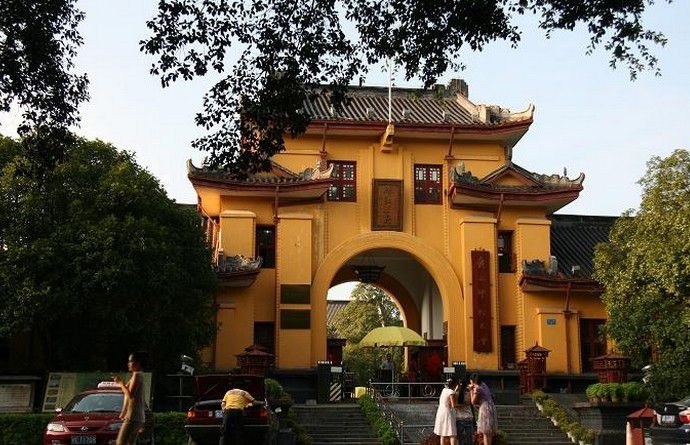
Visitors are often surprised to learn that Guilin's Princes' City was built decades before the Forbidden City in Beijing. Work on the Guilin compound began in 1372, while construction of the palace complex in Beijing did not start until 1406.
Although much of the estate has been restored over the last 600 years, many of the stone steps and railings and many portions of the ancient wall surrounding the estate date back to the original 14th century construction. Today, the site continues to provide a unique window into Ming and Qing-era design and architecture.
It is also one of the easiest historical sites in the city to fit into a trip, sitting right in the downtown core rather than out in the countryside. For visitors who want the wider story, our guide to the history of Guilin covers how the city grew up around these karst peaks.
01 A Ming Dynasty Palace in the Heart of Guilin
The compound's full Chinese name is 靖江王府 (Jìngjiāng Wángfǔ), the Jingjiang Princes' Palace. It was built for Zhu Shouqian, a great-nephew of Zhu Yuanzhang, the founding emperor of the Ming Dynasty.
Building the Estate
Construction began in 1372 and took roughly two decades to complete, finishing around 1392. Fourteen Jingjiang princes went on to live here across the remainder of the Ming Dynasty.
The walled enclosure covers about 20 hectares, measuring roughly 550 meters north to south and 335 meters east to west. Its wall stands close to eight meters high, which is why so much of it has survived where the timber halls inside did not.
Ming and Qing Architecture on Display
The layout follows the standard imperial pattern of the period: a central north–south axis, symmetrical courtyards, and ceremonial halls stepping up toward the mountain at the rear. Red walls and yellow-glazed roof tiles mark it out as a princely residence rather than an ordinary official compound.
That combination of Ming foundations and later Qing rebuilding is what makes the site unusual. Much of what stands today is reconstruction, but it sits on original stonework, and the two periods are visible side by side.
You will see the site advertised under several names, which can be confusing when you are buying tickets or searching maps. 王城 (Wángchéng, "Princes' City"), 靖江王府 (Jìngjiāng Wángfǔ, "Jingjiang Princes' Palace"), and 独秀峰王城景区 (Dúxiùfēng Wángchéng Jǐngqū, "Solitary Beauty Peak and Princes' City Scenic Area") all refer to the same place.
02 From Royal Palace to Examination Hall
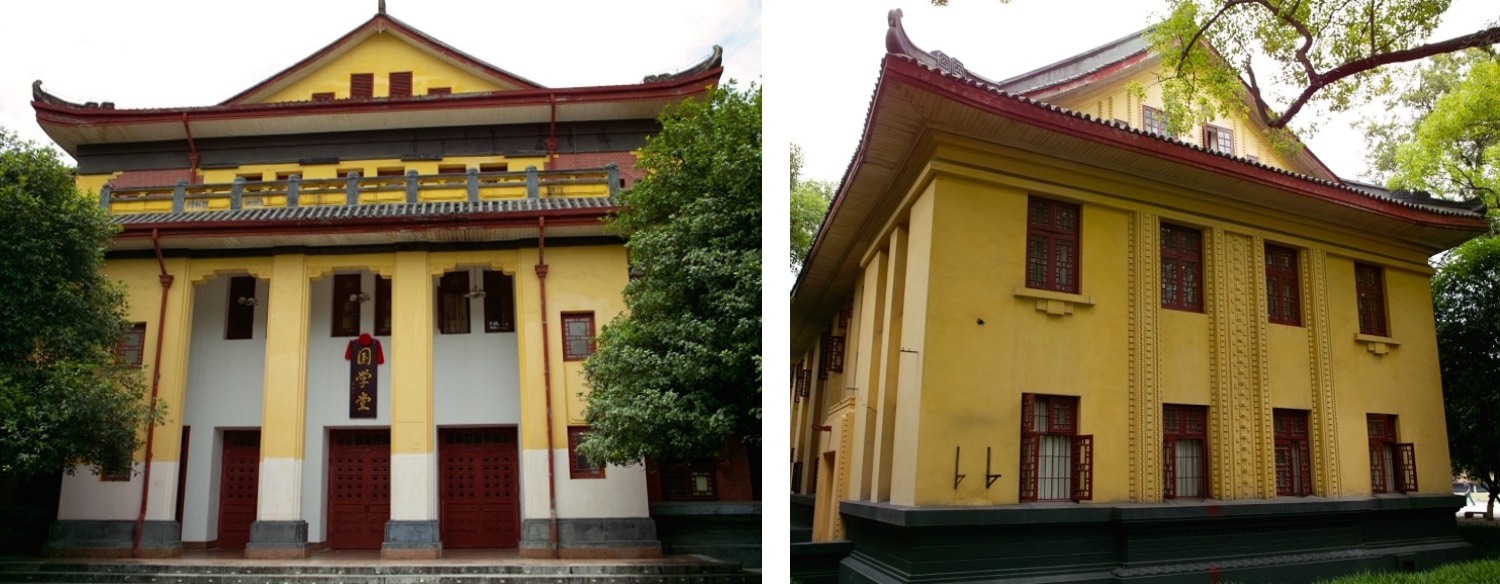
The palace did not survive the fall of the Ming Dynasty intact. In 1652, when Southern Ming forces retook Guilin, the Qing commander stationed in the compound set fire to it and died in the blaze, leaving most of the buildings in ruins.
The Guangxi Provincial Examination Hall
During the Qing Dynasty, the Princes' City was converted into an imperial examination site. In 1657, under the Shunzhi emperor, the provincial examination hall for Guangxi (广西贡院, Guǎngxī Gòngyuàn) was built on the palace ruins.
It went on to serve as the region's main examination venue for roughly 250 years, until the imperial examination system was abolished in 1905. Local records credit the hall with producing four top-ranked 状元 (zhuàngyuán), 585 进士 (jìnshì), and more than 1,600 举人 (jǔrén).
A University Campus
The site was later used as a campus by Guangxi Normal University, which has occupied it since a 1954 site exchange with a military school. It remains the university's Wangcheng campus today, so the grounds double as a working campus and a tourist attraction.
The site is now a fully protected cultural heritage area open to the public, listed among China's major historical and cultural sites protected at the national level in 1996. It is also rated a national 5A scenic area, the highest tier in China's tourism classification system.
03 Solitary Beauty Peak (独秀峰, Dúxiù Fēng)
A karst mountain located within the property known as Solitary Beauty Peak provides an incredible view of the entire city of Guilin and attracts tourists from around the world.
Climbing the Peak
The peak rises about 66 meters above the palace grounds and 216 meters above sea level. A stone staircase of 306 steps runs up its flank to a small pavilion at the summit.
The climb is short but steep, and the reward is a full panorama of downtown Guilin ringed by the karst hills that made the region famous. On a clear day you can trace the Li River as it curves through the city.
Stone Inscriptions and a Famous Line
The base of the peak carries more than 130 carved inscriptions left by officials, poets, and scholars over the centuries. For anyone with an interest in Chinese calligraphy, the cliff face is effectively an open-air gallery spanning a thousand years of writing styles.
The most famous of them is the line 桂林山水甲天下 (Guìlín shānshuǐ jiǎ tiānxià) — "Guilin's scenery is the finest under heaven." It comes from a poem written by the Southern Song official Wang Zhenggong at a banquet for successful examination candidates, and it has been Guilin's unofficial slogan ever since.
04 Visiting the Princes' City
The Princes' City is in the heart of downtown Guilin, a few minutes' walk from Zhengyang Pedestrian Street. That central location makes it easy to pair with a walk along the city's lakes or a stop at one of the nearby karst landmarks.
Most visitors need one to two hours for the grounds, plus another half hour if they climb the peak. If you have more time in the city, Elephant Trunk Hill is a natural second stop for a different kind of karst formation.
Tickets are sold for the combined Solitary Beauty Peak and Princes' City scenic area, and prices and opening hours shift with the season, so check the current details before you go. Because the site is also an active university campus, bring your passport in case ID is requested at the gate, and expect the grounds to be busier during Chinese public holidays.
Walking the grounds is also a reminder of how much more a site like this gives up when you can read what is carved on it. Learn Chinese in China and inscriptions, plaques, and ticket-office signs stop being decoration and start being information.

Study Chinese in Guilin or Start Online
CLI offers personalized Chinese instruction built around your goals. Join our Immersion Program in Guilin or begin from anywhere with a free Chinese lesson .
05 Useful Princes' City Vocabulary
The vocabulary below covers the names, signage, and historical terms you are most likely to encounter at the site.
| Chinese | Pinyin | Translation |
|---|---|---|
| 王城 | Princes' City | |
| 靖江王府 | Jingjiang Princes' Palace | |
| 独秀峰 | Solitary Beauty Peak | |
| 桂林 | Guilin (city name) | |
| 明朝 | Ming Dynasty | |
| 清朝 | Qing Dynasty | |
| 王爷 | prince (title of address) | |
| 城墙 | city wall | |
| 科举 | imperial examination system | |
| 贡院 | provincial examination hall | |
| 状元 | top-ranked examination candidate | |
| 进士 | successful candidate in the palace examination | |
| 举人 | successful candidate in the provincial examination | |
| 石刻 | stone inscription / carving | |
| 书法 | calligraphy | |
| 文物 | cultural relic / historical artifact | |
| 景区 | scenic area | |
| 门票 | entrance ticket | |
| 广西师范大学 | Guangxi Normal University | |
| 桂林山水甲天下 | "Guilin's scenery is the finest under heaven" |
06 Plan Your Visit
Few places in China let you stand inside a Ming palace, a Qing examination hall, and a modern university at the same time. That layering is what makes the Princes' City worth an afternoon, even for travelers who came to Guilin for the scenery rather than the history.
If the site leaves you wanting more of the same, the imperial capital at Xi'an is the natural next step, and Seven Star Park offers another Guilin site where inscribed cliffs and karst peaks sit side by side.