

- Direct equivalents of English names are not commonly used in China — Chinese transliterations are the standard way to introduce yourself.
- Chinese transliterations of English names are based on phonetic approximation using pinyin, and often look similar to their English counterparts when romanized.
- The characters chosen for transliterations follow cultural naming conventions, including auspicious meanings and gender-based associations.
- Long-term learners and expats are encouraged to adopt a culturally appropriate Chinese name with guidance from a teacher.
- Knowing how to say your name in Chinese is an essential first step before traveling or studying abroad in China.
When traveling about in China, you'll need to introduce yourself to those you meet along the way. The vast differences between Chinese and English mean it's important to know the Chinese equivalent of your English name. Whether you're heading to Shanghai for a short trip or planning to Learn Chinese in China for a full semester, knowing how to say your name in Chinese will make a strong first impression. Read on to discover how to find and use the Chinese version of your name.

01 English versus Chinese names
Many long-term expats and Mandarin language students will tell you that the most enriching aspect of their experience in China was meeting new people and making friends with locals.
Knowing how to introduce yourself when you first start meeting new people in China can be tough, though, since direct equivalents of English names are not used in China (except perhaps in English class).
While many young people in big Chinese cities like Shanghai and Beijing speak English and are familiar with the English pronunciation of most common English names, older people and people living in smaller cities like Guilin may struggle to recognize, remember and pronounce them.

02 Chinese names
Generally, choosing a culturally appropriate Chinese moniker for yourself is highly recommended.
The logic behind names in China is quite different from the logic behind names in the West, however. Therefore, deciding what to call yourself in China can be somewhat complicated and generally requires assistance from a Chinese language teacher.
Many foreigners who have spent many years interacting with China and learning Chinese have chosen special "Chinese names."
These unique appellations are usually chosen based on the sounds and meanings of the Chinese characters that they include, instead of being direct transliterations of their English equivalents.
Good examples of foreigners who have chosen authentic Chinese names for themselves include sinologist Jonathan Spence, who goes by 史景迁 (Shǐ Jǐngqiān), and writer Peter Hessler, who is known as 何伟 (Hé Wěi) in China.
If for some reason you don't have time to consult a Chinese teacher when choosing a Chinese moniker for yourself, it's still useful to know what the accepted Chinese equivalent of your English name is so you can use it to introduce yourself to your new friends in China. If you're preparing for a trip, it's also worth reviewing some essential Chinese travel phrases alongside your name — a little preparation goes a long way.
03 Chinese transliterations of English names
Westerners have been interacting with China for hundreds of years, so even though English names aren't used in China, generally accepted equivalents for many of them do exist. In almost every case, these names are actually transliterations of the English versions.
Although the Chinese equivalents of common English names may look completely unrecognizable when written in Chinese characters, many of them look quite similar to their English counterparts when written in pinyin.
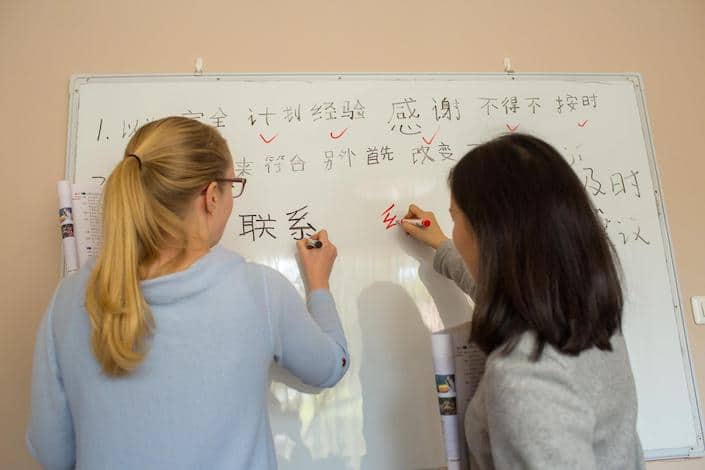
For example, the Chinese characters for Natalie are 娜塔莉, but the pinyin is written as Nàtǎlì. Likewise, Anna is written as 安娜 using Chinese characters, but its pinyin equivalent, Ānnà, is almost identical to the English version (aside from the tone marks).
Transliterated English names may sound a bit odd to the untrained ear due to the fact that phonetically translating each syllable using Chinese characters means that the Chinese versions must be pronounced using Chinese tones. However, with practice, you'll soon learn to recognize the similarities between the Chinese versions and the English originals.
04 Choosing appropriate Chinese characters
Another interesting aspect of Chinese transliterations of English names is the fact that the transliterations often follow some of the same rules that Chinese parents take into consideration when naming their children.

Auspicious meanings
Chinese parents usually try to choose names that feature Chinese characters with auspicious meanings. In a similar vein, many of the characters used in Chinese transliterations of English names also have positive or auspicious meanings.
For example, the character 德 (dé), which means "virtue," is contained in the Chinese transliterations of frequently used English monikers like Richard (理查德 Lǐchádé) and Harold (哈罗德 Hāluōdé).
Likewise, the character 安 (ān), which means "peace," is included in the transliteration of Anthony (安东尼 Āndōngní) and Ryan (赖安 Laì'ān).
Other characters with positive connotations, such as 杰 (jié, outstanding person, hero) and 特 (tè, exceptional) can be found in multiple different Chinese transliterations of English names. Understanding these principles connects naturally with broader topics like Chinese numerology, where symbolic meaning plays a similarly important role in everyday life.
Gender-based naming conventions
When choosing names for girls, Chinese parents frequently choose characters with connotations that are traditionally thought of as being "feminine."
This habit has also carried over into the choice of characters used in Chinese transliterations of traditionally female English names. For example, both Patricia (帕特丽夏 Pàtèlìxià) and Elizabeth (伊丽莎白 Yīlìshābái), contain the character 丽 (lì), which means beautiful or pretty.


Study Chinese in Guilin or Start Online
CLI offers personalized Chinese instruction built around your goals. Join our Immersion Program in Guilin or begin from anywhere with a free Chinese lesson .
05 What about surnames?
In general, Chinese surnames are only one character long. Most foreign surnames, however, often consist of at least two syllables. Thus, when transliterating foreign surnames directly into Chinese, it is often not possible to use a common Chinese surname as a substitute. Rather, it is most common to simply transcribe English surnames phonetically using pinyin.
Chinese surnames generally come first, before given names, in contrast to English surnames, which come last. Traditionally, when full English names that include both the first name and the surname are rendered in Chinese, the English word order is usually retained.
To show where the given name ends and the surname begins, a dot symbol is often used. For example, basketball star Kobe Bryant is generally referred to as 科比·布莱恩特 (Kēbǐ·Bùlái'ēntè) in China.

06 Chinese translations of common English names for women
The names listed below were the most common names for women in the United States between 1920–2019, according to the Social Security Administration.
| English Name | Chinese Equivalent | Pinyin |
|---|---|---|
| Abigail | 亚比该 | |
| Alexis | 阿列克西斯 | |
| Alice | 爱丽丝 | |
| Amanda | 阿曼达 | |
| Amber | 安柏 | |
| Amy | 艾米 | |
| Andrea | 安德烈娅 | |
| Angela | 安格拉 | |
| Ann | 安 | |
| Anna | 安娜 | |
| Ashley | 阿什利 | |
| Barbara | 芭芭拉 | |
| Betty | 贝蒂 | |
| Beverly | 比佛利 | |
| Brenda | 布兰达 | |
| Brittany | 布莱特妮 | |
| Carol | 卡罗尔 | |
| Carolyn | 卡罗琳 | |
| Catherine | 凯瑟琳 | |
| Charlotte | 夏洛特 | |
| Cheryl | 谢丽尔 | |
| Christina | 克里斯蒂娜 | |
| Christine | 克丽丝汀 | |
| Cynthia | 辛西雅 | |
| Danielle | 丹妮尔 | |
| Deborah | 底波拉 | |
| Debra | 黛博拉 | |
| Denise | 丹妮丝 | |
| Diana | 戴安娜 | |
| Diane | 黛安 | |
| Donna | 唐娜 | |
| Doris | 多丽丝 | |
| Dorothy | 多萝西 | |
| Elizabeth | 伊丽莎白 | |
| Emily | 埃米莉 | |
| Emma | 爱玛 | |
| Evelyn | 伊芙琳 | |
| Frances | 弗兰西丝 | |
| Gloria | 格洛丽亚 | |
| Grace | 格蕾丝 | |
| Hannah | 汉娜 | |
| Heather | 海瑟 | |
| Helen | 海伦 | |
| Isabella | 伊莎贝拉 | |
| Jacqueline | 杰奎琳 | |
| Janet | 珍妮特 | |
| Janice | 珍妮丝 | |
| Jean | 珍 | |
| Jennifer | 珍妮佛 | |
| Jessica | 杰西卡 | |
| Joan | 琼 | |
| Joyce | 乔伊斯 | |
| Judith | 朱迪思 | |
| Judy | 朱迪 | |
| Julia | 朱莉亚 | |
| Julie | 朱丽 | |
| Karen | 凯伦 | |
| Katherine | 凯萨琳 | |
| Kathleen | 凯瑟琳 | |
| Kathryn | 凯瑟琳 | |
| Kayla | 凯拉 | |
| Kelly | 凯利 | |
| Kimberly | 金伯利 | |
| Laura | 劳拉 | |
| Lauren | 劳伦 | |
| Linda | 琳达 | |
| Lisa | 丽莎 | |
| Madison | 麦迪逊 | |
| Margaret | 玛格丽特 | |
| Maria | 玛丽亚 | |
| Marie | 玛丽 | |
| Marilyn | 玛丽莲 | |
| Martha | 玛莎 | |
| Mary | 玛丽 | |
| Megan | 梅根 | |
| Melissa | 梅丽莎 | |
| Michelle | 米歇尔 | |
| Nancy | 南希 | |
| Natalie | 娜塔莉 | |
| Nicole | 妮可 | |
| Olivia | 奥利维亚 | |
| Pamela | 帕米拉 | |
| Patricia | 帕特丽夏 | |
| Rachel | 雷切尔 | |
| Rebecca | 利百加 | |
| Rose | 萝丝 | |
| Ruth | 路得 | |
| Samantha | 萨曼莎 | |
| Sandra | 桑德拉 | |
| Sara | 莎拉 | |
| Sarah | 莎拉 | |
| Sharon | 雪伦 | |
| Shirley | 雪莉 | |
| Sophia | 索菲亚 | |
| Stephanie | 丝黛芬妮 | |
| Susan | 苏珊 | |
| Teresa | 特里萨 | |
| Theresa | 特里萨 | |
| Victoria | 维多利亚 | |
| Virginia | 弗吉尼亚 |
07 Chinese translations of common English names for men
According to the Social Security Administration, the names below were the most common names for U.S. men between 1920–2019.
| English Name | Chinese Equivalent | Pinyin |
|---|---|---|
| Aaron | 亚伦 | |
| Adam | 亚当 | |
| Alan | 艾伦 | |
| Albert | 阿尔伯特 | |
| Alexander | 亚力山大 | |
| Andrew | 安德鲁 | |
| Anthony | 安东尼 | |
| Arthur | 亚瑟 | |
| Austin | 奥斯汀 | |
| Benjamin | 本杰明 | |
| Billy | 比利 | |
| Bobby | 巴比 | |
| Bradley | 布莱德利 | |
| Brandon | 布兰登 | |
| Brian | 布莱恩 | |
| Bruce | 布鲁斯 | |
| Bryan | 布赖恩 | |
| Carl | 卡尔 | |
| Charles | 查尔斯 | |
| Christian | 克里斯蒂安 | |
| Christopher | 克里斯托弗 | |
| Daniel | 丹尼尔 | |
| David | 大卫 | |
| Dennis | 丹尼斯 | |
| Donald | 唐纳德 | |
| Douglas | 道格拉斯 | |
| Dylan | 迪伦 | |
| Edward | 爱德华 | |
| Eric | 埃里克 | |
| Ethan | 伊桑 | |
| Eugene | 尤金 | |
| Frank | 弗兰克 | |
| Gabriel | 加百列 | |
| Gary | 加里 | |
| George | 乔治 | |
| Gerald | 杰拉尔德 | |
| Gregory | 格里高利 | |
| Harold | 哈罗德 | |
| Henry | 亨利 | |
| Jack | 杰克 | |
| Jacob | 雅各 | |
| James | 詹姆斯 | |
| Jason | 杰森 | |
| Jeffrey | 杰弗里 | |
| Jeremy | 杰里米 | |
| Jerry | 杰瑞 | |
| Jesse | 杰西 | |
| Joe | 乔 | |
| John | 约翰 | |
| Johnny | 强尼 | |
| Jonathan | 乔纳森 | |
| Jordan | 约旦 | |
| Jose | 霍赛 | |
| Joseph | 约瑟夫 | |
| Joshua | 约书亚 | |
| Juan | 胡安 | |
| Justin | 贾斯汀 | |
| Keith | 基思 | |
| Kenneth | 肯尼思 | |
| Kevin | 克文 | |
| Kyle | 凯尔 | |
| Larry | 拉里 | |
| Lawrence | 劳伦斯 | |
| Logan | 罗根 | |
| Louis | 路易斯 | |
| Mark | 马克 | |
| Matthew | 马太 | |
| Michael | 迈克尔 | |
| Nathan | 內森 | |
| Nicholas | 尼古拉斯 | |
| Noah | 诺亚 | |
| Patrick | 帕特里克 | |
| Paul | 保罗 | |
| Peter | 彼得 | |
| Philip | 斐理伯 | |
| Ralph | 拉尔夫 | |
| Randy | 兰迪 | |
| Raymond | 雷蒙德 | |
| Richard | 理查德 | |
| Robert | 罗伯特 | |
| Roger | 罗杰 | |
| Ronald | 罗纳德 | |
| Roy | 罗伊 | |
| Russell | 罗素 | |
| Ryan | 赖安 | |
| Samuel | 塞缪尔 | |
| Scott | 斯考特 | |
| Sean | 肖恩 | |
| Stephen | 斯蒂芬 | |
| Steven | 史蒂文 | |
| Terry | 特利 | |
| Thomas | 托马斯 | |
| Timothy | 提摩太 | |
| Tyler | 泰勒 | |
| Vincent | 文森特 | |
| Walter | 瓦尔特 | |
| Wayne | 韦恩 | |
| William | 威廉 | |
| Willie | 威利 | |
| Zachary | 匝加利 |
08 What's in a name?
Although Chinese equivalents of English names are not commonly used in China and it's always better to choose a more authentic Chinese moniker, there are times when knowing some of the most common Chinese transliterations can be useful.
Examining the strategies used to produce these transliterations also provides fascinating insights into Chinese culture. If you find yourself curious about the deeper layers of the language — from character etymology to cultural symbolism — there's always more to explore. You might also find it helpful to review common Chinese greetings so that once you introduce your name, you can keep the conversation going naturally.

09 FAQ
Do Chinese people use English names?
Direct English names are not commonly used in China outside of English class settings. Chinese transliterations are the standard way foreigners introduce themselves, particularly in smaller cities or when speaking with older generations.
How are English names transliterated into Chinese?
English names are transliterated phonetically into Chinese using characters that approximate the sound of each syllable. The characters selected are usually chosen with auspicious meanings and gender-appropriate connotations in mind.
Should I choose a proper Chinese name instead of a transliteration?
Yes, if you plan to spend significant time in China or are serious about learning Chinese, it's recommended to work with a native speaker or Chinese teacher to choose a name that sounds natural and carries meaningful characters — rather than relying solely on a transliteration.
How do Chinese surnames work for foreigners?
Because most foreign surnames are multi-syllabic, they are usually transcribed phonetically into Chinese rather than replaced with a common Chinese family name. When written in full, English name word order (given name first) is typically retained.
Where can I learn more basic Chinese for travel?
A great place to start is our guide to basic Chinese words and phrases, which covers everyday vocabulary you'll need on the ground in China.