

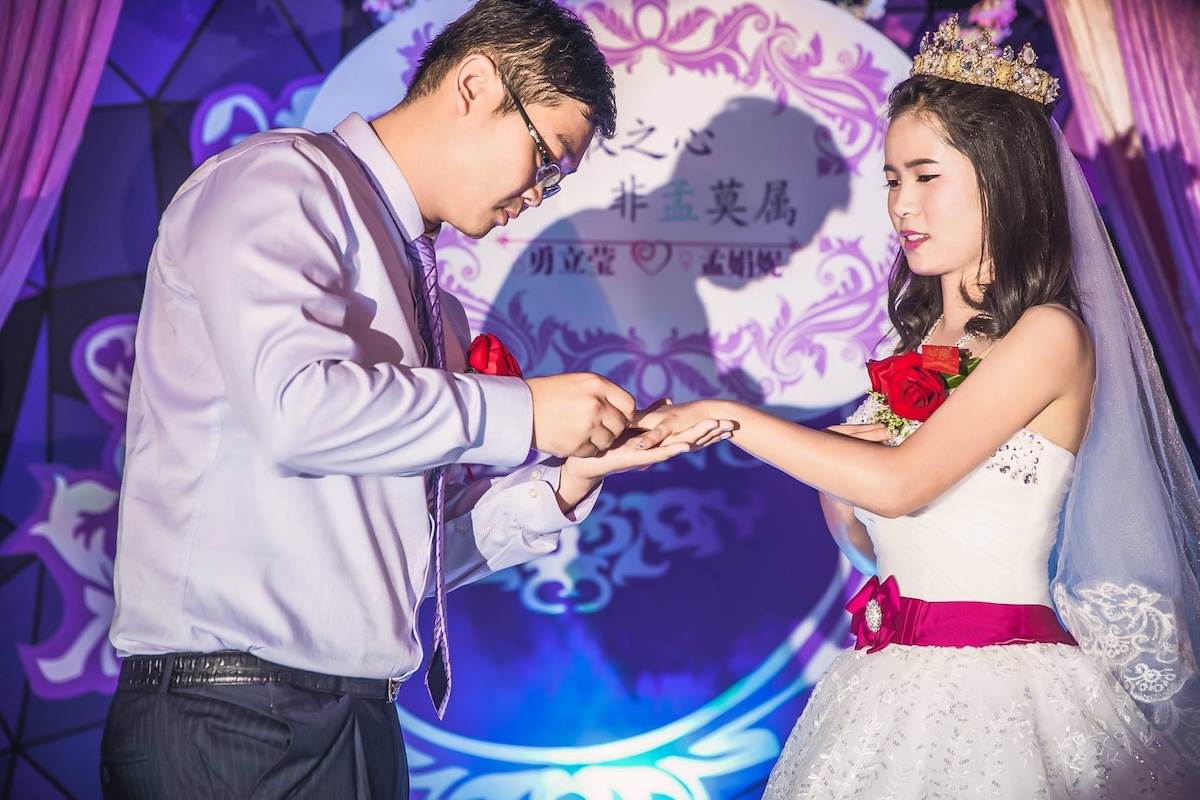
- Dating in China (恋爱, ) is rarely separated from marriage — relationships are widely understood as a pathway toward long-term commitment, shaped by family expectations and social pressures.
- Arranged blind dates (相亲, ) and parental involvement remain influential, reflecting a culture where marriage is often viewed as a union between two families rather than just two individuals.
- China's One-Child Policy created lasting effects: a skewed gender ratio, intensified parental investment in children's marital prospects, and the emergence of public marriage markets.
- Modern challenges — including "996" work culture, rising bride prices (彩礼, ), and dating scams — are driving declining marriage rates and delayed commitment among young adults.
- Despite these shifts, traditional customs haven't disappeared. They've adapted, creating a hybrid dating culture where personal desires must still be balanced against family expectations.
Dating in China (恋爱, ) is rarely separated from marriage (婚姻, ). While modern relationships emphasize emotional connection and personal choice, dating is often understood as a pathway toward long-term commitment, shaped by family expectations and social pressures.
This guide examines how historical tradition, government policy, and modern social change have shaped the way romantic relationships form in China.
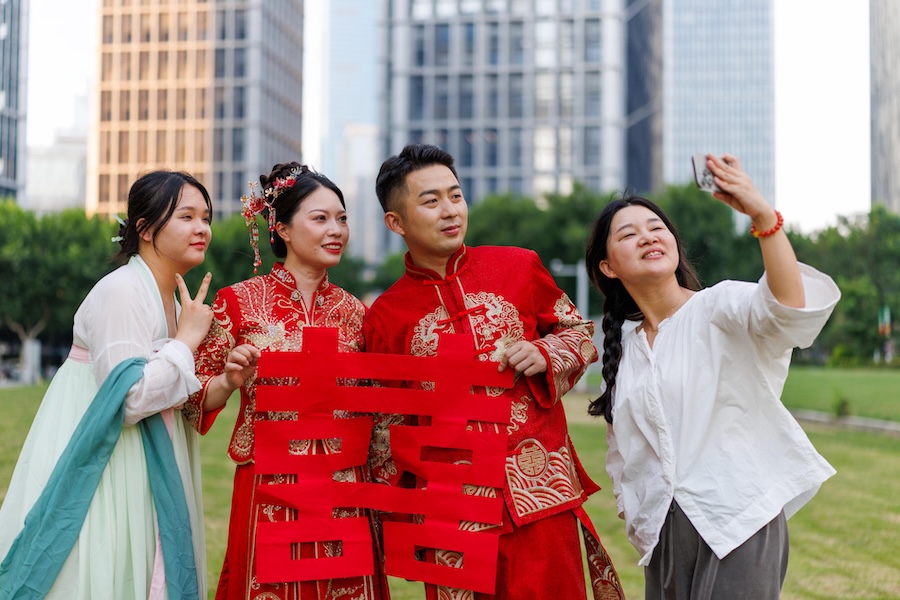
01 Dating and Marriage in Traditional China
For much of Chinese history, dating as a concept did not exist in the modern sense. Like many traditional societies, relationships were not formed through courtship but through marriage arrangements made by families.
Marriage (婚姻, ) functioned primarily as a social and economic contract rather than a romantic choice between individuals, and unions were typically organized by parents or matchmakers (红娘, ) based on family status, financial compatibility, and lineage continuity.
A well-known saying from this period captures this mindset: "Marry a chicken, follow a chicken; marry a dog, follow a dog" (嫁鸡随鸡,嫁狗随狗, ). The phrase reflects the expectation that a woman should fully adapt to the family she married into, regardless of circumstances, emphasizing duty over personal choice or emotional fulfillment.
This began to change in the early 20th century with the New Culture Movement and was later reinforced by the 1950 Marriage Law, which banned arranged marriages and established the right to choose one's partner. However, legal reform did not erase social norms. While most people today select their own partners, parental approval (父母认可, ) and family negotiation remain influential.
Globalization has further reshaped dating attitudes by introducing ideas of romantic love, emotional compatibility, and individual choice (个人主义, ). Rather than replacing tradition (传统习俗, ), these values coexist with it, creating a hybrid dating culture where personal desires must still be balanced against family expectations.
The Impact of China's One-Child Policy on Dating
Implemented in 1979 and in effect until 2015, China's One-Child Policy profoundly reshaped family structure and continues to influence dating and marriage today. Multiple generations grew up as only children, carrying intense parental attention and heightened expectations around success, marriage, and family responsibility.
Another major consequence of this policy was a skewed gender ratio. Cultural preference for sons, combined with sex-selective practices, resulted in significantly more men than women. This imbalance has intensified competition among men and raised expectations in dating when it comes to a man's income and long-term stability.
With only one child to carry on the family line, families became deeply invested in their child's marital prospects. This has contributed to sustained parental involvement in partner selection and the emergence of marriage markets (相亲市场, ), where parents publicly promote their children's credentials.
02 Understanding Modern Chinese Dating Culture
In China, universities, workplaces, and social events are common ways to meet partners, but traditional matchmaking channels remain influential. Introductions through friends and family are widely trusted, reflecting China's "acquaintance society" where social credibility matters.
These introductions often follow the principle of 门当户对 (), which literally means "matching doors and equal households." The phrase refers to families of comparable social status, education, and economic background, reflecting the belief that relationships are more stable when both sides are evenly matched.
Blind Dates and Parental Involvement (相亲)
相亲 () usually involves advance screening of practical factors such as education, income, family background, and hukou status before the couple meets. This family-led filtering is often seen as efficient, especially for busy urban professionals with limited social circles. Unlike casual Western blind dates, 相亲 is explicitly marriage-oriented from the outset.
Meetings usually take place in public settings like cafés or restaurants, and parents may be present. The tone is pragmatic rather than romantic, with both sides evaluating not only personal chemistry but also family expectations and long-term stability.
Parents often remain involved beyond the introduction itself, arranging further meetings or contributing financially to housing and wedding costs. This means relationships that lack family approval frequently face sustained pressure. More broadly, 相亲 reflects how marriage in China is often viewed as a union between two families rather than just two individuals.
Chinese society places strong importance on marriage, reinforcing a powerful social clock. Labels such as "leftover women" (剩女, ) and "leftover men" (剩男, ) stigmatize unmarried adults in their late twenties, particularly women. Pressure comes from parents anxious about grandchildren, peers reaching marriage milestones, and concerns around aging and fertility. While some marry early to relieve this pressure, others increasingly resist these timelines and prioritize personal autonomy.
The Rise of Dating Apps in China
Alongside offline introductions, dating apps (约会软件, ) and Chinese social media platforms have become a common way for people to meet potential partners. Rather than replacing traditional dating norms, these platforms often function as an extension of them, with relationships still expected to move toward seriousness over time.
Swipe-based apps such as Tantan (探探, — often described as China's version of Tinder) are especially popular among urban singles. Like Tinder, Tantan emphasizes photos and quick first impressions, making it easy to meet new people but also encouraging superficial judgments that may limit long-term compatibility.
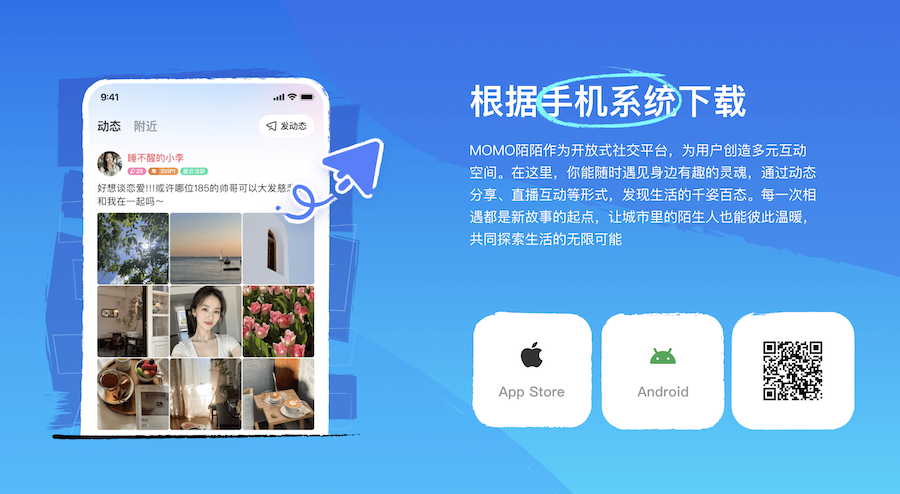
More socially oriented platforms like Momo (陌陌, ) combine dating with livestreaming, group chats, and interest-based communities. This blurs the line between social networking and dating, and the platform is commonly associated with more casual or exploratory interactions.
WeChat, although not a dating app, also includes several discovery features such as "People Nearby" (附近的人, ) and "Shake" (摇一摇, ), which allow users to meet strangers based on proximity or chance. While these functions are less commonly used for serious dating today, they reflect broader changes in China's dating landscape.
How Dating Works in Practice
In everyday dating, romantic interest in China is often expressed indirectly rather than through explicit declarations. Frequent WeChat messaging, invitations to group activities, or small acts of care are common signals of interest. Even phrases like 多喝热水 (; "drink more hot water" — often joked about online as a traditional Chinese expression of care) can function as a subtle way of showing concern and affection.
Early dates tend to be public and low-pressure, emphasizing shared time over intimacy. Traditional expectations that men pay still exist, but among younger urban couples, splitting bills or taking turns is increasingly accepted. Public displays of affection remain restrained: holding hands is common, while kissing in public may attract disapproval, especially outside major cities.
Casual dating exists but is less normalized than in many Western contexts. Dating is generally understood as moving toward commitment, and exclusivity is often assumed rather than explicitly discussed. Gift-giving on occasions like Qixi (Chinese Valentine's Day) carries symbolic meaning, signaling seriousness and emotional investment.
03 Marriage Markets and Matchmakers
Marriage Markets (相亲角)
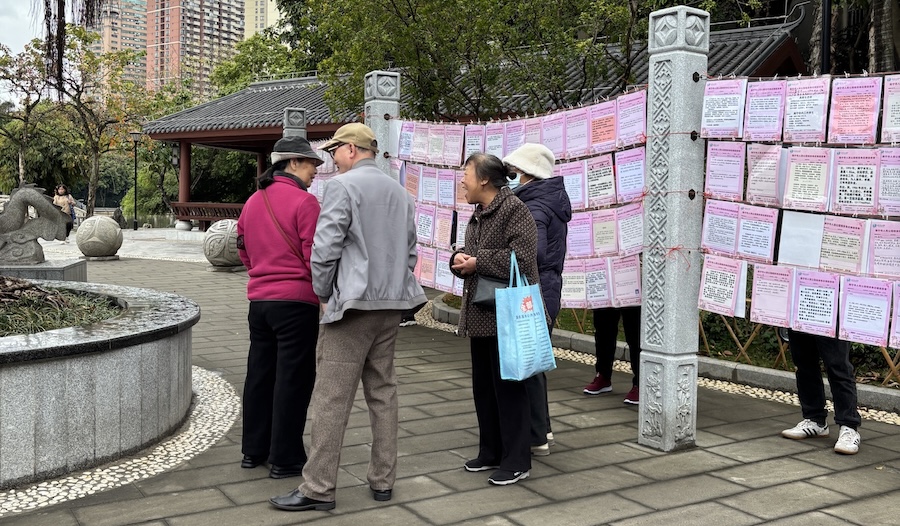
Marriage markets, known in Chinese as 相亲角 (, literally "matchmaking corners"), are one of the most visible manifestations of parental involvement in dating. This uniquely Chinese phenomenon typically appears in large urban parks, often in a fixed area that becomes especially active on weekends. Well-known examples include People's Park in Shanghai, Zhongshan Park in Beijing, and Tianhe Park in Guangzhou.
At these gatherings, parents display their children's "résumés" on bulletin boards or umbrellas. These listings usually include age, education, income, occupation, and property ownership. Parents walk through the area, exchange information, and negotiate potential matches on their children's behalf.
While often criticized by younger generations, these marriage markets continue to operate as a powerful symbol of parental influence and marriage-oriented dating culture.
The Role of Matchmakers (红娘)
The 红娘 (; matchmaker) is traditionally a person, often an older woman, who acts as a go-between, arranging marriage introductions between families. In modern China, this role has become increasingly professionalized.
Today's matchmakers include formal agencies, online consultants, relatives, and community workers. Beyond introductions, they may offer services such as compatibility matching, dating advice, and even emotional coaching, acting as a bridge between traditional marriage expectations and contemporary dating life.

04 Modern Challenges to Dating
Like many societies worldwide, China is experiencing significant cultural shifts in how young people approach dating and marriage.
Marriage rates (结婚率, ) have steadily declined, with recent years recording some of the lowest levels in decades. At the same time, the average age of first marriage has risen to around 28 nationwide and exceeds 30 in many major cities, reflecting a widespread delay in long-term commitment.
While there is no single official statistic on people who are not dating, multiple urban surveys suggest that 30–50% of young adults are single (单身, ) or not actively pursuing relationships, a proportion that continues to grow.
The pursuit of personal happiness has overtaken marrying out of obligation for many young Chinese. Marriage has shifted from necessity to choice, and staying single is increasingly viewed as valid — at times even celebrated, as seen through events like Singles' Day. However, changing values alone do not explain these trends. Structural pressures, particularly around work, time, and economic stability, play an equally important role in shaping modern dating behavior.
High-Intensity Work and "Time Poverty"
Many young people point to career demands as a major barrier to dating. Work cultures such as "996" (9 a.m. to 9 p.m., six days a week) have severely compressed the time and energy available for socializing and building relationships. As a result, many feel they have no time to date, no energy to consider marriage, and little capacity to plan for family life.
Bride Price and Economic Pressures
For many Chinese men, the bride price, known as 彩礼 (), has become a major deterrent. Since dating is widely seen as a step toward marriage, some men opt out of dating altogether to avoid the financial burden they expect to face later.
The bride price refers to money or valuable gifts given by the groom's family to the bride's family before marriage, typically including cash, gold jewelry, or contributions toward housing or wedding expenses. Traditionally, it was intended to symbolize respect and the groom's ability to support a family.
In many regions, especially rural areas and smaller cities, bride prices commonly range from 100,000 to 300,000 RMB, with some exceeding 500,000 RMB — often surpassing a family's annual income by several times.
These sums often represent many years of total household earnings. Today, the bride price has become a flashpoint in broader debates about family values, gender equality, and the commercialization of marriage.
Dating Scams
Alongside economic pressure and time constraints, growing distrust has become another obstacle in China's dating landscape. Dating scams have become a serious social issue, especially long-term romance scams in which perpetrators slowly build emotional trust before exploiting victims financially. These schemes are commonly known as "pig-butchering scams" (杀猪盘, ).
Scammers typically create fake profiles, cultivate emotional relationships, and then persuade victims to invest in fraudulent platforms, with some high-profile cases involving losses exceeding 100 million RMB. Traditional marriage fraud also persists, especially in rural areas, where scammers promise marriage, collect bride prices, and then disappear. Together, these scams exploit loneliness and marriage pressure, contributing to widespread caution and distrust on dating apps.
05 Conclusion
China's approach to dating and marriage has undergone profound change. Traditional expectations around family, gender roles, and lifelong commitment now coexist with modern values like individual choice, emotional fulfillment, and personal independence (女性独立, ).
Rather than disappearing, long-standing customs have adapted, reshaped by social change while continuing to influence how relationships are formed today. Views on dating and marriage (婚恋观, ) continue to evolve, driven by generational differences (代际差异, ) and shifting economic realities.
Explore Chinese Culture Through Language
If you'd like to explore Chinese dating culture and social dynamics through guided reading practice, check out our graded reader Wedding Conventions in Modern China. Or study with a CLI teacher who understands the nuances of Chinese culture firsthand.
06 Vocabulary About Dating in China
| Chinese | Pinyin | English |
|---|---|---|
| 婚姻 | marriage | |
| 恋爱 | romantic relationship; dating | |
| 相亲 | arranged blind date | |
| 门当户对 | suitable match (similar family status) | |
| 父母认可 | parental approval | |
| 家庭压力 | family pressure | |
| 彩礼 | bride price | |
| 结婚率 | marriage rate | |
| 单身 | single | |
| 剩女 | "leftover woman" | |
| 剩男 | "leftover man" | |
| 婚恋观 | views on dating and marriage | |
| 代际差异 | generational differences | |
| 个人主义 | individualism | |
| 女性独立 | women's independence | |
| 婚前同居 | cohabitation before marriage | |
| 相亲市场 | marriage market | |
| 红娘 | matchmaker | |
| 约会软件 | dating app | |
| 传统习俗 | traditional custom |