

- China's National Day (国庆节, Guóqìngjié) falls on October 1st each year and commemorates the founding of the People's Republic of China in 1949.
- The holiday marks the start of Golden Week (黄金周, Huángjīnzhōu), a seven-day national break and one of China's biggest annual travel periods.
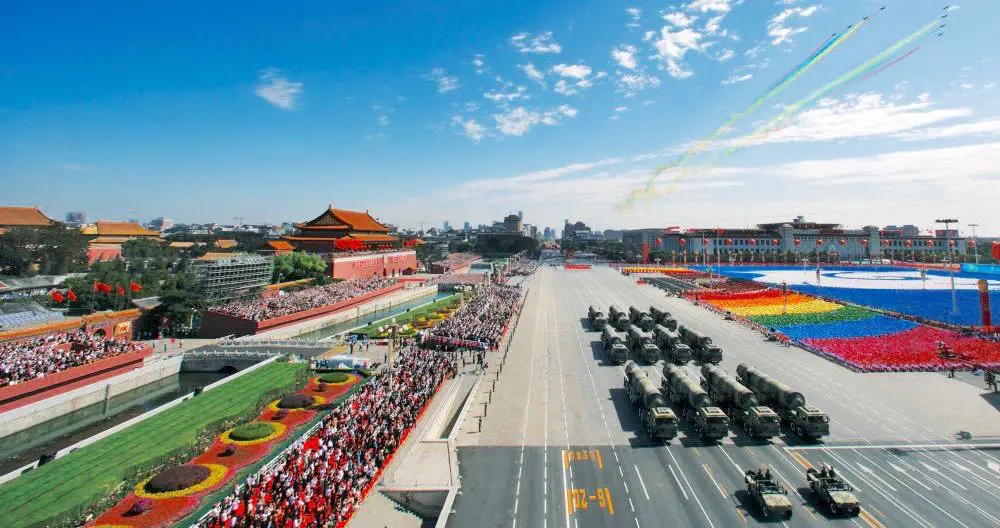
- Official celebrations include a sunrise flag-raising ceremony at Tiananmen Square, fireworks, cultural performances, and — on major anniversary years — grand military parades.
- For Chinese learners, National Day offers a useful window into modern Chinese culture and provides natural vocabulary for conversations with teachers, tutors, and language partners.
Every October 1st, China marks National Day (国庆节, Guóqìngjié) — a holiday that commemorates one of the most significant moments in modern Chinese history. But for most people in China, the day is also the starting signal for something more immediate: Golden Week, one of the country's biggest extended breaks and one of its busiest travel periods.
The result is a holiday that blends patriotic ceremony with family reunions, massive domestic travel, and a nationwide change of pace.
01 What Is China's National Day?
National Day (国庆节, Guóqìngjié) is China's annual holiday commemorating the founding of the People's Republic of China. It falls on October 1st and is one of the country's most important public holidays.
In everyday conversation, many Chinese people simply call it 十一 (Shíyī) — literally "October First" — much like Americans might say "the Fourth" for Independence Day. However, National Day is not an independence day. China was not a colony gaining sovereignty from a foreign power. Rather, October 1st marks the establishment of a new government and political system.
The holiday carries two distinct layers. The first is ceremonial and patriotic: flag-raising events, official speeches, and public displays of national pride. The second is personal and practical: October 1st kicks off Golden Week (黄金周, Huángjīnzhōu), a seven-day break during which hundreds of millions of people travel, visit family, and enjoy time off.
Understanding both layers is key to understanding what National Day means in modern China.
02 The History Behind October 1st
To understand why October 1st matters, it helps to know what happened on that day — and in the months leading up to it.
The Chinese Civil War and the founding of the PRC
By the late 1940s, China's long civil war between the Chinese Communist Party (CCP) and the Nationalist government (国民党, Guómíndǎng) was nearing its end. As communist forces gained control of the mainland, the Nationalists retreated to Taiwan.
On September 21, 1949, Mao Zedong addressed the Chinese People's Political Consultative Conference (CPPCC) in Beijing, signaling the political establishment of a new state ahead of the October 1st public ceremony.
The October 1st ceremony
Ten days later, on October 1, 1949, Mao stood atop the Tiananmen Gate (天安门, Tiān'ānmén) in central Beijing and addressed the assembled crowd in a public ceremony marking the inauguration of the new Central People's Government.
During the event, the national flag was raised for the first time, and the People's Liberation Army held its first formal military parade.
In simple terms: September 21st laid the political groundwork, October 1st marked the public ceremony, and on December 2, 1949, the Central People's Government formally designated October 1st as National Day. In popular memory — and in official observance — October 1st is the date that matters most.
The famous phrase "The Chinese people have stood up" (中国人民站起来了) is often attributed to the October 1st ceremony. In fact, Mao spoke those words at the September 21st CPPCC session, not from Tiananmen Gate.
03 Golden Week Explained
For most people in China, the words "National Day" bring to mind something more than patriotic ceremony: Golden Week.
What Is Golden Week?
Golden Week (黄金周, Huángjīnzhōu) is the seven-day national holiday that begins on October 1st and usually runs through October 7th. Officially, only three days are designated public holidays (October 1–3). The government extends the break to a full week by rearranging nearby weekends, which means workers typically have to make up the time by working on designated Saturdays or Sundays before or after the holiday.
This system of "make-up workdays" (调休, tiáoxiū) can feel unusual to newcomers, but it is a well-established part of working life in China.
Why was Golden Week created?
The Golden Week system was introduced in 1999 and took effect in 2000 as a deliberate policy to stimulate domestic tourism and consumer spending. By giving the entire country a synchronized week off, the government created a massive window for travel and leisure.
Along with the Spring Festival holiday in January or February, National Day Golden Week is one of the country's two main extended national breaks. For a complete overview of when these breaks fall each year, see CLI's guide to the Chinese calendar.
When Golden Week becomes eight days
In some years, the Mid-Autumn Festival (中秋节, Zhōngqiūjié) falls close enough to October 1st that the government combines the two holidays into an extended break of eight days. This will happen again in 2025.
During Golden Week, many government offices and schools close for the week. Most retail shops, restaurants, and tourist attractions remain open — and are often much busier than usual.

Learn Chinese with Cultural Context
CLI offers personalized Chinese instruction built around real language and culture. Join our Immersion Program in Guilin or start online with a free Chinese lesson.
04 How National Day Is Celebrated
National Day celebrations operate on two levels: the official and the personal. Both are worth understanding.
Official celebrations
The most prominent official event is the flag-raising ceremony at Tiananmen Square. Every morning at sunrise on October 1st, a military honor guard raises the national flag in a formal ceremony that draws tens of thousands of spectators. The event is broadcast on national television and is open to the public, though arriving early is essential — crowds begin gathering well before dawn.
On major anniversary years, the government holds grand military parades (阅兵, yuèbīng) through Tiananmen Square. These parades were held annually from 1949 to 1959, then became infrequent. Since 1984, they have taken place roughly every ten years on milestone anniversaries: 1984 (35th), 1999 (50th), 2009 (60th), and 2019 (70th).
If that recent pattern continues, another major National Day parade would likely be expected in 2029.
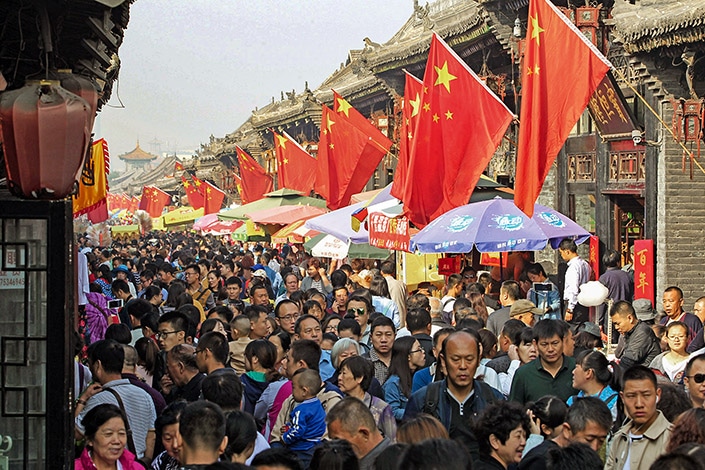
Beyond the parades, cities across China mark the holiday with fireworks, concerts, patriotic exhibitions, and public decorations. Red flags, lanterns, and floral displays transform public spaces — parks, government buildings, and commercial districts alike — into a sea of national color.
How everyday people spend the holiday
For most Chinese families, Golden Week is about rest, travel, and time together. It is one of the few chances in the year to take an extended trip or visit relatives in another city.
The scale of travel during Golden Week is staggering. Hundreds of millions of domestic trips are made during the week, making it one of the largest annual human migrations on the planet. Popular destinations — from the Great Wall to West Lake in Hangzhou — see enormous crowds, and prices for flights, trains, and hotels rise sharply.
For ideas on where to go beyond the most crowded spots, CLI's guide to the best places to visit in China is a helpful starting point.
Not everyone travels, of course. Many people spend the week relaxing at home, catching up with friends, shopping, or simply enjoying the rare luxury of consecutive days off.
Navigating the Golden Week travel rush
If you are planning to travel in China during Golden Week, it helps to know what to expect — and how to work around the crowds. Coastal cities and major destinations like Beijing, Shanghai, Hong Kong, and Sanya draw the heaviest traffic, and popular scenic spots such as the Great Wall or West Street in Yangshuo can become so packed that it is difficult to enjoy the scenery.
Less obvious regions tend to be more rewarding during this period. China's western and southwestern provinces — including Qinghai, western Sichuan, and Xishuangbanna — see fewer domestic tourists and offer dramatic landscapes without the worst of the crowds. In the northeast, the Changbai Mountains are another option worth considering.
A few practical strategies can also make a significant difference. Avoiding travel on the first and last days of the holiday — October 1st and 7th — helps you sidestep the worst congestion on trains, flights, and highways. Booking transportation and accommodation well in advance is essential, since popular routes sell out quickly and prices climb as the holiday approaches.
And if your schedule is flexible, traveling just before or just after Golden Week is often the simplest way to enjoy a trip without the peak-season pressure. Wherever you go, brushing up on a few useful travel phrases in Chinese can go a long way toward making your trip smoother.
Train tickets in China can be booked up to 60 days before departure. For Golden Week travel, booking as soon as tickets become available gives you the best chance of securing seats on popular routes.
05 Practical Tips for Chinese Learners
If you are studying Chinese, National Day and Golden Week offer a natural opportunity to connect your language studies to real life.
A built-in conversation topic
National Day is one of the easiest topics to bring up with a Chinese teacher, tutor, or language partner. Asking someone about their Golden Week plans — 你十一有什么打算?(Nǐ Shíyī yǒu shénme dǎsuàn?) — is a natural, friendly question that most people are happy to answer. After the holiday, asking how their break went is just as easy and opens the door to listening practice.
What to expect if you are in China
If you happen to be in China during Golden Week — whether you study abroad in China or are visiting independently — expect a different rhythm of life. Schools will be closed, your usual routines may shift, and public spaces will be more crowded and festive than normal.
It is also a good time to explore your host city, since many locals leave for their hometowns — meaning some neighborhoods feel quieter even as tourist sites fill up.
Keep learning through Chinese holidays
National Day is just one of many Chinese holidays that offer rich cultural and linguistic context. For a broader look at the full calendar, including Chinese New Year, the Mid-Autumn Festival, and more, explore CLI's complete guide to Chinese holidays.
And for learners who want structured support building their Chinese, CLI's one-on-one lessons — available in Guilin or online — are designed to help you learn Chinese in China or from anywhere in the world, at your own pace with a dedicated teacher.
06 Useful Vocabulary for China's National Day
The following terms will help you talk about National Day and Golden Week with confidence.
| Chinese | Pinyin | Translation |
|---|---|---|
| 国庆节 | National Day | |
| 黄金周 | Golden Week | |
| 十一 | "October First" (colloquial name for National Day) | |
| 中华人民共和国 | People's Republic of China | |
| 天安门 | Tiananmen (Gate of Heavenly Peace) | |
| 阅兵 | military parade; military review | |
| 放假 | to have a holiday; time off | |
| 调休 | make-up workday; adjusted rest day | |
| 国旗 | national flag | |
| 中秋节 | Mid-Autumn Festival | |
| 旅游 | tourism; to travel | |
| 庆祝 | to celebrate |