
Key Takeaways
  • The FSI estimates roughly 2,200 hours to reach professional Mandarin proficiency — but for most learners, the real question is how to use the hours they actually have each week.
  • Tones and pronunciation must come first; learners who rush past this stage develop errors that persist even at advanced levels.
  • The Four Strands framework recommends splitting study time equally across input, output, deliberate language study, and fluency practice — most self-study learners drastically over-invest in drills.
  • A study plan that specifies what to do on which day — at a realistic intensity tier — is far more effective than a vague intention to "practice more."
  • The intermediate plateau, around the 1,000–1,500 hour mark, is predictable and surmountable with the right strategy shifts.
  • One-on-one instruction accelerates progress at every tier, especially for tones, pronunciation correction, and real-time speaking feedback.

The U.S. Foreign Service Institute — the government agency that trains American diplomats in foreign languages — estimates that reaching professional proficiency in Mandarin Chinese takes approximately 2,200 hours of classroom instruction. That number shows up in almost every "how long does it take to learn Chinese" article on the internet. And it's accurate, as far as it goes. But it describes a very specific scenario: full-time, intensive study with professional instructors, five days a week, for career diplomats.

That's probably not you.

If you're studying Chinese on your own time — fitting practice around a job, a degree, or a life — the real question isn't "how many total hours does Chinese take?" It's "how should I spend the hours I actually have?" That's what a good Chinese study plan answers. Not just what to learn, but when, in what order, and for how long each week.

This article gives you that plan. Whether you can commit three hours a week or twenty, you'll find a structured roadmap organized into three phases, with specific weekly schedules for each intensity level, research-backed time allocation, and realistic milestones. No vague promises about being "conversational in three months." No one-size-fits-all timelines that quietly assume you have no job.

CLI student working one-on-one with a Chinese teacher at the Chinese Language Institute in Guilin, China
A study plan matched to your real schedule — not an idealized one — is the foundation of effective Mandarin learning.

01 How Long Does It Really Take to Learn Chinese?

The honest answer: it depends almost entirely on how many hours per week you can study consistently.

The FSI's 2,200-hour figure is the most reliable benchmark we have. It's based on decades of data from training English-speaking diplomats in dozens of languages, and Mandarin Chinese sits in the hardest category — Category IV, alongside Arabic, Japanese, and Korean. But that 2,200 hours assumes intensive classroom instruction: approximately 23 hours per week in class plus 17 hours of self-study, in a full-immersion environment with professional instructors. Most independent learners study far less than that. And self-study is generally less efficient per hour than structured instruction because you lack real-time feedback on pronunciation, tones, and grammar.

A more practical way to think about timelines is to map study intensity against approximate proficiency milestones. Under the HSK 3.0 framework — China's standardized proficiency test, which is transitioning to nine bands from beginner to near-native — here's a rough picture of what to expect:

Milestone Casual (3 hrs/week) Serious (8 hrs/week) Intensive (20+ hrs/week)
HSK Band 1–2 — basic survival, simple conversations ~12–18 months ~5–7 months ~2–3 months
HSK Band 3–4 — daily-life competence, straightforward professional topics ~3–5 years ~1.5–2.5 years ~6–12 months
HSK Band 5–6 — fluent discussion, professional use, reading newspapers ~7+ years ~3–4 years ~1.5–2 years
A Note on These Projections

These timelines are approximations — treat them as rough planning anchors, not benchmarks you're racing against. The FSI data is built on full-time students with professional instructors; self-study timelines at every tier involve more individual variation than the table implies. Key factors the table can't capture: whether you use a spaced repetition system consistently, how much Chinese you encounter outside of study sessions, and your prior experience with tonal or logographic languages. Speakers of Japanese or Korean, for instance, often move through character acquisition significantly faster than the averages suggest. The casual tier is the most variable of all — at three hours per week, the gap between a learner who reviews daily in short sessions and one who studies in a single weekly block can easily be a year or more at the same total hour count.

The good news? Even the casual tier produces results, as long as you study consistently and follow a sensible sequence. Which brings us to the next question.

Chinese language flashcards spread out on a desk alongside study notes
Proficiency timelines vary dramatically by weekly study intensity — a casual and an intensive learner can reach the same milestone years apart.

02 What to Learn First: The Right Sequence

One of the most consequential decisions you'll make as a Chinese learner has nothing to do with which app to download or which textbook to buy. It's what you study first.

Experienced Chinese teachers — across schools, countries, and teaching philosophies — agree on a remarkably consistent sequence. Getting this order right saves months of frustration later. Getting it wrong creates problems that compound over time.

  1. Tones and pronunciation (声调 shēngdiào and 发音 fāyīn). This is non-negotiable as your starting point. Mandarin has four tones (plus a neutral tone), and each one changes a word's meaning entirely. The syllable means "mother," means "hemp," means "horse," and means "to scold." Teachers consistently report that students who rush past tones in the first weeks end up with fossilized pronunciation errors that are extremely difficult to correct later — even at advanced levels. Spend your first two to four weeks focused almost exclusively on hearing and producing tones accurately.
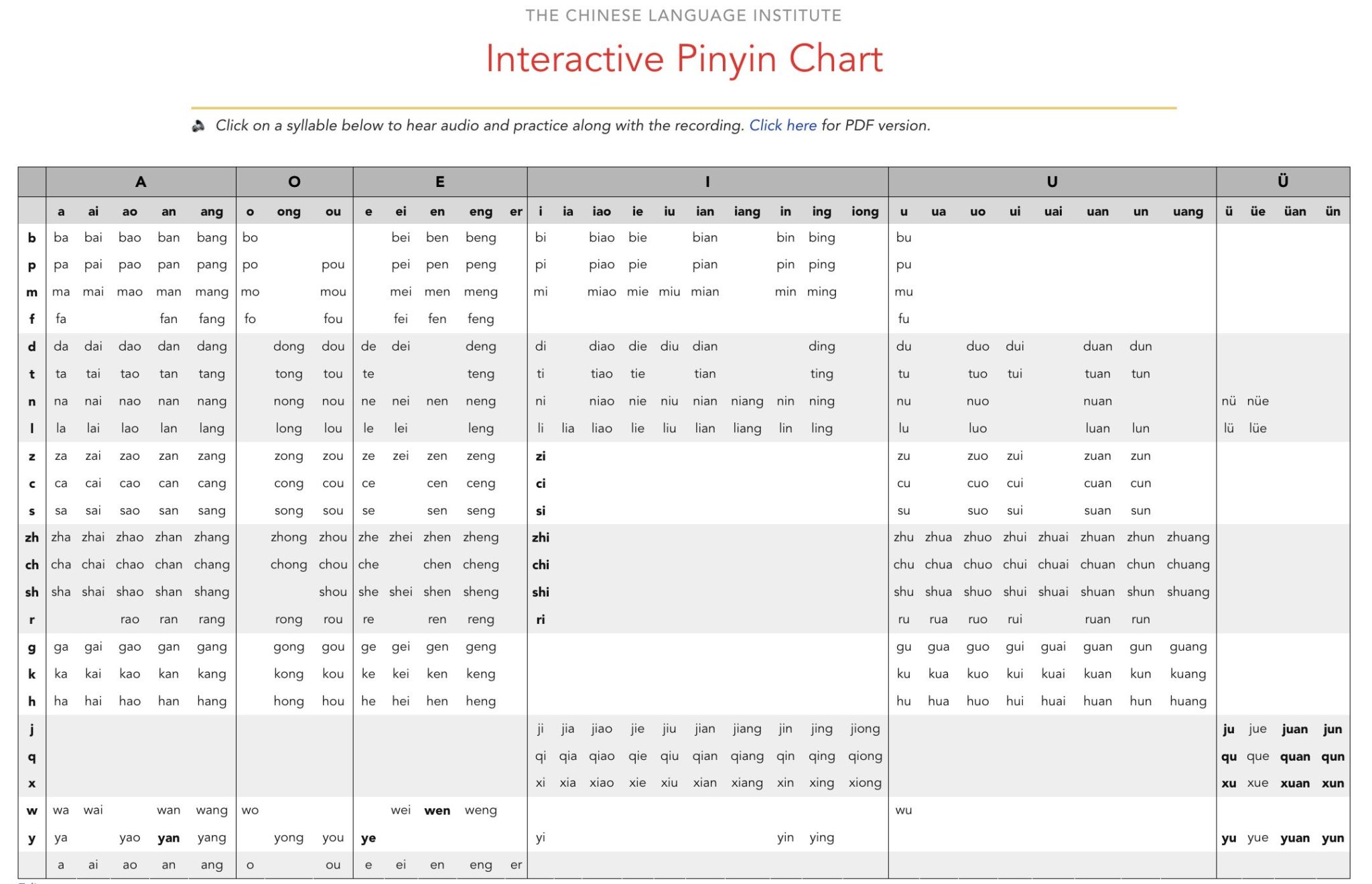
  2. Pinyin (拼音 pīnyīn). Pinyin is the romanization system that represents Chinese sounds using the Latin alphabet. You'll rely on it heavily in the early months as a pronunciation guide and a bridge to characters. Learn it thoroughly alongside tones — but be warned that some pinyin spellings are deceptive. The c in cài sounds nothing like the English "c," and q, x, zh, and r all represent sounds that don't exist in English. This is one area where working with a teacher — even briefly — makes a measurable difference. Having someone physically show you how to position your tongue for zh versus j will save you weeks of guessing from audio recordings.
  3. Characters and radicals (汉字 hànzì and 部首 bùshǒu). Start learning characters within the first two to four weeks — don't delay this. A radical-based approach, where you learn the building blocks that make up characters, is significantly more efficient than memorizing characters as arbitrary shapes. For example, once you know that relates to water, characters like (, river), (, lake), and (hǎi, sea) start making visual sense. Focus on recognition first; production (writing from memory) can come later.
  4. Core vocabulary through context. Build your first 300–500 words not from isolated word lists, but from textbook dialogues, graded readers, or structured input that shows words in sentences. This is where a good Chinese textbookIntegrated Chinese, HSK Standard Course, or New Practical Chinese Reader — becomes essential.
  5. Grammar through comprehensible input. Chinese grammar is considerably simpler than English in many respects — no conjugation, no gender, no articles. Most basic grammar patterns are best absorbed through reading and listening to material you mostly understand, rather than through explicit grammar drills. The pattern 我想去… (wǒ xiǎng qù…, "I want to go to…") makes more sense encountered in a conversation than memorized from a grammar table.
  6. Output — speaking and writing. This comes last in the sequence, not because it's unimportant, but because you need a foundation of sounds, characters, and patterns before your output practice can be productive. Many learners try to speak too early, before they can hear tones accurately, and end up reinforcing mistakes.
Should You Speak from Day One?

For many languages, early output is encouraged. For Mandarin, most experienced teachers recommend a brief listening-first period — typically the first two to four weeks — before prioritizing spoken production. The reasoning is practical: tones are perception problems before they're pronunciation problems. If you can't reliably hear the difference between second and third tone, producing them accurately is guesswork. A few weeks of focused tone-training before active speaking doesn't delay your progress — it gives your mouth better habits to form from the start.

Interactive pinyin chart showing all Mandarin Chinese initials and finals organized in a grid
Mastering pinyin alongside tones in the first two to four weeks creates the pronunciation foundation that every subsequent skill depends on.

03 How to Split Your Study Time: The Four Strands Framework

Knowing what to study is only half the equation. How you divide your time across different activities matters just as much — and this is where most self-study plans go wrong.

Paul Nation, one of the most cited researchers in second-language acquisition, developed a framework called the Four Strands. It's among the most widely cited research-backed models for study time allocation in language learning — with over 488 citations in peer-reviewed literature — and it recommends splitting your time roughly equally across four types of activity:

Strand What It Means Chinese Examples Common Mistake
Meaning-focused input (25%) Listening to or reading Chinese to understand the message — not studying the language itself Watching a Chinese show with subtitles, listening to a podcast at your level, reading a graded reader Skipping this entirely in favor of more drills
Meaning-focused output (25%) Speaking or writing to communicate something real Talking with a tutor or language partner, texting a friend in Chinese, describing your day out loud Waiting until you feel "ready" and never starting
Language-focused learning (25%) Deliberate study of tones, grammar, vocabulary, and characters Textbook exercises, flashcard review, pronunciation drills, learning new radicals Spending 80% of all study time here
Fluency development (25%) Working with familiar material to build speed and automaticity Re-reading a passage you already understand, retelling a story you know, speed drills with known vocabulary Ignoring this completely — always chasing new material

The key insight is the balance. Experienced teachers consistently observe that most self-study learners spend far more than 25% of their time on language-focused learning — grinding flashcards, memorizing grammar rules, doing textbook drills — and far less than 50% on the meaning-focused strands that actually build real comprehension and communication ability.

This imbalance is understandable. Flashcards and textbook exercises feel productive because the feedback is immediate: you got the card right, you completed the exercise, you checked the box. Listening to a podcast where you understand 70% of the words feels uncertain and messy. But that messy, partially-understood listening is exactly what builds real comprehension — and it's the kind of practice most study plans quietly neglect.

Audit Your Weekly Study Time

You don't need to track your minutes with a stopwatch — just do a rough audit once a month. If your last four weeks were almost entirely Anki reviews and textbook exercises, something is off. If more than a third of your study time is drills and flashcards, shift some of that time toward listening, reading, and speaking. Input and output strands are where real fluency is built.

For learners considering a structured program, it's worth noting that CLI's Immersion Program in Guilin is designed around essentially this distribution: 20 hours per week of one-on-one instruction covers language-focused learning and meaning-focused output, daily life in a Chinese-speaking city provides meaning-focused input, and repeated real-world interactions with familiar vocabulary build fluency naturally. Most classroom-only programs struggle to provide the input and fluency strands; immersion solves this structurally.

CLI student reviewing Chinese study materials at a desk at the Chinese Language Institute
The Four Strands framework works best when all four activity types are distributed across the week — not concentrated into a single long study session.
CLI student in a one-on-one Mandarin lesson with a Chinese teacher in Guilin

Study Chinese with One-on-One Instruction

CLI's Immersion Program in Guilin delivers 20 hours per week of one-on-one instruction — structurally designed around the Four Strands balance that most self-study plans can't replicate. Not ready to travel? CLI's online Chinese lessons bring the same instruction quality to your schedule.

04 Your Month-by-Month Chinese Study Plan

Here's where the plan gets specific. The roadmap below is divided into three phases, each with sample weekly schedules at all three intensity levels. The Four Strands framework shapes how time is allocated within each phase.

A note on the timelines: the months listed assume the "serious" tier (8 hours/week) as the baseline. Casual learners should expect to spend roughly twice as long in each phase. Intensive learners will move through phases faster — in some cases much faster, especially with structured instruction.

Phase 1 — Foundations (Months 1–3)

What you're building: Accurate tones, pinyin fluency, your first 200–400 characters (recognition), 300–500 vocabulary words, and basic sentence patterns.

What success looks like at the end of Phase 1: You can introduce yourself, order food, ask for directions, and handle simple daily interactions. You can read sentences in pinyin with correct tones and recognize 200+ characters. You're halfway through Integrated Chinese Level 1 Part 1 (or equivalent).

Your Daily Non-Negotiable (All Tiers)

Spend 15–20 minutes on spaced repetition review using Anki or Pleco's built-in flashcard system. This is the single habit that makes everything else stick. Spaced repetition shows you cards just before you're about to forget them — dramatically more efficient than re-reading notes or cramming. Set it up in week one and don't skip days. Even five minutes of review is better than zero.

Day Casual (3 hrs/week) Serious (8 hrs/week) Intensive (20+ hrs/week)
Mon 30 min: Tone drills + SRS review 1.5 hrs: Textbook lesson + tone drills + SRS 4 hrs: 1-on-1 lesson (pronunciation focus) + textbook + SRS
Tue 1 hr: Character writing + radical study 4 hrs: 1-on-1 lesson (characters & reading) + graded reader + SRS
Wed 30 min: Character recognition + SRS 1.5 hrs: Textbook lesson + listening practice + SRS 4 hrs: 1-on-1 lesson (grammar & vocabulary) + character writing + SRS
Thu 1 hr: Listening (textbook audio or beginner podcast) + SRS 4 hrs: 1-on-1 lesson (listening & speaking) + review + SRS
Fri 30 min: Listening practice + SRS 1.5 hrs: Review + speaking practice + SRS 4 hrs: 1-on-1 lesson (review & conversation) + listening practice + SRS
Sat 30 min: Weekly review 1.5 hrs: Character review + graded reading + SRS 2 hrs: Self-study review + immersion activities
Sun 30 min: Listening or graded reading
Total ~3 hrs ~8 hrs ~22 hrs

In Phase 1, your Four Strands balance will lean slightly heavier toward language-focused learning (closer to 35%) because tones, characters, and basic grammar require deliberate study at the outset. Meaning-focused input fills about 20%, with the remaining time split between output practice and fluency work with familiar material. This Phase 1 skew is expected and documented — Nation himself acknowledges that the 25/25/25/25 split describes a course in full operation, not a beginner's first weeks. The balance shifts toward that ideal as your foundation grows.

Casual Tier Reality Check

At three hours per week, Phase 1 will take closer to six months than three. That's fine. The sequence and activities are the same — only the pace changes. The critical factor is consistency. Three hours spread across three or four sessions beats three hours crammed into one weekend block, because spaced repetition works better with shorter, more frequent reviews.

Phase 2 — Building (Months 4–8)

What you're building: Vocabulary expanding to 800–1,200 words, character recognition reaching 600+, ability to read simplified texts, hold basic conversations, and understand the gist of everyday speech.

What changes from Phase 1: Less time on pronunciation drills (your tones should be solid by now), more time on reading and listening to real-ish content. You're transitioning from "learning to read" to "reading to learn." The Four Strands balance moves closer to the ideal 25/25/25/25 split.

What success looks like at the end of Phase 2: You can have a simple conversation about daily life, read short articles with a dictionary, understand the main idea of Chinese media aimed at learners, and write short paragraphs. You're working through Integrated Chinese Level 1 Part 2 or equivalent.

Day Casual (3 hrs/week) Serious (8 hrs/week) Intensive (20+ hrs/week)
Mon 30 min: Graded reading + SRS 1.5 hrs: Textbook lesson + conversation practice + SRS 4 hrs: 1-on-1 lesson + graded reader + SRS
Tue 1 hr: Listening (learner podcast or show) + SRS 4 hrs: 1-on-1 lesson + listening practice + writing exercise
Wed 30 min: Listening practice + SRS 1.5 hrs: Reading + character expansion + SRS 4 hrs: 1-on-1 lesson + extended reading + SRS
Thu 1 hr: Speaking practice (tutor or language partner) 4 hrs: 1-on-1 lesson + conversation + review
Fri 30 min: Textbook lesson + SRS 1.5 hrs: Review + mixed practice + SRS 4 hrs: 1-on-1 lesson + self-study + SRS
Sat 30 min: Conversation practice or review 1.5 hrs: Extended reading or watching Chinese content 2 hrs: Immersion activities + self-directed study
Sun 30 min: Listening or reading for pleasure
Total ~3 hrs ~8 hrs ~22 hrs

Notice that reading and listening activities take up more space in Phase 2. This is intentional. Once you have a foundation of 500+ words and basic grammar patterns, spending time with comprehensible input — material you understand 70–90% of — is the most efficient way to grow. Graded readers like the Mandarin Companion series and learner podcasts are designed exactly for this stage.

The mechanism is simple: when you read or listen to something where you know most of the words, your brain picks up new vocabulary and grammar patterns from context — the same way children learn their first language, but accelerated by your existing knowledge. A graded reader set at your level exposes you to new words surrounded by familiar ones, so you can often guess meaning without reaching for a dictionary. This kind of incidental learning is far more durable than memorizing word lists, and it doesn't feel like work in the same way drills do.

At eight hours per week, Phase 2 is where adding a regular tutor session (even one hour per week) pays the biggest dividends. A tutor catches pronunciation drift, corrects grammar patterns before they fossilize, and provides the accountability that keeps self-study learners from stalling. If you haven't considered one-on-one instruction yet, this is the phase where it matters most. CLI's online lessons offer this kind of structured support without requiring you to be in China.

Phase 3 — Intermediate Breakthrough (Months 9–12+)

What you're building: Vocabulary past 1,500 words, character recognition past 1,000, ability to engage with authentic materials — news, TV shows, podcasts for native speakers — and conversational fluency on familiar topics.

What changes from Phase 2: You're leaving learner materials behind and engaging with real Chinese content — even if it's hard. The Four Strands balance should now be close to 25/25/25/25, with meaning-focused input (authentic reading and listening) taking the largest share of your time. Language-focused learning narrows to targeted gap-filling rather than broad study.

What success looks like by month 12: You can follow a Chinese TV drama without subtitles for the gist (if not every word), read news articles with moderate dictionary use, hold extended conversations on topics you care about, and write coherent paragraphs. You're working at roughly HSK Band 3–4 level if studying seriously, or approaching Band 2–3 if studying casually.

Day Casual (3 hrs/week) Serious (8 hrs/week) Intensive (20+ hrs/week)
Mon 30 min: Authentic listening (podcast or show) + SRS 1.5 hrs: Authentic reading + targeted vocabulary + SRS 4 hrs: 1-on-1 lesson + authentic content discussion + SRS
Tue 1 hr: Conversation practice (tutor or partner) 4 hrs: 1-on-1 lesson + extended reading + writing
Wed 30 min: Reading (news or social media) + SRS 1.5 hrs: Listening + speaking practice + SRS 4 hrs: 1-on-1 lesson + listening + review
Thu 1 hr: Targeted grammar or character study + SRS 4 hrs: 1-on-1 lesson + authentic media + SRS
Fri 30 min: Speaking practice + SRS 1.5 hrs: Mixed practice + review + SRS 4 hrs: 1-on-1 lesson + conversation + self-study
Sat 30 min: Extended reading or show 1.5 hrs: Authentic content (show, book, or long article) 2 hrs: Immersion activities + self-directed practice
Sun 30 min: Review or listening for pleasure
Total ~3 hrs ~8 hrs ~22 hrs
Casual Tier Reality Check

At three hours per week, you may still be working through Phase 2 material at the nine-month mark, and that's perfectly normal. The phases aren't a race — they describe what you should be doing at each proficiency level, not a fixed calendar. If you're still building vocabulary at 800 words in month 10, stay in Phase 2 until the activities described in Phase 3 feel appropriate. The timeline for your tier shifts right by roughly two-thirds compared to the serious tier baseline; the sequence and activities are identical.

Learners studying 20+ hours per week — especially in an immersion environment like CLI's program in Guilin — often reach intermediate proficiency in four to six months rather than twelve. The combination of structured one-on-one instruction, daily real-world practice, and constant Chinese input compresses the timeline dramatically. This is consistent with documented outcomes from intensive immersion study.

CLI student practicing conversational Chinese with a teacher at an outdoor market in Guilin, China
Phase 3 shifts study time toward authentic materials — real conversations, news, and media created for native speakers rather than language learners.
CLI structured curriculum materials and lesson resources for Mandarin Chinese students

Add Structure to Your Study Plan

Whether you're at the casual, serious, or intensive tier, CLI's online Chinese lessons can serve as the backbone of your study plan. A teacher who hears your tones, corrects your grammar in real time, and adjusts to your pace is something no app or textbook can replicate.

05 Five Mistakes That Derail Your Progress

Good study plans fail when learners make preventable errors. These five mistakes are the ones experienced Chinese teachers identify most consistently — and each one compounds over time if left uncorrected.

  1. Treating tones as optional after week one. Many learners focus on tones during their first few lessons, then quietly stop paying attention once they can communicate basic meaning. Native speakers may understand you despite imperfect tones — but this creates a false sense of security. Students who neglect tones routinely reach advanced grammar levels while still struggling to be understood in natural conversation. Fix: Keep tones as a conscious focus for at least the first three months. Record yourself and compare against native audio regularly.
  2. Delaying character learning. It's tempting to rely on pinyin indefinitely — after all, you can technically learn to speak without reading characters. But students who delay learning characters past the first month face a much steeper learning curve later, and they miss the structural patterns (radicals, components) that make vocabulary acquisition faster. Fix: Start learning characters in week two or three, focusing on recognition before production. Even 15 minutes a day makes a difference.
  3. Using pinyin as a permanent crutch. Pinyin is a tool for learning pronunciation, not a replacement for 汉字. Learners who read everything in pinyin never develop the visual recognition that makes reading natural. Fix: Transition away from pinyin-only materials as soon as you can recognize 200–300 characters. Read with characters and use pinyin only for unfamiliar words.
  4. Translating word-for-word from English. Chinese word order, sentence structure, and logic differ fundamentally from English. Trying to assemble Chinese sentences by translating English word-by-word produces phrases that are technically made of Chinese words but mean nothing to a native speaker. Fix: Learn phrases and sentence patterns as chunks, not individual words. When you learn 不好意思 (bù hǎo yìsi), learn it as a unit meaning "excuse me / I'm embarrassed," not as four separate words.
  5. Spending all your study time on drills and flashcards. This is the Four Strands problem in action. If your entire study session is Anki reviews and textbook exercises, you're over-investing in language-focused learning at the expense of the input, output, and fluency practice that build real ability. Fix: Audit your weekly study time. If more than a third is drills and flashcards, shift some of that time to listening, reading, or conversation.
CLI student working through Chinese language exercises during an individual study session
Most preventable mistakes in Chinese study share a common root: over-reliance on passive memorization at the expense of real communication practice.

06 The Intermediate Plateau — and How to Push Through It

Somewhere around the 1,000- to 1,500-hour mark — roughly the transition from Phase 2 to Phase 3 — many Chinese learners hit a wall. You're studying consistently, you're following a plan, and yet progress feels invisible. You still can't understand fast native speech. You still search for words in conversation. Your reading speed is still painfully slow.

This is the intermediate plateau, and it's a well-documented phenomenon in language learning.

The reason it happens is mathematical. Linguists describe it through Zipf's Law: the most common words in any language are extraordinarily useful, but each additional word you learn provides less marginal benefit than the last. When you knew 100 words, learning 100 more doubled your vocabulary and dramatically expanded what you could do. When you know 2,000 words, learning 100 more is a 5% increase — and those new words are rarer and less likely to appear in conversation.

You Haven't Stopped Improving

The plateau doesn't mean progress has stopped. It means improvements have become harder to feel. You are still acquiring vocabulary, refining grammar, and improving listening speed — but gains are now spread across thousands of partially-known words rather than concentrated in the dramatic leaps of early learning. The plateau is a predictable stage that every learner who reaches intermediate proficiency encounters. Knowing it's coming makes it easier to push through.

Four strategies that experienced learners and teachers recommend for pushing through:

First, concentrate your effort. If you spread 100 hours across all skills equally, the improvement in any single area may be imperceptible. If you spend 100 hours focused specifically on listening comprehension, or reading speed, or pronunciation accuracy, you will notice clear progress. Pick one area, focus for a month, then rotate.

Second, switch to authentic materials. If you're still reading textbook dialogues at the 1,000-word mark, you've outgrown them. Transition to Chinese content made for Chinese people — news apps, TV dramas, podcasts, social media. Yes, it will be hard. That's the point.

Third, benchmark your progress explicitly. Record yourself speaking every few months and compare the recordings. Count how many characters you can read per minute. Track your Anki retention rate. When progress is invisible to your feelings, make it visible through data.

Fourth, change your study methods regularly. One experienced polyglot describes changing his approach entirely every week, based on whatever felt like his biggest obstacle. This kind of active experimentation — rather than grinding the same routine indefinitely — is often the key to breaking through stagnation.

07 Essential Tools and Resources

A study plan needs materials. Here are the tools and resources that have stood the test of time at each phase, along with how they fit into the Four Strands.

Category Phase 1 (Foundations) Phase 2 (Building) Phase 3 (Breakthrough)
Textbook Integrated Chinese Level 1 Part 1 or HSK Standard Course Band 1–2 Integrated Chinese Level 1 Part 2 or New Practical Chinese Reader Transition to authentic materials; textbooks for targeted grammar gaps
SRS App Anki (enable FSRS) or Pleco's built-in flashcards Continue Anki/Pleco; add character-specific practice with Skritter Maintain Anki for new vocabulary; reduce daily time as acquisition shifts to reading
Listening/Reading Textbook audio; beginner podcasts Mandarin Companion graded readers; learner podcasts Native podcasts, Chinese TV/film, news apps, social media
Speaking Practice Tutor (1-on-1 instruction); pronunciation apps Regular tutor sessions or language exchange partner Extended conversation; debate; topic-based discussion

A note on Anki. Anki is the most powerful spaced repetition tool available for language learning, but it has a learning curve. Two tips that will save you frustration: first, enable the FSRS algorithm in settings (under "Deck Options" → "FSRS"). FSRS is more efficient than Anki's default SM-2 scheduler — it adapts to your actual memory patterns rather than using fixed intervals, which means fewer unnecessary reviews and better long-term retention. Second, keep your daily new cards to 10–15. Adding too many cards too fast is the number one reason learners abandon SRS — the review pile becomes overwhelming within weeks. Twenty to thirty minutes of daily review is the sweet spot for most learners; more than that, and you're cutting into time better spent on reading, listening, and speaking.

A note on Pleco. If Anki feels too technical, Pleco is the essential Chinese dictionary app that also includes a built-in flashcard system. It's less customizable than Anki but more convenient for Chinese specifically — you can tap any character in the dictionary to add it to your flashcard deck, and the optical character recognition feature lets you point your phone camera at Chinese text and get instant definitions.

A note on textbooks. Integrated Chinese is the standard in U.S. university programs and offers a well-structured progression with good cultural context. HSK Standard Course aligns directly with HSK exam levels, which is useful if certification is a goal. New Practical Chinese Reader takes a more traditional approach with extensive drills. All three are solid choices — the best textbook is the one you'll actually use consistently.

08 Getting Started

The difference between a study plan that works and one that doesn't isn't complexity — it's specificity. Vague intentions ("I should study more Chinese") produce vague results. A schedule that tells you exactly what to do on Tuesday evening produces progress.

Start with your tier. Be honest about how many hours per week you can realistically sustain — not in a burst of new-year-resolution enthusiasm, but month after month for a year. Pick the schedule that matches. Print it, bookmark it, set calendar reminders for your study blocks. Then follow it for twelve weeks before evaluating whether the structure works for your life. Tweaking your plan every few days is a form of procrastination.

If your plan includes structured one-on-one instruction — and the research strongly suggests it should, especially for tones and speaking — CLI offers both immersion programs in Guilin and online Chinese lessons that can serve as the backbone of your study plan at any intensity level. A teacher who hears your tones, corrects your grammar in real time, and adjusts to your pace is something no app or textbook can replicate. For the intensive tier, CLI's Immersion Program puts you in a Chinese-speaking city with 20 hours of weekly one-on-one instruction — essentially the study plan in this article, fully resourced and structurally optimized. For the casual or serious tier, online lessons provide the same quality of instruction on a schedule that fits your life.

Whatever tier you choose, the principles are the same: tones first, characters early, balance your time across the Four Strands, and show up consistently. Chinese is not easy — the FSI put it in the hardest category for a reason. But with a plan this specific, it's entirely manageable.

Chinese Pinyin Translation
shēngdiào tone
fāyīn pronunciation
pīnyīn pinyin (romanization system)
hànzì Chinese character(s)
bùshǒu radical
river
lake
hǎi sea
bù hǎo yìsi excuse me / I'm embarrassed

09 Sources

  • U.S. Foreign Service Institute — Foreign language training: difficulty rankings and study-hour estimates for Mandarin Chinese, including Category IV classification for Mandarin (2,200 class hours). View source →
  • Nation, Paul (2007) — The Four Strands: a framework for balancing study time across meaning-focused input, meaning-focused output, language-focused learning, and fluency development. International Journal of Innovation in Language Learning and Teaching. View source →
  • Hacking Chinese (Olle Linge) — The Four Strands applied to Mandarin study, including the observation that most learners over-invest in language-focused learning. View source →
  • Hacking Chinese (Olle Linge) — How to push past the intermediate Chinese learning plateau, including the 1,000–1,500 hour range and concentrated-effort strategies. View source →
  • Scott H. Young (2023) — The intermediate plateau: what causes it and how to move beyond it, including a Zipf's Law analysis of diminishing vocabulary returns. View source →
  • Mandarin Blueprint — Five-step Chinese learning sequence supporting the learning order presented in this article. View source →
  • Yan et al. (2013) — Efficient learning strategy of Chinese characters based on network approach — demonstrating that radical-based learning order substantially improves character acquisition efficiency. PLoS ONE. View study →
  • Migaku — SRS methodology supporting the 20–30 minute daily review recommendation, including spaced repetition scheduling and forgetting curve management for language learners. View source →
  • Cheng & Tsui — Publisher of Integrated Chinese, referenced as the leading textbook in U.S. university Mandarin programs. View source →