


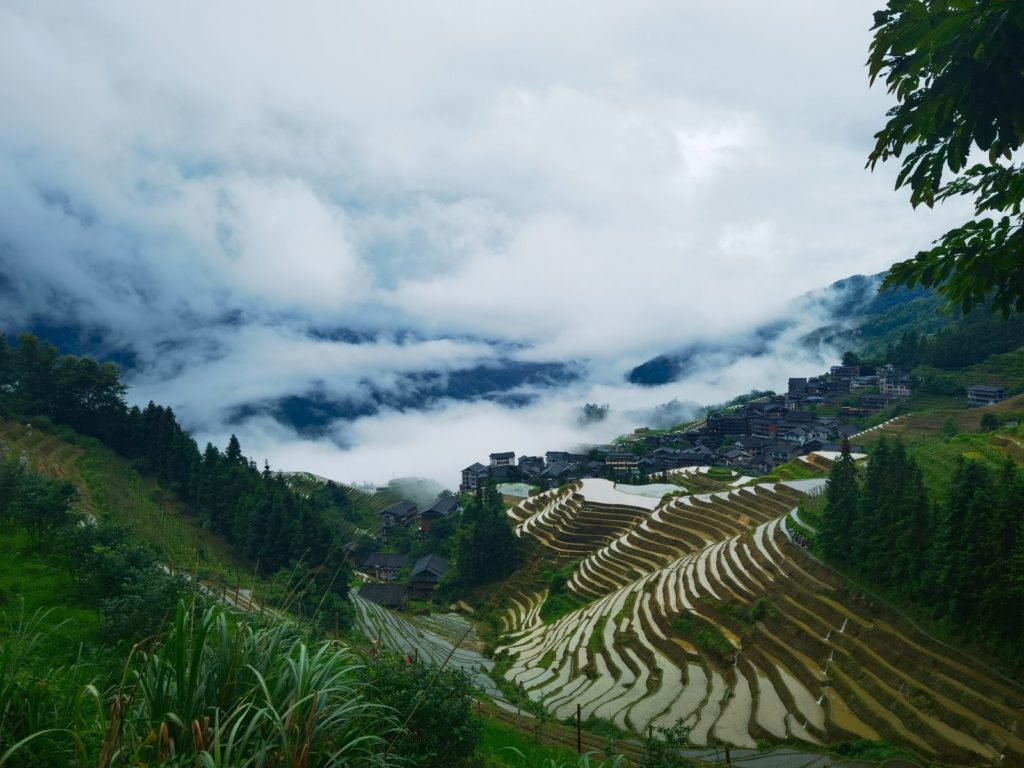
- On September 12, 2026, our students hiked the Longji rice terraces in Longsheng, two to two and a half hours north of Guilin by road, as the rice began to turn gold.
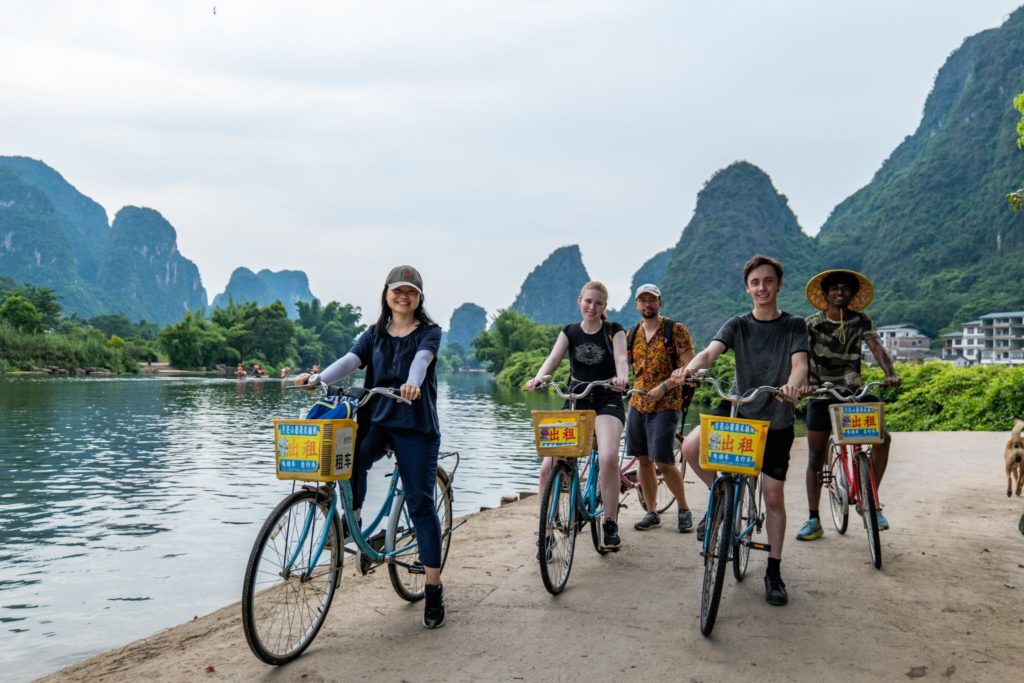
- A week later they cycled the farm roads outside Yangshuo and rafted the Li River between the karst peaks.
- The terraces are at their most golden from late September to mid-October. For water-filled, mirror-like terraces, go from late April to early June, when the fields are flooded for planting.
- Both work as day trips from Guilin, though Longji is a long one. Yangshuo is about 1.5 hours by coach. Planning your own trip has times and tickets for both, with links to our full guides.
The rice around Guilin was almost ready to cut, so on the first two Saturdays of the fall semester we took our students at the Chinese Language Institute (CLI) out of the city. On September 12 we went north to the Longji rice terraces (龙脊梯田 Lóngjǐ Tītián) in Longsheng County. A week later we went south to the Yangshuo countryside for a morning on bikes and an afternoon on bamboo rafts.
The Longji rice terraces, September 12
Our day on the terraces
We met in the CLI lobby at 8:50 in the morning. Lunch was included, so the packing list was short: good walking shoes, sunscreen or a hat, water and a passport. One new student signed up for the trip before even arriving in China, so the terraces were their first full day in Guilin.
В середине сентября рис ещё в основном зелёный, лишь на кончиках колосьев проступает первое золото. День был тёплым и туманным. Большая часть подъёма от деревни проходит по стёртым каменным ступеням и узким тропам вдоль края полей, где до риса можно дотронуться рукой.
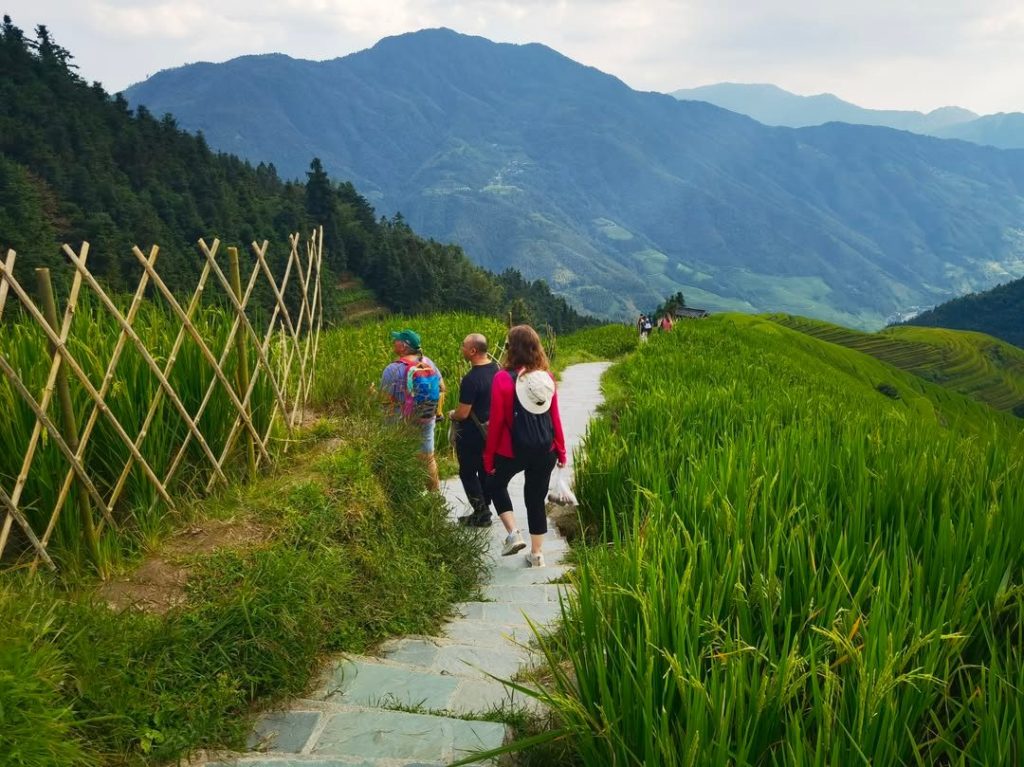
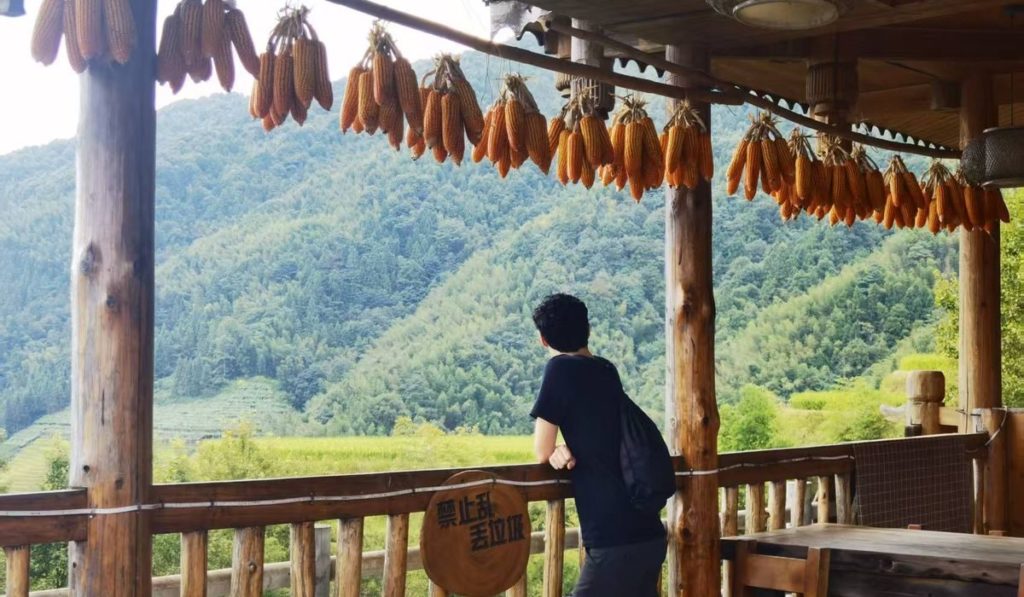
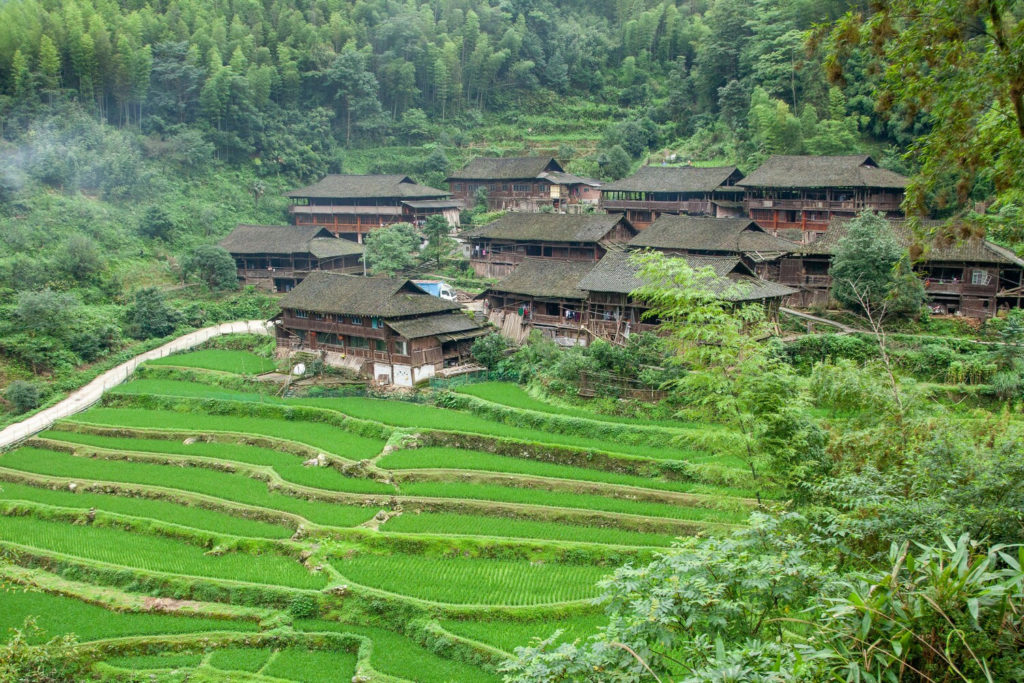
Along the way we stopped at a wooden café with ears of corn hung up to dry along the eaves. From the lookouts you can see the whole village of dark wooden houses, with the fields curving around it.
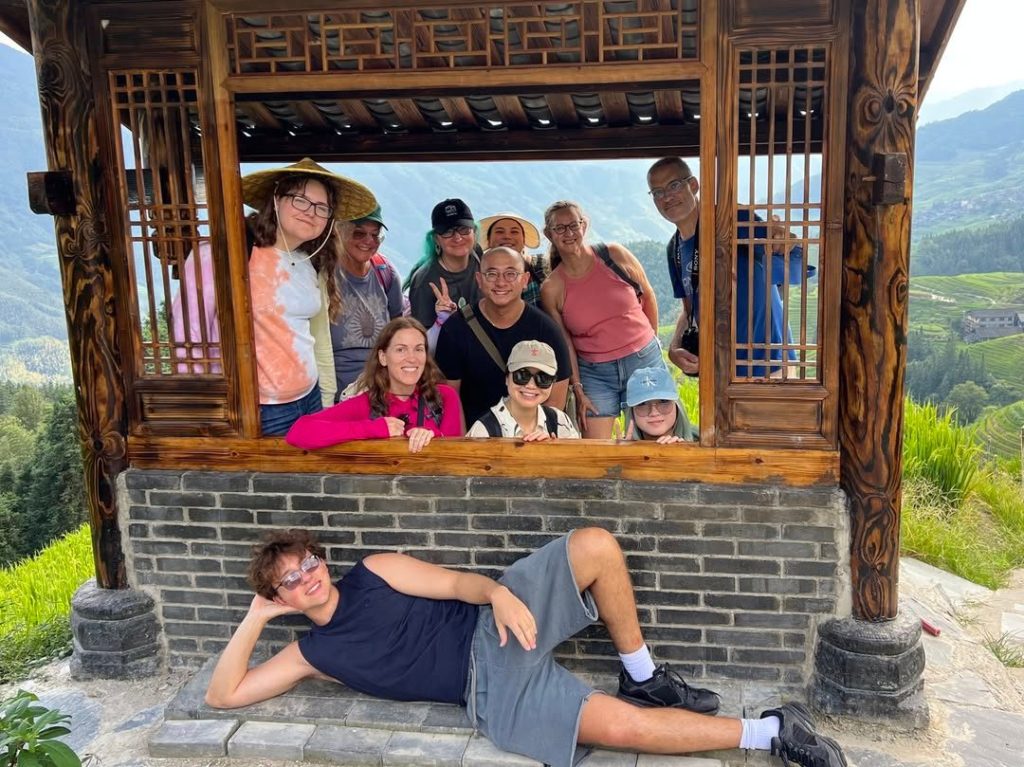
At one lookout, eleven of us squeezed into a carved wooden window frame for a group photo, one of us lying across the ledge in front. Someone still had to stand outside it to take the picture.
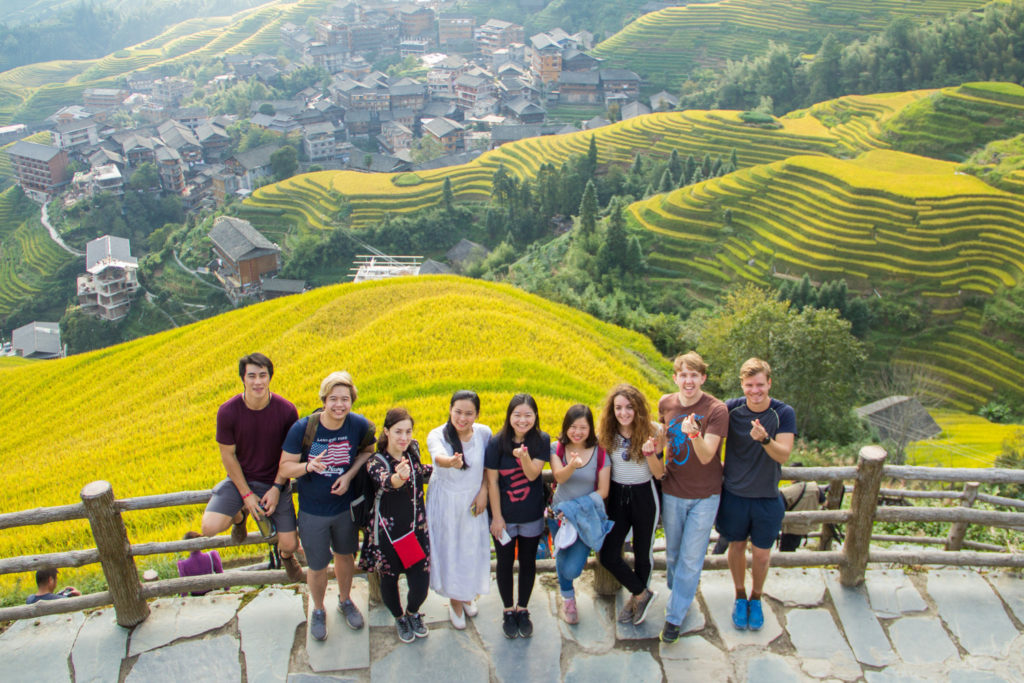
A few weeks later in the season, the whole hillside turns gold.
Words of the season
Our teachers introduced the words of the season along the way. Here are five of them, with the name of the terraces added at the end. Tap any word to see its meaning, and tap again to watch it written stroke by stroke.
| Китайский | Пиньинь | Значение |
|---|---|---|
| 初秋 | early autumn | |
| 梯田 | terraced fields, literally "ladder fields" | |
| 稻田 | rice paddy | |
| 丰收 | a good harvest | |
| 金黄色 | golden yellow | |
| 龙脊 | "dragon's backbone," the name of the terraces |
Longsheng, Longji and the people who farm the terraces
Longji sits in Longsheng (龙胜 Lóngshèng), a mountain county in the north of Guilin whose full name is the Longsheng Various Nationalities Autonomous County. About 70 percent of the people there belong to China's ethnic minorities, mostly the Dong, Zhuang, Yao and Miao. The Longji terraces are the work of Zhuang and Yao villages. People have farmed these slopes for centuries. Most of today's terraces took shape during the Ming and Qing dynasties, on hillsides too steep to farm any other way. The largest block of fields climbs more than 860 meters from the bottom tier to the top. In 2018 the UN's Food and Agriculture Organization listed the Longji terraces, with other terrace systems in southern China, as a Globally Important Agricultural Heritage System.
From the lookouts you can see where the name comes from: the ridge curves away like a dragon's spine, with the terraces as its scales. One ticket covers the three main areas. Ping'an (平安 Píng'ān), a Zhuang village, is the easiest for a first visit. It has paved paths and two well-known viewpoints: Nine Dragons and Five Tigers, and Seven Stars Around the Moon. Farther in is Dazhai (大寨 Dàzhài), a Red Yao village below the Jinkeng terraces. These climb to the area's highest viewpoint, West Hill Music, and a cable car from Dazhai goes up to Golden Buddha Peak if you'd rather not climb. The third area, the Longji Ancient Zhuang Village, is smaller and quieter.
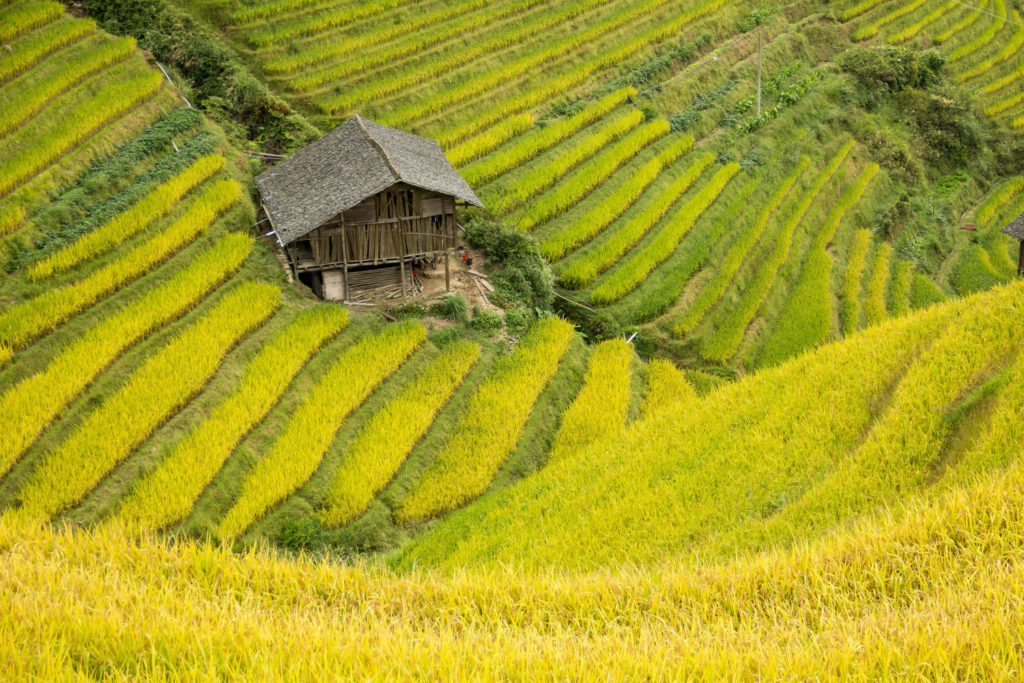
The Red Yao take their name from the red clothes the women wear, and the women are known for their very long hair, which they wear wound around the head. In April 2023, 256 Red Yao women in Huangluo (黄洛 Huángluò), a village at the foot of the terraces, set a Guinness World Record for the longest hair-combing chain. In Dazhai, on the 6th day of the 6th lunar month (July 19 in 2026), families hang their embroidered clothes out in the sun for the Clothes-Drying Festival (晒衣节 Shàiyī Jié).
Яншо, 19 сентября
Yangshuo and its karst peaks
Yangshuo (阳朔 Yángshuò) is a county about 65 kilometers south of Guilin city, and it's where most of the famous Guilin scenery actually is. The peaks are karst: limestone worn by rain and rivers into steep, separate towers. In 2014 two areas of them in Yangshuo County became part of the South China Karst World Heritage Site. The Li River (漓江 Lí Jiāng) winds between them for about 80 kilometers on its way from Guilin to Yangshuo.
If you have a 20-yuan note, the river on the back is the Li near Xingping (兴坪 Xīngpíng), a small river town in Yangshuo County. Yangshuo town itself is busier. West Street (西街 Xī Jiē) goes back to the year 590, when the town became the county seat, and today it's full of shops and cafés. A few minutes out on a bike, you're among rice fields again.
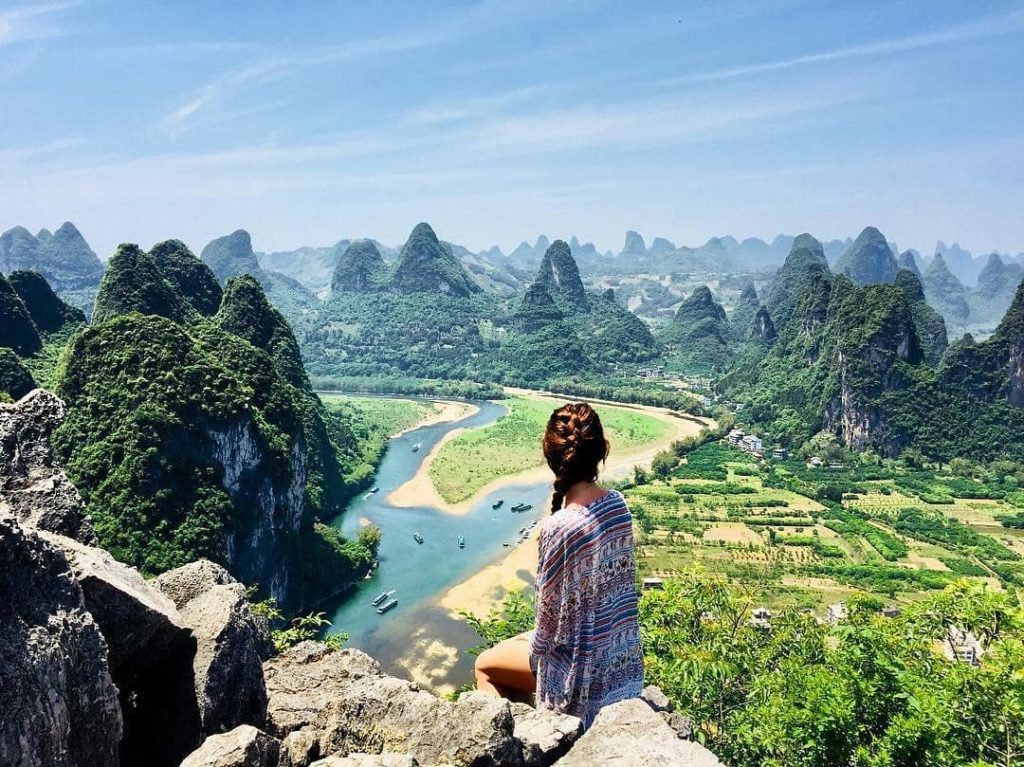
By bike through the countryside
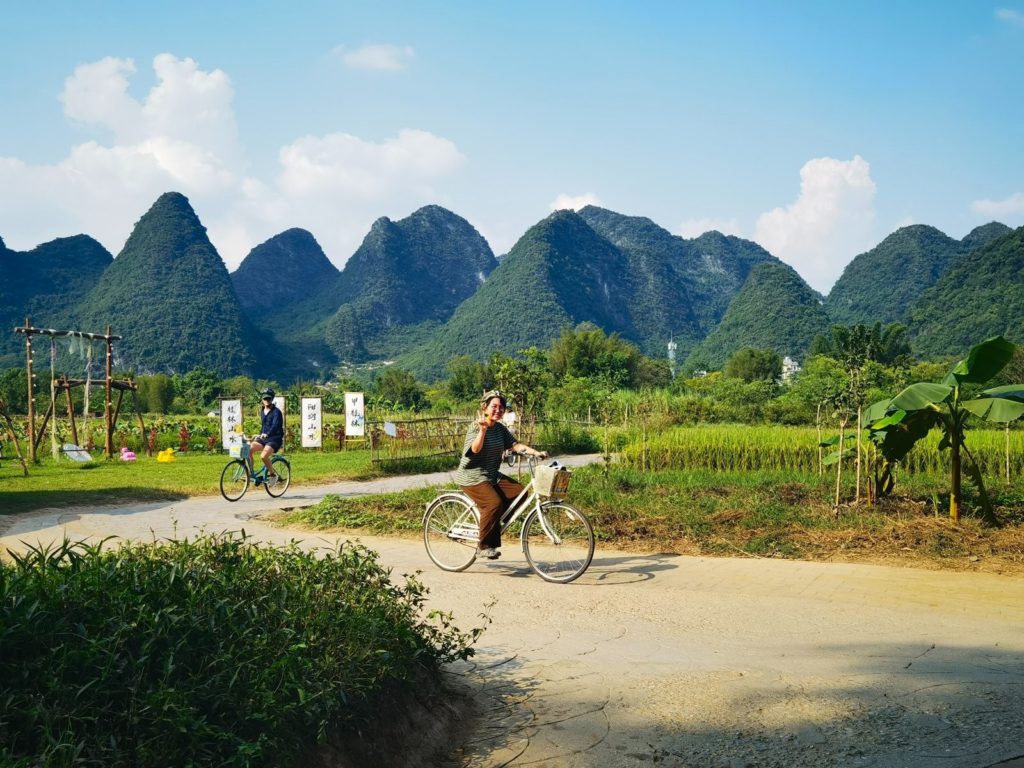
The land between Yangshuo's peaks is surprisingly flat, so you can ride for hours on farm roads without much climbing. We rode past rice fields and roadside flowers with the mountains lined up behind them. It was sunny and hot, and everyone got plenty of practice with 骑自行车 qí zìxíngchē, to ride a bike.
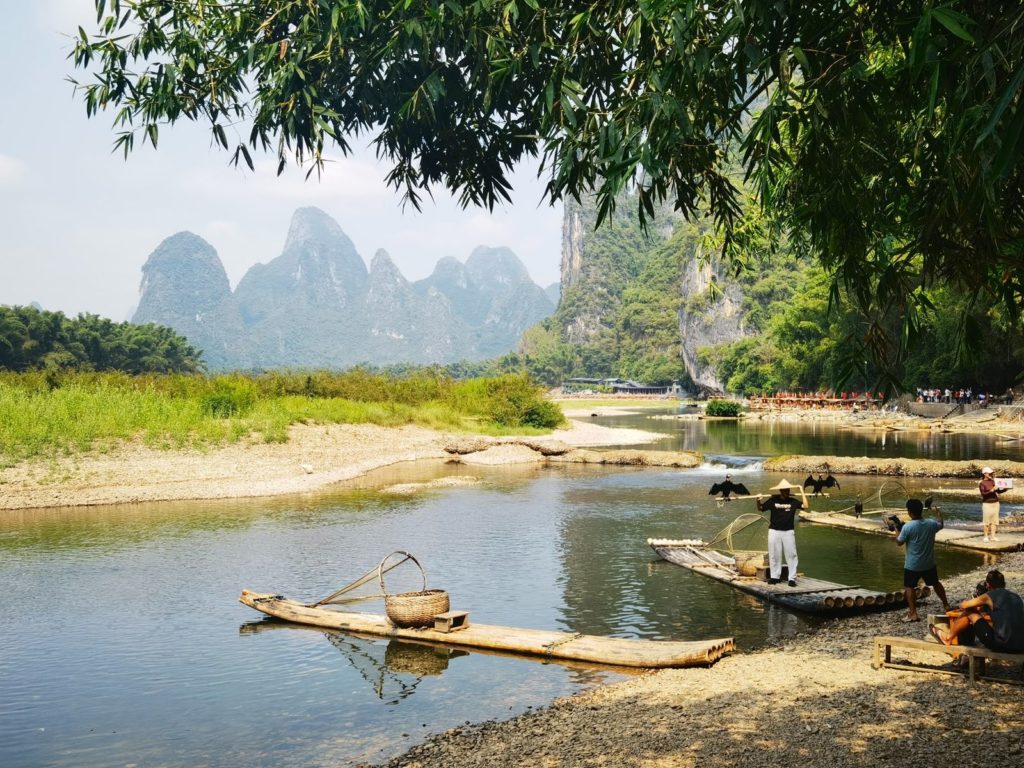
On a bamboo raft on the Li River
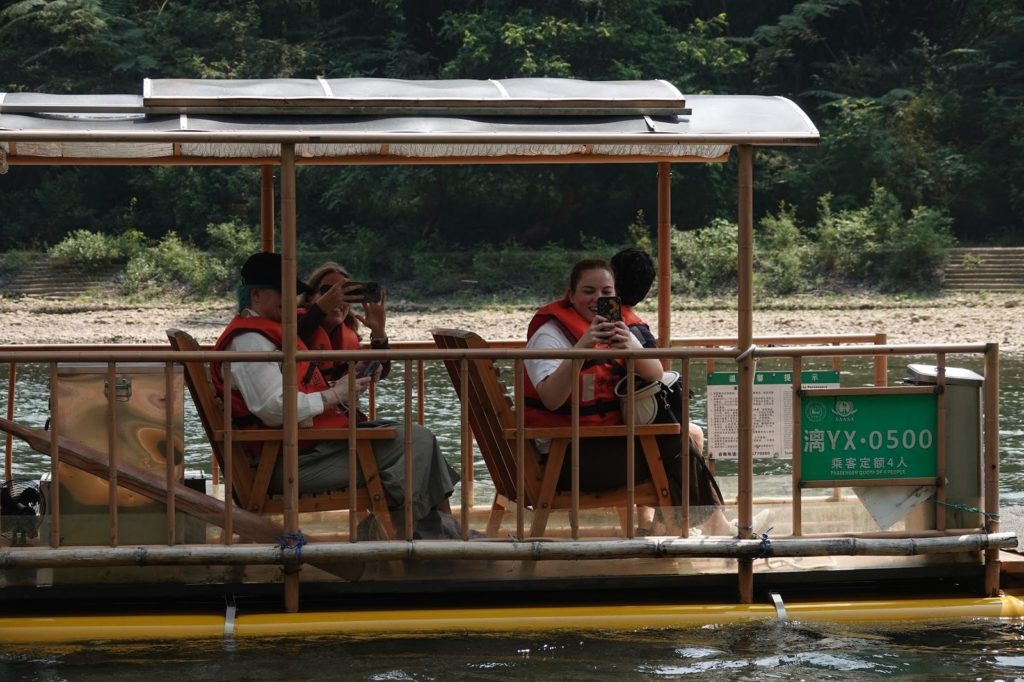
After the ride we traded the bikes for bamboo rafts (竹筏 zhúfá) on the Li River. By the riverbank a fisherman stood on his raft with his cormorants perched on a pole. The dictionary word for them is 鸬鹚 lúcí, but most people just call them 鱼鹰 yúyīng, "fish hawks." Fishermen on the Li River have long trained the birds to dive for fish and bring them back to the raft. Today it's mostly done for visitors and photographers, so the birds pose more than they fish.
The rafts are covered, with deck chairs and a green plate on the back, and the plate on ours made a good reading exercise. It starts with 漓 lí for the Li River, then says 乘客定额4人 chéngkè dìng'é sì rén, a limit of four passengers. The "bamboo" is plastic pipe these days, with a small electric motor, so once you've read the plate you just sit back and watch the peaks go by. A ride like this is 漂流 piāoliú, literally "to drift," and the everyday word for rafting.
Before heading home there was time to look at the stalls selling carved bamboo tubes and red beads with gold characters. The word for the day's scenery is 山水 shānshuǐ, literally "mountains and water," the same 山水 as in 山水画 shānshuǐhuà, a Chinese landscape painting. People in Guilin are fond of the saying 桂林山水甲天下 Guìlín shānshuǐ jiǎ tiānxià: "Guilin's scenery is the finest under heaven."
Planning your own trip
You can do both on your own from Guilin. Start early, especially for Longji, which is two to two and a half hours each way.
Getting there, tickets and time
| Longji rice terraces | Яншо | |
|---|---|---|
| Из Гуйлиня | About 2 hours north by car to Ping'an and 2.5 hours to Dazhai; coaches take about 3 hours. | About 1.5 hours south by coach, about ¥30. High-speed trains from Guilin North or Guilin West reach Yangshuo Station in 20 to 30 minutes (about ¥26 to ¥40), but the station is near Xingping, about an hour by bus from Yangshuo town. The Li River cruise takes about four hours, and there is no boat back. |
| Entry | About ¥80 for one ticket that covers Ping'an, Dazhai and the Ancient Zhuang Village; the Dazhai cable car is extra (about ¥55 one way). | No ticket for the town or the countryside; rafts, cruises and shows are paid separately. |
| How long | A long day trip, or a night in Ping'an or Dazhai to see the fields at sunrise. | A day for cycling and a raft, two or three days to slow down. |
| Лучше всего подходит для | Hiking and the harvest | Cycling and the river |
| Our full guide | Longsheng rice terraces | Путеводитель по Яншо |
In Yangshuo, a bike costs about ¥30 to ¥50 a day; check the brakes before you pay. The classic ride goes from West Street along the Yulong River valley toward Moon Hill, about 15 to 25 kilometers, which takes half a day.
Wear shoes with grip, because the stone steps get slippery after rain. Bring sunscreen, a hat, water and a light rain jacket, and your passport, which you need for train tickets and to check in anywhere you stay the night. September afternoons in the Guilin area average about 30°C (86°F).
When to see the terraces
Most people come for the gold, but the flooded fields of late spring are just as good on a clear morning.
| When | What you'll see |
|---|---|
| Late April to early June | The fields are flooded and planted, so the terraces fill with water and reflect the sky. |
| Mid-June to mid-September | Bright green rice. June is the wettest month and July is still rainy, so the paths get muddy. |
| Late September to mid-October | The rice turns gold, and cutting usually starts in October. The busiest time of year. |
| Late October to April | The fields are cut and bare, and quiet. Some winters bring snow between December and February. |
Avoid the National Day holiday, October 1 to 7, when half of China seems to be on the same stone steps as you. A weekday in late September or mid-October gets you the gold with room to stop for photos.
Trips with CLI
Our students live in Guilin, so Longji and Yangshuo are weekend trips for them. We run weekly activities and, about once a month, an excursion beyond the city. Teachers and pengyou (local Chinese friends who help with language practice) often come along, so there's plenty of Chinese on the trail. Some activities are included in tuition, and for optional ones we pass along the direct costs with no markup. You can see more of what students do on our Immersion Program page and in the photo gallery.
Частые вопросы
When is the harvest at the Longji rice terraces?
The rice turns gold from about late September. Most fields are cut in the middle and second half of October, over a few weeks, depending on the year and the height of the fields. In mid-September it's still mostly green with gold at the tips.
Can you visit the Longji rice terraces as a day trip from Guilin?
Yes. It's about two to two and a half hours each way by car, which leaves time for a few hours of hiking and lunch in Ping'an or Dazhai. Staying a night lets you see the terraces at sunrise.
Which is better, Ping'an or Dazhai?
Ping'an is easier for a first visit or a day trip, with paved paths and the most convenient guesthouses and restaurants. Dazhai and the Jinkeng terraces climb higher, up to West Hill Music, the area's highest viewpoint, and a cable car from Dazhai to Golden Buddha Peak saves most of the climb. The same ticket covers both, and the hike between them takes about five hours.
Are the bamboo rafts on the Li River really made of bamboo?
Not on the Li River. The covered rafts there are plastic pipes made to look like bamboo, with a small electric motor, and they carry up to four people. Ours had a numbered green plate on the back. On the smaller Yulong River near Yangshuo town, the rafts are real bamboo, poled by hand.
Источники
Facts were checked on November 9, 2026. Tickets, fares and train times change, so check them before you travel.
- People's Daily via Huanqiu: the history and height of the Longji terraces. View source →
- Xinhua: the Longji terraces as a Globally Important Agricultural Heritage System, and the meaning of the name. View source →
- Wikipedia: Longsheng Various Nationalities Autonomous County and the Longsheng rice terraces. View source → View source →
- Guinness World Records: the Red Yao hair-combing chain at Huangluo, April 2023. View source →
- Phoenix News: the Clothes-Drying Festival in Dazhai. View source →
- China Highlights and China Discovery: the villages, viewpoints, seasons, tickets and travel times at Longji. View source → View source →
- Wikipedia: Yangshuo County, the South China Karst World Heritage Site and the 20-yuan note. View source → View source → View source →
- Travel China With Me: Li River and Yulong River rafts compared. View source →
- China Highlights: Moon Hill and the bike ride along the Yulong River valley. View source →
- China Highlights: Yangshuo Station and the bus into town. View source →
- Travel China Guide: high-speed trains from Guilin to Yangshuo, and Guilin weather in September. View source → View source →