
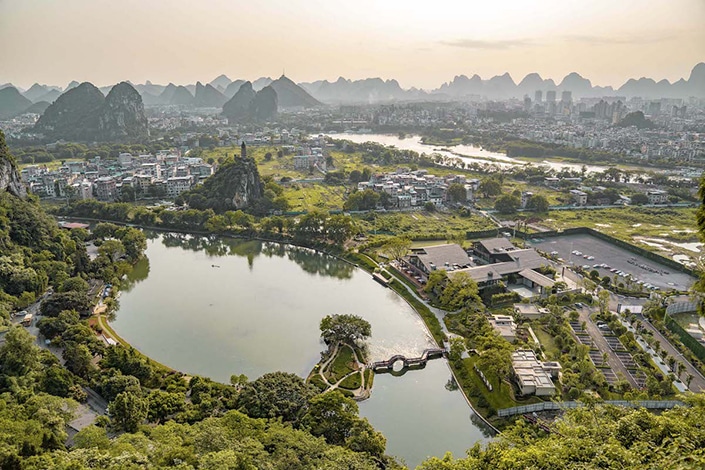
- Guilin is a mid-sized city of roughly 700,000 residents known for its UNESCO-recognized karst landscape, clean air, welcoming locals, and rich ethnic diversity — making it one of the best cities in China to study Mandarin.
- As the home of Guangxi Normal University (GXNU) and the Chinese Language Institute (CLI), Guilin offers international students a rare combination of world-class natural beauty and deep cultural immersion.
- The famous phrase 桂林山水甲天下 ("Guilin's scenery is the best under heaven") was first penned by Southern Song official Wang Zhengong in 1201 and rediscovered as a stone inscription at Duxiu Peak in 1983 — a testament to the enduring power of Guilin's landscape.
Choosing where to learn Chinese in China matters just as much as choosing how. The right city shapes your experience — from the conversations you have each day to the scenery you wake up to each morning. For over two decades, Guilin has drawn language learners from around the world, and the reasons go far beyond its famous mountains and rivers. Here's why Guilin stands out as one of the best places in China to study Mandarin.

01 Friendly Locals: Why Guilin's People Make It Easy to Learn Chinese
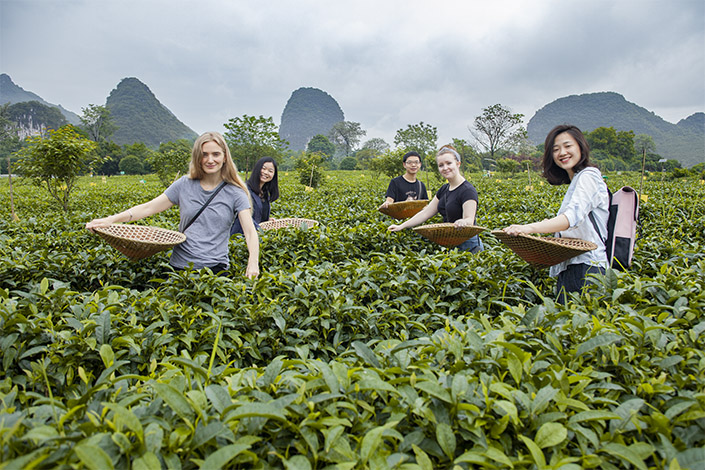
Whether it's a result of the scenic surroundings, a pleasant pace of life, or simply a cultural nuance, Guilin's people are friendly and eager to help. For most locals, interacting with foreigners is still something of a novelty. Because of this, you'll quickly find that people are genuinely eager to strike up a conversation with you.
It doesn't matter whether you're lost and in need of directions, curious about the best dish on a menu, or simply looking to make a new friend. In short, it's tough to find a more welcoming place than Guilin.
Moreover, this warmth translates directly into real-world language practice. Street vendors, taxi drivers, and neighbors become informal tutors who correct your tones and teach you local slang. For students who come to Guilin to study Mandarin, this everyday openness is one of the most valuable parts of the experience.

02 Guilin's Size: A Mid-Sized City That's Perfect for Language Learners
From an educational perspective, basing your Mandarin studies in a mega-city like Beijing or Shanghai doesn't always offer the best experience. It's easy to feel overwhelmed in such a fast-paced environment. On top of that, the abundance of English-speaking expat communities can make it tempting to stay inside a comfort zone.
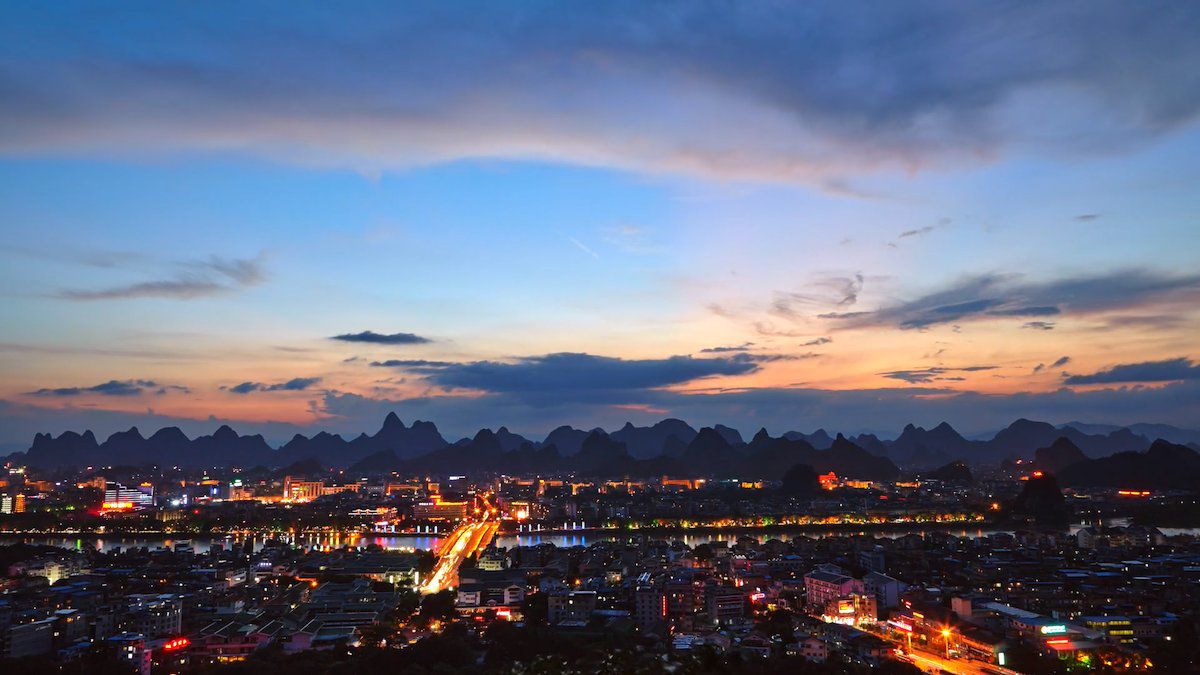
Guilin, on the other hand, strikes a different balance. With roughly 700,000 residents in its urban core, it's a mid-sized city with all the modern amenities you'd expect — high-speed rail, modern hospitals, and fast internet. Yet it comes without the sensory overload of a tier-one metropolis.
What's more, the countryside is only about a fifteen-minute bicycle ride from Guangxi Normal University, CLI's partner institution. Whether you're the cautious type or the adventurous type, Guilin is a city you can feel at home in from day one.
03 Clean Air and Natural Beauty in Guilin
There are few cities in China that can boast consistently clean, breathable air. While many Chinese cities experience periodic bouts of haze and smog, Guilin is different. The city is not home to heavy industry, so pollution here is minimal.
The main reason for this is that Guilin's primary industry is tourism. As a result, the local government has long prioritized preserving the natural beauty that draws visitors year-round. In 2014, Guilin's karst landscape was officially inscribed as part of the UNESCO South China Karst World Heritage Site, further cementing this commitment.
In addition, streets throughout the city are tree-lined, the downtown waterfront is well-maintained, and public spaces are kept clean. For students spending months — or even years — in China, this environmental quality makes a real difference in daily well-being.
04Guilin’s Culture and Ethnic Diversity
Beyond its natural beauty and practical advantages, Guilin also offers a depth of cultural experience that few other Chinese cities can match. From its role in China's rapid economic transformation to the ethnic diversity of its surrounding region, the city gives language learners context that goes far beyond the classroom.
Guilin as a Symbol of China's Economic Transformation
Many of Guilin's residents are the first members of their families to earn a living beyond the farm. Similarly, many Chinese students enrolled at GXNU are the first in their families to pursue a university degree. Together, these stories reflect the economic strides China has made in recent decades.
Guilin is a city on the move. New infrastructure, expanding transit networks, and a growing service economy are all visible signs of transformation. At the same time, subtler shifts in daily life — from the rise of mobile payments to the growing café culture downtown — reveal just how quickly things are changing.
As a result, any local resident will be glad to share stories about how different things looked just ten or twenty years ago. For language students, these conversations are more than small talk. They're a window into one of the most significant economic stories of the modern era.
Ethnic Minorities in Guilin and Guangxi
Guangxi province is actually an autonomous region, officially named Guangxi Zhuang Autonomous Region (广西壮族自治区). The Zhuang (壮族) are the region's largest ethnic minority, making up roughly 32% of the total population. In addition, Guilin and its surroundings are also home to the Yao (瑶族), Miao (苗族), and Dong (侗族) peoples, among others.
To learn more about how China's ethnic and regional diversity shapes its linguistic landscape, see our guide to languages in China.
The traditional ways of life of each of these groups can be experienced within short day trips from the city. For example, the Longsheng Rice Terraces offer a stunning introduction to the agricultural traditions of the region's highland communities. Likewise, the distinctive wooden architecture of the Dong is just a bus ride away.
For students interested in Chinese culture, Guilin consequently delivers one of the most diverse experiences available on the Chinese mainland.

05Guilin’s Karst Scenery and the Li River
There's a reason so many Chinese language programs are based in scenic cities: environment matters. Research in second-language acquisition consistently shows that positive surroundings improve retention and motivation. In Guilin, the beauty of the setting isn't separate from the learning experience — it's woven into it. A morning hike along the Li River or an afternoon spent sketching karst peaks becomes part of the process. As a result, students gain experiences worth talking about in their next class.
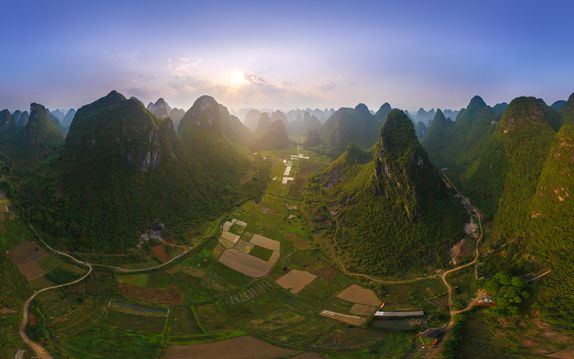
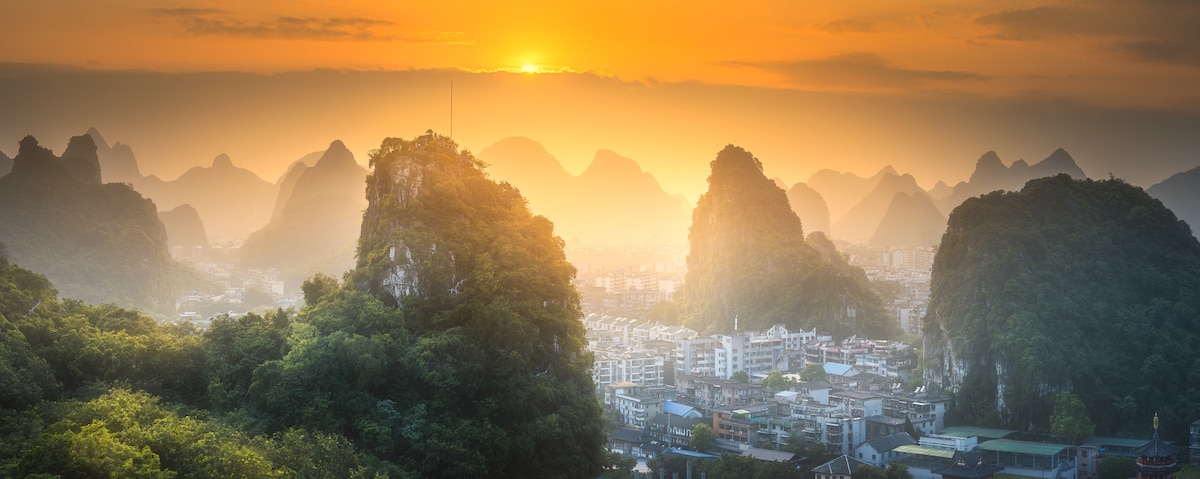
No article about Guilin would be complete without addressing the scenery itself. The karst formations around the city — tower-shaped limestone peaks rising from flat plains, draped in greenery and often half-hidden in mist — are the product of hundreds of millions of years of geological change. Specifically, the underlying limestone was deposited during the Devonian and Carboniferous periods. It was then sculpted by water, weathering, and tectonic uplift into the landscape visible today.
Karst Geology and the UNESCO Designation
Geologists recognize Guilin as a global reference site for two major karst landform types: fēnglín (峰林, tower karst) and fēngcóng (峰丛, cone karst). The interplay between these two forms is known in academic literature as the "Guilin model" of karst evolution. It is considered internationally significant.
In 2014, the Guilin Karst was inscribed as part of the UNESCO South China Karst World Heritage Site. This joined an earlier group of sites recognized in 2007. Notably, the inscription acknowledged Guilin's "spectacular tower karst and internationally acclaimed fenglin riverine landscapes."
The Li River, the 20-Yuan Note, and Beyond
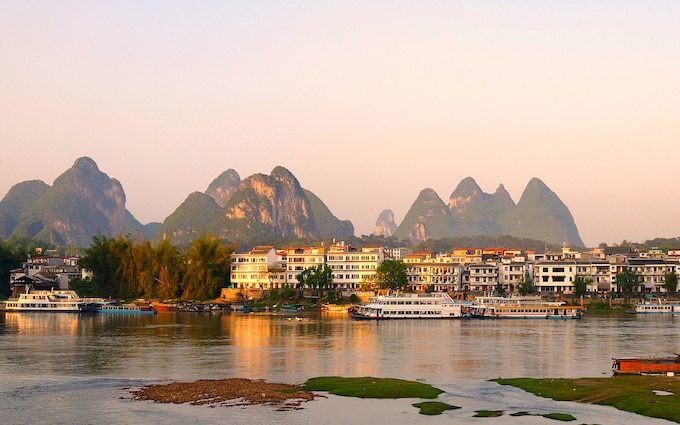
The Li River runs 83 kilometers from Guilin south to Yangshuo. The boat journey between the two is one of the most celebrated scenic experiences in all of China. In particular, the view of karst peaks reflected in the river's waters near Xingping is so iconic that it was chosen for the back of China's 20-yuan banknote.
Within the city itself, landmarks like Elephant Trunk Hill and Seven Star Park offer easy access to Guilin's geological wonders. For language students, these sites aren't just weekend excursions — they're living classrooms. Here, vocabulary like 山 (shān, mountain), 水 (shuǐ, water), and 洞 (dòng, cave) come to life.
Why Guilin Is Famous: The Meaning of 桂林山水甲天下
Guilin's beauty isn't just a modern tourism slogan — it has been celebrated for over 800 years. Few phrases in the Chinese language carry as much cultural weight as 桂林山水甲天下 (Guìlín shānshuǐ jiǎ tiānxià), best translated as "Guilin's mountains and waters are the best under heaven." For most Chinese people, these seven characters are inseparable from the identity of Guilin itself. However, the story behind the phrase — who wrote it, how it was lost, and how it was found again — is one that even many Chinese people don't know.
Wang Zhengong and the Lùmíng Banquet
The phrase was first composed in 1201 by Wang Zhengong (王正功), a Southern Song dynasty official from Ningbo. At the time, he was serving in Guilin as a regional judicial officer. He wrote the line as the opening of the second of two poems known as the Quànjià Shī (劝驾诗), or "Poems of Encouragement."
The occasion was a lùmíng yàn (鹿鸣宴), a traditional banquet held to celebrate scholars who had passed the provincial exams. Importantly, Wang's intent was not simply to praise the landscape. Instead, he used Guilin's beauty as a metaphor: just as these mountains and rivers were unmatched under heaven, so too should the candidates aim to be unmatched in their ambitions.
Although many Tang dynasty poets — including Du Fu, Han Yu, and Li Shangyin — had written admiringly about Guilin before him, Wang was the first to crystallize its reputation into a single, unforgettable line. For a deeper look at the layers of history that shaped this city, see our guide to the history of Guilin.
Rediscovery at Duxiu Peak
After Wang Zhengong's time, the exact origin of the phrase fell into dispute. From the late Qing dynasty through the mid-20th century, scholars debated its authorship for over six decades. Some attributed it to later writers, while others believed it was simply a folk saying.
The mystery was finally resolved in 1983. That year, cultural heritage workers in Guilin were cleaning stone inscriptions at Duxiu Peak (独秀峰). Beneath a thick layer of calcium deposits near a cave entrance, they uncovered a carved stone bearing the full text of Wang's poems, dated to 1201 CE.
This discovery settled the debate once and for all. Remarkably, Duxiu Peak sits inside the grounds of Guangxi Normal University's Wangcheng Campus. As a result, the birthplace of Guilin's most famous line is still a living part of the city's academic life — and a place that CLI students can visit any day of the week.
From Poetry to National Identity
In the centuries since Wang first wrote the line, it has grown far beyond its origins as a banquet poem. During the Yuan, Ming, and Qing dynasties, the number of poems about Guilin's scenery swelled into the thousands. Furthermore, in 1962, writer Chen Miao (陈淼) popularized the phrase through a widely assigned primary school essay titled Guilin's Scenery (桂林山水).
Today, the phrase is known to virtually every Chinese person. In fact, the landscape it describes — limestone towers along the Li River — even appears on the back of China's 20-yuan banknote. In 2005, Guilin's city government hosted a conference that produced official translations of the phrase into over 40 languages.
Whenever you tell a Chinese person that you're planning to live, teach, or study in Guilin, they will almost always respond with the same line: 桂林山水甲天下! After 800 years, this phrase endures — and once you've seen the landscape for yourself, you'll understand why.


Learn Chinese with Cultural Context
CLI offers personalized Chinese instruction built around real language and culture. Join our Immersion Program in Guilin or start online with a free Chinese lesson.
06Study Chinese in Guilin with CLI
As the saying goes: 千里之行,始于足下 — a journey of a thousand miles begins with a single step. Guilin is a city that rewards curiosity. Whether you come for the scenery, the people, or the language, you'll leave with something far deeper than what you expected.
If you're still weighing your options, explore our ultimate guide to studying abroad in China for practical information on scholarships, visas, and program types. And when you're ready, our team at the CLI Center in Guilin is here to help.
Ready to get started?
- Explore the CLI Study Abroad page.
- Learn more about Guangxi Normal University.
- Start your online application today.
桂林山水甲天下!
07Essential Guilin Vocabulary for Chinese Learners
Whether you're planning a trip or already on campus, these terms will help you navigate conversations about Guilin. If you're new to reading Chinese pronunciation, our guide to pinyin is a great place to start.
| Chinese | Pinyin | Meaning |
|---|---|---|
| 桂林山水甲天下 | Guilin's scenery is the best under heaven | |
| 桂林 | Guilin (lit. "forest of sweet osmanthus") | |
| 山水 | Mountains and water; scenery; landscape | |
| 甲 | First; best; number one | |
| 天下 | Under heaven; the whole world | |
| 漓江 | Li River | |
| 喀斯特 | Karst (geological term) | |
| 峰林 | Tower karst; peak forest | |
| 阳朔 | Yangshuo (county south of Guilin) | |
| 少数民族 | Ethnic minority | |
| 独秀峰 | Duxiu Peak; Solitary Beauty Peak | |
| 石灰岩 | Limestone | |
| 象鼻山 | Elephant Trunk Hill | |
| 七星公园 | Seven Star Park | |
| 龙脊梯田 | Longsheng Rice Terraces (lit. "Dragon's Backbone Terraces") | |
| 壮族 | The Zhuang ethnic group | |
| 鹿鸣宴 | Lùmíng banquet; traditional exam celebration feast | |
| 峰丛 | Cone karst; cluster peaks | |
| 油茶 | Oil tea; traditional Guilin tea ceremony drink | |
| 广西师范大学 | Guangxi Normal University (GXNU) |