Chinese Tattoos: Meanings, Symbols & Ideas
 Anias Stambolis-D’Agostino
Learn Chinese in China or on Zoom and gain fluency in Chinese!
Join CLI and learn Chinese with your personal team of Mandarin teachers online or in person at the CLI Center in Guilin, China.

From calligraphy characters rich with ancient wisdom to watercolor landscape scenes, Chinese-style tattoos are alluring and emblematic.
However, they are often misunderstood by foreigners or those lacking insight into Chinese culture. Read on to learn about the cultural context of body ink in China and get ideas for your next Chinese tattoo.

Tattoos in Chinese Culture
While Chinese tattoos are quite popular in the Western world, many people who get them are unaware of the complex and nuanced status of tattoos in Chinese society.
In order to understand the cultural significance of body ink in the Middle Kingdom and grasp the meaning of your own Chinese tattoo, it’s worth taking a look at the history and modern reception of body ink in China.
If you're most interested in reading about ideas for your next Chinese tattoo, feel free to jump right to our Types of Chinese Tattoos section below.

A Checkered Past
Tattoos have historically been a social taboo in China and many parts of East Asia.
This negative sentiment is likely in part rooted in Confucianism, the ancient Chinese philosophy guided by the scholar 孔子 (Kǒngzǐ Confucius). According to traditional Confucian beliefs, in order to demonstrate filial piety, children should keep their bodies as pure and unmarked as they were when their parents created them.
Tattooing, therefore, was considered a defiling and dishonorable act against the sacred family unit.
As the dynasties passed on, tattoos gradually came to be associated with crime and deviance. During certain periods, convicts and deserters were tattooed on their faces and exiled to faraway lands, literally branded for life in a practice known as 刺配 (cìpèi).
When organized crime groups arose in the 18th and 19th centuries, body ink became a way to signify gang membership.

Mark of Identity
Despite the social stigma surrounding tattoos, there are several historical accounts of Chinese warriors who got themselves inked with oaths of national loyalty. These individuals are generally regarded positively in the Chinese historical narrative.
As legend has it, General Yue Fei of the Southern Song dynasty (1127–1279 AD) was tattooed with the four characters 盡忠報國 (rendered in simplified characters as 尽忠报国 jìn zhōng bào guó), meaning “loyal to my country.”
This celebrated patriotic tattoo would later become part of the national myth that depicts him as a folk hero who was unfairly executed on charges fabricated by his enemies. The plot of Full River Red, China’s highest-grossing movie of 2023, hinges on Yue Fei’s folkloric tattoo.
In addition to the Han majority, China is also home to many Chinese ethnic minority groups, some of which have cultural traditions that involve tattoos.
One of China’s smallest officially recognized ethnic groups, the Derung tribe of Yunnan province, is known for inking facial tattoos on female members, a practice called 纹面 (wénmiàn).
Other minority groups, including the Dai (傣族 Dǎizú) and Li (黎族 Lízú) of southwestern China, have tattooed themselves with geometric shapes and lines for centuries as a rite of passage.

All the Rage in the Modern Age
In present-day China, tattoos still remain somewhat stigmatized by the mainstream public as a symbol of the criminal underworld. This attitude is especially prevalent among social conservatives and members of the older generations.
Government censorship has also aimed to curb the emergence of tattoos in popular culture. In 2021, sports authorities told national-team footballers to cover or remove tattoos in an effort to prohibit depictions of “subculture.”
However, despite these enduring negative attitudes, tattoos are fast becoming more widely accepted in China.
Today, when walking through one of the country’s many urban centers, you’ll almost certainly pass a number of tattooed locals who are more likely to be making a fashion statement than claiming gang affiliation.
Social media, which presents images of inked-up Westerners covered in both Western and Chinese-style tattoos, has helped to draw body art out of China’s social margins and into the pop-culture mainstream.
As a result, many tattoo artists in China have found unprecedented success over the past decade, reporting an influx of clientele from all walks of life, from teenage hipsters to high-level CEOs.
The rising popularity of tattoos is sometimes attributed to the pursuit of individualism and the sprouting of a newfound desire for self-expression in the modern Chinese psyche.

Two Main Types of Chinese Tattoos
Whether you’re a fan of Chinese culture and language or are simply drawn to the elegant aesthetic of Chinese calligraphy and art, Chinese tattoos offer a range of themes and styles to choose from when considering your next piece of inkwork.
Chinese Characters
Chinese characters (汉字 Hànzì) are the equivalent of words and syllables in English and make for classic tattoos.
Each character contains a unique story and most have undergone a long process of evolution and developed a great breadth of meaning.
Usually tattooed as Chinese calligraphy or handwritten script in traditional characters (繁体字 fántǐzì), the long, bold strokes of character tattoos create a minimalistic yet eye-catching aesthetic on the skin.
If you’re considering a Chinese character tattoo, it’s a good idea to first choose what you want to say in English, then have your tattoo translated into Chinese. Alternatively, check out this list of commonly tattooed Chinese words for inspiration:
| Traditional | Pīnyīn | Definition |
|---|---|---|
| 和 | hé | harmony; peace |
| 力 | lì | power; strength |
| 愛 | ài | love (traditional character version) |
| 夢 | mèng | dream (traditional character version) |
| 志 | zhì | ambition |
| 氣 | qì | vital energy (traditional character version) |
| 命 | mìng | fate; destiny |
| 信 | xìn | faith |
| 道 | dào | truth; principle |
| 仁 | rén | benevolence |
| 美 | měi | beauty |
| 神 | shén | spirit |
| 安 | ān | tranquility; peace |
| 智 | zhì | wisdom |
| 德 | dé | virtue |
| 孝 | xiào | filial piety |
| 慈 | cí | compassion |
| 誠 | chéng | sincerity (traditional character version) |
| 明 | míng | enlightenment |
In addition to the characters above, quotes from Chinese philosophers and classic idioms (成语 chéngyǔ) also make for eloquent tattoos. Check out these proverbs about learning and proverbs about family, or do your own research to find one that resonates with you and embodies your life philosophy.
Note that Chinese character tattoos aren’t particularly common among Chinese people in China. Ironically enough, you’re just as likely to see a local with a tattoo in English.
Therefore, while a Chinese tattoo won’t exactly help you blend in with the locals, it could instead be a way to commemorate your dedication to and understanding of Chinese language and culture.

Symbols and Imagery
If you’re looking for a more visually intricate design than a word or saying, classical images steeped in Chinese cultural symbolism also make for decorative and expressive tattoos.
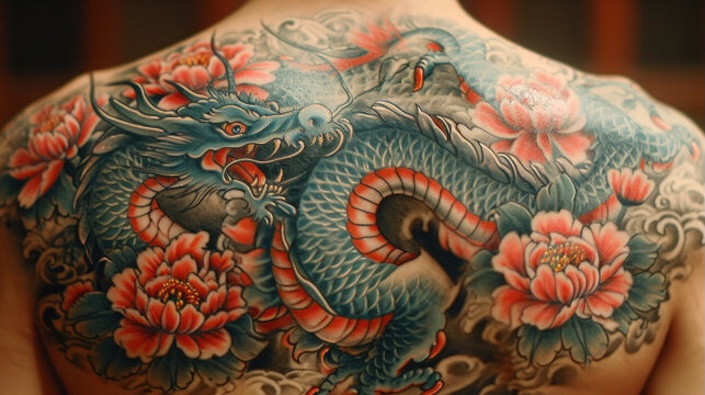
Dragons (龙 lóng), a powerful creature in Chinese folklore and symbol of the country’s national identity, are commonly depicted in Chinese-style body art. Tigers (老虎 lǎohǔ) and other Chinese zodiac animals are seen as noble yet playful tattoos.
Stone lions 石狮 (shíshī), sometimes colloquially called “Foo Dogs” in English, serve as guardians keeping silent watch over palaces and temples alike. Frequently memorialized in East Asian architecture, inked portraits of these imposing animals are common and auspicious tattoos in China.
Warriors and important figures from Chinese history, as well as folk gods like Guan Yu (关羽 Guān Yǔ), a martial deity, are also frequently depicted in body art on men.
Lotus flowers (莲花 liánhuā) and koi fish (锦鲤 jǐnlǐ), which symbolize enlightenment and prosperity, respectively, are timeless tattoos imbued with cultural significance in China and throughout East Asia.
Watercolor-style (水彩纹身 shuǐcǎi wénshēn) tattoos invoke themes of harmony with nature through traditional Chinese landscape aesthetics. They usually illustrate scenes of natural landscapes, such as mountains, waves, trees, and birds.
A Word to the Wise
Before getting a Chinese tattoo that features Chinese characters, make sure you know what it means! From minorly funny to downright offensive, Chinese tattoos can be hit or miss, particularly when inked on someone who doesn’t fully understand his or her tattoo’s linguistic or cultural significance.
When you sit down in the tattoo chair, make sure that you truly comprehend what the Chinese characters used in your tattoo mean.
If you’re planning on inking yourself with a Chinese-style image, remember to first read up on its history, symbolism, and perception among Chinese people.
It’s also a good idea to ensure that the artist is either a Chinese speaker or familiar enough with Chinese calligraphy to write the characters correctly.
Otherwise, you may be in for an epic — and permanent — Chinese tattoo fail.

Come to Guilin and learn more!
The best way to ensure that your Chinese tattoo fits your vision is to first discuss it with several native speakers.
Better yet, consult with a Chinese teacher or someone else who is well-informed about the nuances of Chinese language and culture to get all your questions answered. Sign up today for a free one-on-one lesson!

Chinese Tattoo Vocabulary
| Hànzì | Pīnyīn | Definition |
|---|---|---|
| 纹身 | wénshēn | tattoo (commonly used in mainland China) |
| 刺青 | cìqīng | tattoo (commonly used in Taiwan) |
| 汉字 | Hànzì | Chinese character |
| 书法 | shūfǎ | calligraphy |
| 繁体字 | fántǐzì | traditional Chinese character |
| 社会污名 | shèhuì wūmíng | social stigma |
| 刺配 | cìpèi | an ancient practice of tattooing criminals |
| 纹身师 | wénshēnshī | tattoo artist |
| 纹面 | wénmiàn | face tattoo |
| 典故 | diǎngù | a quote from literature or a classic story |
| 成语 | chéngyǔ | a Chinese idiom |
| 石狮 | shíshī | stone lion or "foo dog," a common tattoo in China |
| 龙 | lóng | dragon |
| 老虎 | lǎohǔ | tiger |
| 关羽 | Guān Yǔ | Guan Yu, the Chinese God of War |
| 锦鲤 | jǐnlǐ | koi fish |
| 莲花 | liánhuā | lotus flower |
| 水彩画 | shuǐcǎihuà | watercolor |

Anias holds a BA in East Asian Studies and Chinese Language from Bard College and has lived, studied, and worked in China and Taiwan for over seven years. She first moved to Guilin with the Chinese Language Institute's Teach in China program in 2016 and joined the CLI team as a Program Manager in 2017. Anias is fluent in Chinese and brings deep knowledge of contemporary Chinese society and culture to her writing. She currently lives in Taiwan.