

- Pinyin (汉语拼音) is the standard romanization system for Standard Mandarin and the pronunciation system most learners use to begin learning Chinese.
- If you want to learn Chinese pronunciation well, the most important beginner priorities are tones, a few high-value sound traps, and lots of listening to native audio.
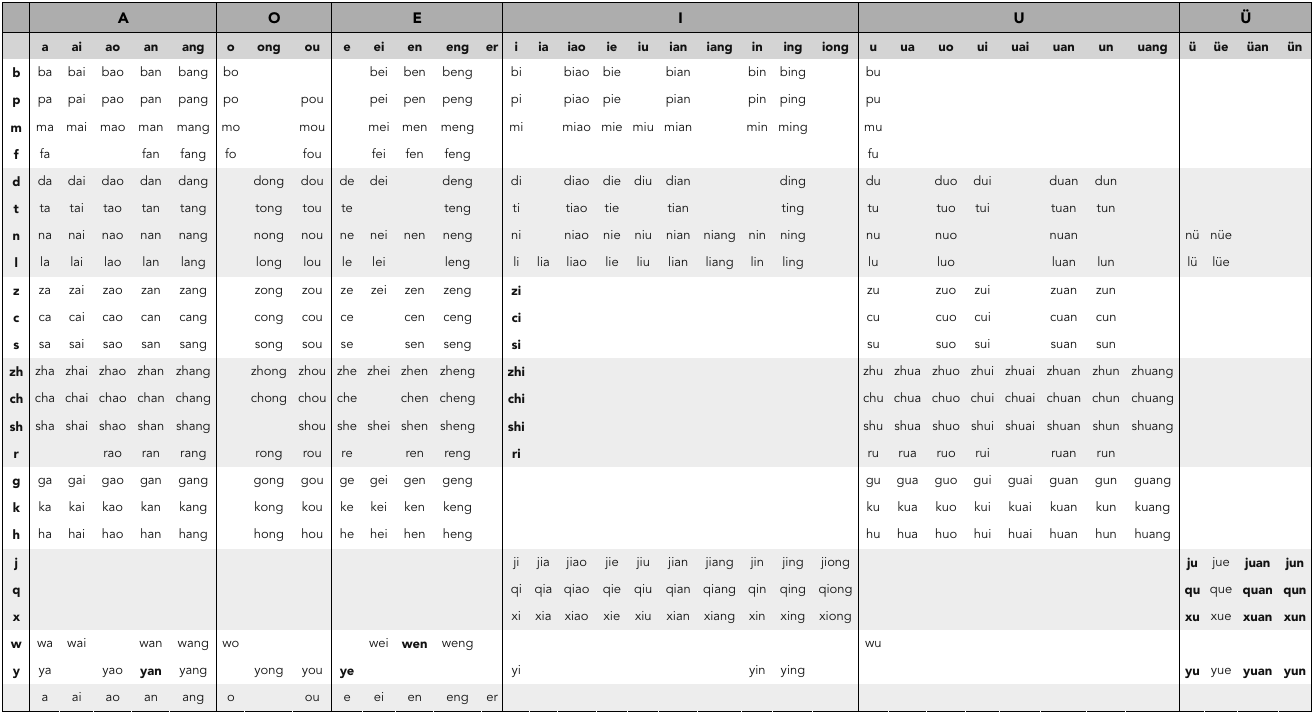
- Pinyin uses familiar Roman letters, but many of those letters do not sound the way English speakers expect. An interactive pinyin chart with audio is one of the best tools for hearing how each syllable actually sounds.
- This guide includes a complete pinyin cheat sheet with approximate American English equivalents for every pinyin initial, final, and special syllable to help you conceptualize each sound.
- Tones are part of the word in Mandarin. Change the tone and you may change the meaning.
- Pinyin is extremely useful for speaking, typing, dictionary lookups, and learning new words, but over time, you should rely more on characters and less on pinyin when reading.
If you're starting to learn Chinese, pinyin can feel like a lifesaver. After staring at Chinese characters and wondering where to begin, suddenly you see something written in letters you already know.
Why first impressions of pinyin can be misleading
That first impression is helpful, but it can also be misleading. Chinese pinyin uses the Roman alphabet, yet it does not work like English. If you pronounce it the way an English speaker would instinctively guess, you'll build habits that are hard to fix later.
This guide is designed for beginners. It will show you what pinyin is, how it works, which mistakes matter most at the start, and how to use pinyin in a way that helps you learn Chinese faster and more accurately.
It also includes a complete pinyin cheat sheet with American English approximations for every sound in the system.

01 What Is Pinyin? (汉语拼音)
Hanyu Pinyin ( 汉语拼音) is the standard system used to write the sounds of Mandarin Chinese with Roman letters.
In practice, pinyin helps learners pronounce new words, helps Chinese speakers type on phones and computers, and provides a bridge between spoken Mandarin and Chinese characters ( 汉字).
Pinyin was officially adopted in 1958 and is now the main romanization system used in textbooks, dictionaries, apps, and Chinese learning materials around the world. For most people who want to learn Chinese today, pinyin is the pronunciation system to learn first.
Pinyin is best understood as a pronunciation map. It shows you what sound to make, but it is not a substitute for hearing real Mandarin. When combined with native audio, it becomes a powerful learning tool. Without audio, however, bad habits can take root quickly.
02 How Pinyin Works: Initials, Finals, and Tones
Most pinyin syllables are built from three parts: an initial, a final, and a tone.
| Part | Chinese | Pinyin | Meaning |
|---|---|---|---|
| Initial | 声母 | The consonant sound at the beginning of the syllable | |
| Final | 韵母 | The vowel or vowel combination that follows | |
| Tone | 声调 | The pitch pattern that helps distinguish meaning |
If you're a beginner, the most important thing to understand is this: in Mandarin, the tone is part of the word. It is not optional or decorative.
If you change the tone, you may change the word entirely.
| Tone | Mark | Description | Example |
|---|---|---|---|
| First tone | ˉ | High and level | 妈 (mother) |
| Second tone | ˊ | Rising | 麻 (hemp) |
| Third tone | ˇ | Low / dipping | 马 (horse) |
| Fourth tone | ˋ | Sharp falling tone | 骂 (to scold) |
| Neutral tone | No mark | Light and short | 吗 (question particle) |
Mandarin has a relatively small number of possible syllables compared with English, which is one reason homophones are so common. Tones become even more important as a result.
The syllable , for example, can correspond to many different characters and meanings depending on context.

03 Where Pinyin Sounds Different from English
This is where many beginners get tripped up. Although pinyin looks familiar, several letters and letter combinations do not behave the way an English speaker expects.
While learning pinyin, it is most effective to listen to and repeat each pinyin sound using an audio pinyin chart rather than relying only on written approximations. Nevertheless, approximate English equivalents can be very helpful when conceptualizing and memorizing pinyin sounds for the first time.
The biggest pinyin mistake is assuming that familiar-looking letters must have familiar English sounds. They often do not. The tables below use approximate American English comparisons to help you get started, but these approximations are a stepping stone, not a destination. Always verify with native audio.
Pinyin initials: a sound-by-sound reference
Mandarin has 21 initials (consonant sounds that begin a syllable). Some sound close enough to their English counterparts that beginners can start with an English approximation and refine from there. Others have no real English equivalent and need special attention.
Initials that are close to English
| Pinyin | Approximate sound (American English) |
|---|---|
| b | Like b in boy, but without vibrating the vocal cords (unaspirated, unvoiced) |
| p | Like p in pin, with a strong puff of air |
| m | Like m in mama |
| f | Like f in fan |
| d | Like d in day, but without vibrating the vocal cords (unaspirated, unvoiced) |
| t | Like t in top, with a strong puff of air |
| n | Like n in not |
| l | Like l in let |
| g | Like g in go, but without vibrating the vocal cords (unaspirated, unvoiced) |
| k | Like k in kite, with a strong puff of air |
| h | Like h in he, but rougher and further back in the throat |
| s | Like s in say |
Initials that need special attention
| Pinyin | Approximate sound (American English) |
|---|---|
| z | Like ds in kids — not like English "z" |
| c | Like ts in cats — not like English "k" or "s" |
| zh | Like jur in jury — tongue curled back (retroflex) |
| ch | Like chur in church — tongue curled back with a puff of air |
| sh | Like shir in shirt — tongue curled back |
| r | No equivalent. Curl your tongue up near the top front of your mouth and create a vibration while making an "r" sound. Not like English "r" |
| j | Sounds very similar to the English letter G (as in "gee"). Tongue is flat and forward |
| q | No equivalent. Similar to "ch" except with your tongue flat and in the front of your mouth — not like English "kw" |
| x | No equivalent. Similar to "sh" except with your tongue flat and in the front of your mouth — not like English "ks" |
b / p, d / t, and g / k are mostly about air
For many beginners, one of the most useful pronunciation discoveries is that Mandarin pairs like , , and are not best understood through English spelling habits.
A simpler beginner way to think about them is this: one member of the pair has a strong puff of air (aspiration), and the other does not.
To illustrate, hold your hand in front of your mouth and say the English word "pin." You should feel a burst of air. Now say "spin." Much less.
Similarly, Mandarin , , and have the stronger puff of air, while Mandarin , , and do not.
Three groups of similar-sounding initials
Mandarin has three groups of consonants that can sound confusingly similar to English speakers. Understanding the tongue position for each group is the key to telling them apart.
| Group | Initials | Tongue position |
|---|---|---|
| Flat tongue (平舌) | Tongue tip touches behind the lower teeth | |
| Curled tongue (翘舌) | Tongue tip curls back toward the roof of the mouth (retroflex) | |
| Front tongue (尖舌) | Tongue stays flat and forward, near the hard palate |
If you can only focus on one consonant distinction early on, focus on the difference between the flat-tongue group () and the curled-tongue group (). This is one of the most common sources of confusion for English speakers.

04 Pinyin Finals: A Complete Sound Reference
Pinyin finals (韵母 ) are the vowel sounds or vowel-plus-consonant combinations that follow an initial. They are the heart of every pinyin syllable.
Although many finals are straightforward for English speakers, others hide surprises. The tables below give approximate American English equivalents for every standard final in the pinyin system.
These approximations are based on American English pronunciation. They are meant to help you conceptualize each sound, not to replace listening to native audio. For an audio reference, visit the CLI interactive pinyin chart.
Simple finals
| Pinyin | Approximate sound (American English) |
|---|---|
| a | Like a in mama |
| o | No exact equivalent. When preceded by a consonant, use the "wo" sound (think: bwo, pwo, mwo, fwo). The "o" and "uo" sounds are very similar |
| e | Like uh in duh or u in up — not like English "ee" or "eh" |
| i | Like ee in bee, or the English letter E |
| u | Like oo in too |
| ü | No equivalent. Round your lips as if saying "oo" but try to say "ee." Be sure to curl your upper lip forward |
Finals starting with a
| Pinyin | Approximate sound (American English) |
|---|---|
| ai | Like eye (example: Shanghai) |
| ao | Like ow in cow (example: Chairman Mao) |
| an | Pinyin "a" + "n" |
| ang | Pinyin "an" + "g" |
Finals starting with o
| Pinyin | Approximate sound (American English) |
|---|---|
| ou | Like oh in "oh no!" or the English letter O |
| ong | Pinyin "ou" + "ng" — not like English "ong" in "song" |
Finals starting with e
| Pinyin | Approximate sound (American English) |
|---|---|
| ei | Like ay in bay, or the English letter A (example: Beijing) |
| en | Like un in fun |
| eng | Pinyin "e" + "ng" (like ung in fungus) |
| er | Like ar in are — the "r-colored" vowel unique to Mandarin |
Finals starting with i
In the compound finals below, the "i" sounds like the "ee" in "bee." Use this "ee" sound for all "i" combinations that follow.
| Pinyin | Approximate sound (American English) |
|---|---|
| ia | Pinyin "i" (ee) + pinyin "a" |
| iao | Pinyin "i" + pinyin "ao" |
| ie | Pinyin "i" + "eh" as in education |
| iu | Pinyin "i" + pinyin "ou" (sounds like the English letters E + O strung together) |
| ian | Sounds like the English letters E + N strung together in succession |
| iang | Pinyin "i" + pinyin "ang" |
| in | No exact equivalent, but similar to a cross between seen and sin |
| ing | Like ing in sing |
| iong | Pinyin "i" + pinyin "ong" |
Finals starting with u
| Pinyin | Approximate sound (American English) |
|---|---|
| ua | Pinyin "u" (oo) + pinyin "a" |
| uo | Pinyin "u" + pinyin "wo" |
| ui | Pinyin "u" + pinyin "ei" (example: Guilin). With a consonant before it, "ui" sounds like way |
| uai | Pinyin "u" + pinyin "ai" |
| uan | Pinyin "u" + pinyin "an" (like the Spanish name "Juan") |
| un | No exact equivalent, but similar to a cross between win and woon |
| uang | Pinyin "u" + pinyin "ang" |
Finals starting with ü
| Pinyin | Approximate sound (American English) |
|---|---|
| üe | Pinyin "ü" + "eh" as in education |
| üan | Pinyin "ü" + the en in when |
| ün | No equivalent, but similar to a cross between win and wean |
Special syllable sounds: when i does not sound like "ee"
In most pinyin syllables, the letter "i" sounds like "ee" in "bee." But after certain initials, the written "i" represents a completely different sound.
These are among the most important exceptions in the entire pinyin system.
| Pinyin | Approximate sound (American English) |
|---|---|
| zi, ci, si | The "i" has no "ee" equivalent. It sounds similar to the i in zit — a short, buzzing vowel |
| zhi, chi, shi, ri | The "i" sounds like the ur in church — a deeper, retroflex vowel |
Standalone syllables that look different from their building blocks
Some pinyin syllables are written as standalone words (without a preceding initial) and use special spellings that can surprise beginners.
A few of the most common ones are worth memorizing early.
| Pinyin | Approximate sound (American English) |
|---|---|
| ye | Like ye in yes |
| yan | Rhymes with "ten" — not like English "yan" in "yank" |
| yuan | Sounds like the English letters U and N strung together in succession |
| wen | No exact equivalent, but similar to the English word when |
In pinyin cheat sheets and reference charts, you may see asterisks (*) next to certain entries like zi, ci, si, zhi, chi, shi, ü, yan, ye, yuan, and wen. The asterisk means that the vowel sound in that syllable has a variation within the pinyin system — the letter does not map to its "default" sound. Knowing which syllables carry these variations is one of the most important things a beginner can learn.
05 The Hidden ü and Other Pinyin Quirks
The hidden ü: why ju, qu, and xu are tricky
After j, q, and x, the written letter u is always pronounced like ü. The same sound family also appears in , , , and . Even though the following pinyin combinations use the üan construction, , , , and are written with a standard "u," not with the umlaut (ü).
If your native language is English, this sound may feel unfamiliar. Do not worry too much about getting it perfect immediately.
The important thing is to know that the spelling is hiding something non-English, so you remember to learn it from native audio instead of guessing.
Typing ü on a keyboard
When using pinyin to type Chinese characters on a computer or phone, you will inevitably encounter a practical question: how do you type ü?
The two syllables where this matters most are (女, woman) and (绿, green). On most pinyin input systems, you can type these as nv and lv respectively — the letter "v" serves as a stand-in for ü.
After , , , and , you can simply type "u" because the ü sound is the only possibility in those combinations.
The letter i does not always sound the same
In words like or , the letter "i" sounds close to "ee."
However, after , , and , the written "i" sounds more like the short "i" in "zit."
Furthermore, after , , , and , the "i" sounds like the "ur" in "church."
A beginner does not need the full phonetics lesson here — you just need to know that pinyin spelling is systematic, and the same letter can sound different depending on the initial that precedes it.
06 Tone Changes You Will Hear in Real Mandarin
Most beginner materials teach the four tones first, which is exactly right. But as you continue learning Chinese, you quickly notice that tones do not always sound in real speech the way they look on paper.
These common changes are called tone sandhi ( 变调).
Third tone + third tone: when two third tones come together, the first one usually sounds more like a second tone. For instance, 你好 is written but usually pronounced more like .
不 before a fourth tone: often changes to a rising tone before another fourth tone, so 不是 is commonly pronounced .
一 changes by context: the number one, , often changes in connected speech. For example, 一个 is commonly pronounced , and 一天 is commonly pronounced .
You do not need to master tone sandhi before you begin speaking Mandarin. Just be aware that it exists. The more native speech you hear, the more natural these tone changes will start to sound.


Want a faster, clearer path through the HSK levels?
CLI's programs combine personalized one-on-one teaching with a study plan built around your current level, your goals, and the skills you actually need next.
07 A Few Pinyin Spelling Rules Worth Knowing
Most beginners do not need a full course in pinyin orthography. Even so, there are a few spelling rules that are useful to know because they explain why certain words look the way they do.
The apostrophe rule. An apostrophe helps prevent ambiguity when a new syllable starts with , , or . A classic example is (西安) versus (先).
Tone mark placement. Tone marks do not go on a random vowel. There is a standard priority system for where the mark belongs. You do not need to memorize the full rule immediately, but you should know that the placement is systematic, not arbitrary.
Abbreviated finals. Some common written finals are shortened spellings. For instance, is a shortened form of , is short for , and is short for .
As a result, some pinyin syllables do not sound quite the way they look at first glance — and this is why the cheat sheet tables above describe as "pinyin 'u' + pinyin 'ei'" and as "pinyin 'i' + pinyin 'ou'."
For a beginner, the main lesson is simple: if a pinyin spelling seems strange, it usually is not random. There is usually a rule behind it.
08 How Chinese Children Learn Pinyin
Adult learners sometimes wonder whether pinyin is "real Chinese" or just a foreign learner tool. In reality, it is not just for foreigners. Children in mainland China learn pinyin in primary school, and it plays an important role in early pronunciation and literacy development.
It is better, however, not to imagine a rigid sequence where children first master pinyin and only later encounter characters. In practice, pinyin and character learning are closely connected. Although pinyin supports pronunciation and reading, it does not replace characters.
This is also a useful model for adult learners. Use pinyin confidently at the beginning — let it help you pronounce words, type Chinese, and build listening accuracy.
Then, over time, gradually reduce your dependence on it as your character recognition grows.
09 Why Pinyin Still Matters After the Beginner Stage
Pinyin is not just a beginner crutch. It remains practical long after your first months of study.
The most obvious example is typing. Most Chinese input systems ( 输入法) on phones and computers are pinyin-based. You type the pronunciation, and the device offers matching characters.
Beyond typing, pinyin is also how learners check pronunciation in dictionaries, how vocabulary is labeled in many apps, and how Chinese names and place names are often written internationally.
At the same time, there is an important balance to strike. If you always read the pinyin and ignore the characters, your character recognition will grow more slowly.
The healthiest long-term approach is to use pinyin as support for pronunciation and production, while gradually relying more on characters for reading.

10 Pinyin vs. Other Phonetic and Romanization Systems
Pinyin is not the only way Chinese sounds have been represented. Nevertheless, for almost every modern beginner learning Mandarin, it is the right place to start.
Before pinyin became the international standard, older systems such as Wade-Giles were widely used in English-language writing. As a result, you still see spellings like "Peking," "Tao," and "Kung fu," even though modern pinyin spellings are , , and .
In Taiwan, meanwhile, Zhuyin (also called Bopomofo, 注音) is still widely used in education. Unlike pinyin, it uses its own symbols rather than Roman letters.
If your goal is to learn Mandarin broadly, especially with the mainland as your focus, pinyin is still the main system you should learn first.
11 How to Start Learning Pinyin
If you're just beginning to learn Chinese, here is what matters most:
- Start with tones. Although you do not need perfect tones on day one, you do need to take them seriously from the beginning.
- Learn a small number of high-value traps early. Focus first on , , , , , the rule, and the common tone changes in words like 你好, 不是, and 一个.
- Use the cheat sheet tables as a conceptual bridge. The approximate English equivalents in this guide can help you form a mental model for each sound, but they are a starting point, not the finish line.
Building real pronunciation habits
Once you have a basic grasp of pinyin sounds, the next step is to focus on building habits that stick. Here are several additional strategies that can help:
- Use native audio constantly. Pinyin is a guide, not a recording. Learn the sounds by listening and imitating, using an interactive pinyin chart with audio.
- Practice full syllables, not isolated letters. It is more useful to practice , , and than to stare at the letters , , and in abstraction.
- Remember the three special "i" sounds. The "i" in (ee), the "i" in (short buzz), and the "i" in (deep ur) are three different vowels written with the same letter. Learn this early.
- Gradually reduce pinyin support when reading. Once you know a word, try to recognize the character without leaning on the pinyin every time.
- Get feedback if possible. Some pronunciation mistakes are hard to hear in your own speech. A skilled teacher can catch them much earlier.
12 Vocabulary
| Chinese | Pinyin | Translation |
|---|---|---|
| 汉语拼音 | Chinese phonetic alphabet / pinyin | |
| 汉字 | Chinese character(s) | |
| 声母 | initial | |
| 韵母 | final | |
| 声调 | tone | |
| 平舌音 | flat tongue sound | |
| 翘舌音 | curled tongue sound (retroflex) | |
| 注音 | Zhuyin / Bopomofo | |
| 变调 | tone change / tone sandhi | |
| 妈 | mother | |
| 麻 | hemp | |
| 马 | horse | |
| 骂 | to scold | |
| 吗 | question particle | |
| 你好 | hello | |
| 不是 | is not | |
| 一个 | one (of something) | |
| 女 | woman / female | |
| 绿 | green | |
| 输入法 | input method |
13 Sources
- Ministry of Education of the PRC — 汉语拼音方案. View source →
- ISO — ISO 7098:2015, romanization of Chinese using pinyin. View source →
- PRC Ministry of Education — Chinese curriculum standards on early language learning. View source →
- PRC National Textbook Guidance — Clarification on how first-grade literacy instruction relates to characters and pinyin. View source →
- Ministry of Education of Taiwan — 中文譯音使用原則. View source →
- Taiwan Zhuyin Reference — Zhuyin (Bopomofo) reference materials. View source →