


- Chinese and Korean belong to completely different language families, despite centuries of shared cultural history.
- Chinese grammar is famously simple (no conjugations, no tenses, no plurals), while Korean grammar relies on verb conjugation and layered politeness levels.
- Roughly 50 to 70 percent of Korean vocabulary is of Chinese origin, known as Sino-Korean (한자어) words.
- Chinese uses thousands of characters (汉字); Korean uses Hangul (한글), a 24-letter alphabet you can learn in a few hours.
- Chinese has a steeper start (tones and characters) but simpler grammar; Korean has an easy alphabet but more complex grammar and honorifics.
Trying to decide between Chinese and Korean? Maybe you're an avid language learner picking your next challenge, or maybe you're completely monolingual and unsure where to start.
In this guide, we'll compare the two languages across grammar, vocabulary, pronunciation, writing systems, and culture, so you can choose the one that fits your goals.

01 What's the difference between Chinese and Korean?
People who aren't familiar with Asian languages sometimes assume Korean and Chinese are similar, or even lump Japanese in with them. In reality, all three are distinct, and Korean and Chinese belong to two completely different language families.
Korean is part of the Koreanic language family, a small group consisting of Korean and the Jeju language. Mandarin Chinese (the focus of this comparison) belongs to the much larger Sino-Tibetan language family, which encompasses roughly 400 languages.
Its biggest branch is made up of the Sinitic (Chinese) languages, such as Yue (Cantonese), Min, and Hakka.
So why do they feel connected? Because of history.
China's long cultural influence on the Korean peninsula left a deep mark on Korean vocabulary and writing, which is exactly where the two languages overlap most, as we'll see below.
02 Chinese vs. Korean grammar: which is easier?
One of the biggest differences between Chinese and Korean lies in their grammar.
Chinese grammar is refreshingly straightforward, which is why it's often described as a language with "little to no grammar." There are no verb conjugations based on nouns, pronouns, or tense.
There's no grammatical gender, and no singular or plural agreement between nouns and adjectives.
Korean, on the other hand, can be quite a bit more complex. Verb conjugation does exist, and it's shaped by several factors at once: tense, levels of politeness (formal, polite, informal), whether the verb stem ends in a vowel or a consonant, and whether the verb is regular or irregular.
If you've ever wondered whether Chinese is hard to learn, its grammar is one area where it's genuinely forgiving compared to many other languages.
03 Chinese vs. Korean vocabulary: how much overlap is there?
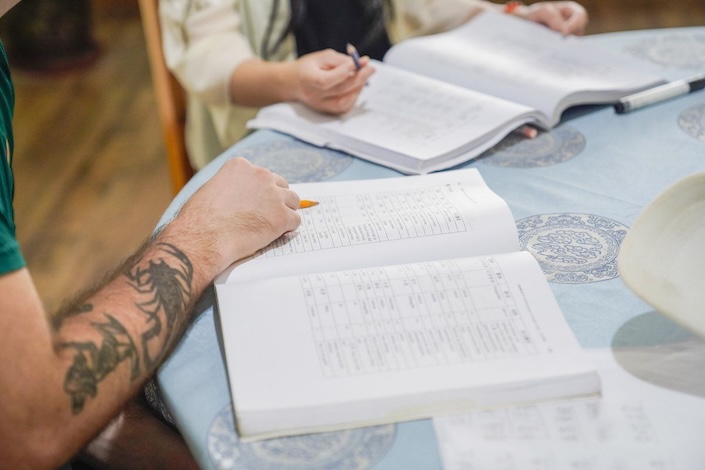
Because Chinese and Korean come from different language families, you might expect their vocabulary to be completely unrelated. In practice, there's a huge overlap of Chinese-derived words in Korean.
Sino-Korean vocabulary: Chinese words used in Korean
Thanks to China's historical influence on Korea, Korean vocabulary was heavily shaped by Chinese. Estimates vary, but many sources suggest that roughly 50 to 70 percent of Korean words are of Chinese origin, even though dramatic shifts in pronunciation can make the similarities hard to spot.
Sino-Korean words (한자어) are typically used in more formal or literary contexts, so the everyday Korean equivalent native speakers reach for might be completely different. Either way, if you already speak one of these languages, you'll get a helpful shortcut when learning vocabulary in the other, especially as you reach more advanced levels.
Here are some examples of Chinese words in Korean. Notice how the pronunciations echo each other:
| Chinese | Pinyin | Meaning | Korean | Romanization |
|---|---|---|---|---|
| 时间 | Time | 시간 | sigan | |
| 家族 | Family | 가족 | gajok | |
| 学生 | Student | 학생 | haksaeng | |
| 大学 | University | 대학 | daehak | |
| 图书馆 | Library | 도서관 | doseogwan | |
| 电话 | Telephone | 전화 | jeonhwa | |
| 银行 | Bank | 은행 | eunhaeng | |
| 三 | Three | 삼 | sam |
Chinese vs. Korean pronunciation: tones and sounds
In most cases, Korean pronunciation is fairly straightforward and easy to pick up for non-native speakers. Korean is a syllable-timed language, meaning syllables tend to follow each other at regular intervals, with roughly equal time given to each one.
This creates an even rhythm that many learners find easier than the stress-timed patterns of English.
Chinese presents a bigger challenge. As a tonal language, the pitch of your voice can completely change a word's meaning, and Mandarin's four main tones (plus a neutral tone) take time to master.
For anyone who doesn't already speak a tonal language, this can feel intimidating at first, though it becomes far more natural with practice and good listening habits.
An introduction to Mandarin Chinese tones:
04 Chinese vs. Korean writing systems: hanzi vs. hangul
One of the clearest differences between Korean and Chinese is the writing system. As you probably know, Chinese uses a character-based writing system, or 汉字 (hànzì).
On average, a Mandarin speaker needs to know roughly 2,000 to 3,000 characters to read a newspaper or novel comfortably. The good news for beginners is that you don't start there: you can learn Chinese characters gradually while leaning on Pinyin, the official romanization system for Standard Mandarin in Mainland China.
Once you've learned the sounds and tone markers, you can read the pronunciation of any character in a dictionary.
Korean, by contrast, uses an alphabet called Hangul.
From Hanja to Hangul: a short history of the Korean alphabet
The Korean alphabet has a fascinating backstory. Koreans originally wrote using Classical Chinese characters (called Hanja, 한자), and, just like in China, texts traditionally ran top to bottom and right to left.
The trouble was that learning Chinese characters was difficult, which left much of the population illiterate.
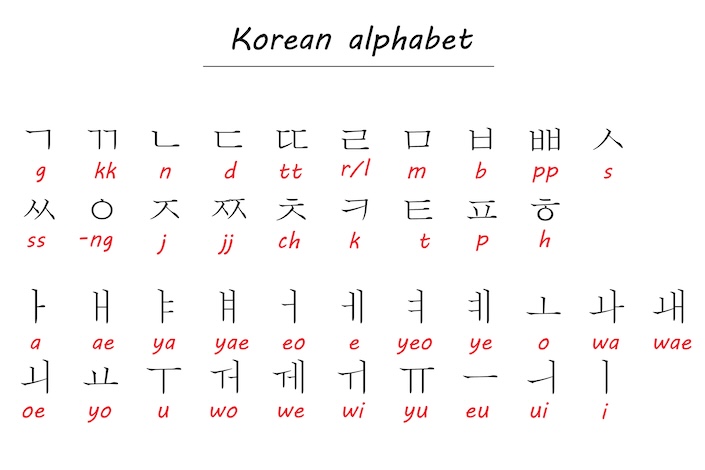
In 1443, King Sejong the Great, the fourth ruler of the Joseon Dynasty, completed the development of the Korean alphabet (Hangul, 한글), which was formally promulgated in 1446. Hangul is remarkably simple: it consists of 24 basic letters today (14 consonants and 10 vowels), down from the original 28.
Its straightforward design dramatically increased the country's literacy rate.
An introduction to the Korean Hangul alphabet:
Hangul is typically written left to right in syllabic blocks, with spaces between words, which makes it pleasant to read and, in some ways, easier to process than Chinese characters. Knowledge of Hanja is still used in high-level academic circles and remains useful for understanding the etymology of Sino-Korean words, but its everyday use has declined sharply since the 1970s, when the South Korean government stopped requiring it in primary-school curricula.
05 How culture shapes Chinese and Korean
Language is more than just words. It reflects how people think, feel, and connect with one another.
In both China and Korea, centuries of Confucian thought have quietly shaped the way people communicate, from the tone of everyday conversation to the words chosen to show respect.
Chinese honorifics and the legacy of Confucianism
Both Chinese and Korean cultures were heavily influenced by Confucianism, the philosophy that grew from the teachings of the Chinese philosopher Confucius. It emphasizes social harmony achieved through respecting hierarchies between people, and these hierarchies are expressed through honorifics: conventional words, titles, or grammatical forms that signal respect and deference.
In China, Confucianism was widely suppressed during the early communist era and seen as an obstacle to progress, and with the establishment of the People's Republic in 1949, hierarchical class distinctions lost much of their influence. Today, honorifics still appear in formal documents and when addressing elders in formal settings, but they've been greatly simplified and are rarely used in casual conversation.
For example, one might use 本人 (běnrén; "myself," formal) instead of 我 (wǒ; "I/me," informal), or 贵公司 (guì gōngsī; "your company," formal) instead of 你们的公司 (nǐmen de gōngsī; "your company," informal).

Korean honorifics: why age and formality matter
Korean honorifics, however, are far more complex, and daily conversations are filled with them. This is because Confucian ideology remains foundational to Korean culture and still shapes how people speak to one another.
Formal speech is always used when addressing someone older or in a position of higher authority, such as a boss versus an employee, or a teacher versus a student, and you must consider your relationship with both the person you're speaking to and the person you're speaking about.
That's why it's extremely common for Koreans to ask someone's age soon after meeting. It establishes whether the other person is older, in which case honorifics are expected as a sign of respect.
Formal speech even appears within families: as a child, someone might call their father 아빠 (appa; "dad," informal), then switch to 아버지 (abeoji; "father," formal) once they reach adulthood.
06 How many people speak Chinese and Korean?
One of the biggest practical differences between the two languages is the sheer number of speakers.
Mandarin Chinese is the most spoken language in the world by native speakers, and the second most spoken when you include both native and non-native speakers. It's the official language of Mainland China, Taiwan, and Singapore, and it's widely spoken by Chinese communities in Malaysia and around the world.
Korean is spoken by roughly 77 million people, primarily in North and South Korea. There are also around 2 million Korean speakers in China, including the 朝鲜族 (cháoxiǎn zú), Chinese citizens of Korean descent who form one of the 56 ethnic groups officially recognized by the Chinese government.

Study Chinese in Guilin or Start Online
CLI offers personalized Chinese instruction built around your goals. Join our Immersion Program in Guilin or begin from anywhere with a free Chinese lesson .
07 Global influence: Mandarin's reach vs. the Korean Wave
Because Chinese has so many native speakers and China's economy has grown so dramatically, Mandarin has become one of the main second languages taught in schools worldwide. In many places, especially across Asia, you'll find public-transport announcements in Chinese alongside local languages in major international cities and tourist destinations.
Korean isn't climbing school curricula at quite the same rate, but it's steadily rising in popularity thanks to the global reach of Korean culture. Over the past two decades, K-pop and Korean dramas have given the language widespread appeal far beyond Asia, and Korean courses have seen dramatic enrollment increases at universities across North America, Europe, and elsewhere.
The upshot for learners is that both languages offer an abundance of engaging material. Whether you're drawn to K-dramas or to bingeing Chinese TV shows, you'll never run short on content, no matter which language you choose.
08 Should you learn Chinese or Korean?
So, which one should you learn? At the end of the day, it's a personal decision based on many factors.
Both languages are beautiful and come with rich cultures. Do you want to understand all of your favorite Korean songs, or be able to chat with locals in your neighborhood's Chinatown?
In general, Chinese has a steeper learning curve at the beginning because of its characters and tones. But the further you progress, the easier it gets, and the grammar is refreshingly simple, especially if you're tired of wrestling with complex tenses and conjugations.
If you'd like to dive straight in, you can even Learn Chinese in China with a dedicated team of teachers, or study Mandarin from home through CLI's one-on-one online program.
Korean flips the difficulty curve: it has a straightforward alphabet you could learn within hours (so you'll start reading and writing quickly), but more complex grammar to master over time. Either way, you won't regret your choice.
Both are excellent investments that reward consistent effort, and a structured Chinese study plan can help you stay on track. And if you're still torn, you can always learn both.
09 Common words in Chinese and Korean compared
Finally, here's a quick side-by-side look at some everyday words and greetings in both languages. Unlike the Sino-Korean examples above, many of these are native words, so you can see just how different the two languages sound in daily use:
| Chinese | Pinyin | Meaning | Korean | Romanization |
|---|---|---|---|---|
| 你好 | Hello | 안녕하세요 | annyeonghaseyo | |
| 谢谢 | Thank you | 감사합니다 | gamsahamnida | |
| 是 | Yes | 네 | ne | |
| 不是 | No | 아니요 | aniyo | |
| 再见 | Goodbye | 안녕히 가세요 | annyeonghi gaseyo | |
| 水 | Water | 물 | mul | |
| 朋友 | Friend | 친구 | chingu | |
| 爱 | Love | 사랑 | sarang |
10 Chinese vs. Korean FAQ
Is Chinese or Korean harder to learn?
It depends on the skill. Chinese is harder at the start because of its tones and character-based writing, but its grammar is very simple.
Korean has an easy alphabet you can learn in hours, but more complex grammar and honorifics. Many learners find Chinese front-loads the difficulty, while Korean spreads it out.
Are Chinese and Korean similar languages?
They belong to completely different language families, so structurally they're very different. However, roughly 50 to 70 percent of Korean vocabulary is of Chinese origin, so the two share a large pool of related words known as Sino-Korean vocabulary.
Does Korean use Chinese characters?
Korean primarily uses Hangul, its own alphabet. Chinese characters (called Hanja in Korean) were once standard and are still used in some academic and formal contexts, but their everyday use has declined sharply since the 1970s.
Is Korean grammar harder than Chinese grammar?
Generally, yes. Korean has verb conjugation, multiple politeness levels, and regular and irregular verbs.
Chinese has no verb conjugations, no grammatical gender, and no singular or plural agreement, which makes its grammar notably simpler.
Which language is more useful to learn?
It depends on your goals. Mandarin Chinese has the most native speakers in the world and broad use across business and travel in Asia.
Korean has a smaller speaker base but growing global appeal driven by K-pop, K-dramas, and Korean culture.
11 Final thoughts
Chinese and Korean are two very different languages that happen to share a long, intertwined history. Chinese rewards you with simple grammar once you get past tones and characters, while Korean welcomes you with an easy alphabet before asking you to master its honorifics and grammar.
Whichever you choose, you're investing in a rich culture and a lifetime of rewarding conversations, and if you can't decide, there's nothing stopping you from learning both.
12 Selected References
- UNESCO Memory of the World: the Hunminjeongum Manuscript, recording King Sejong's promulgation of Hangul (development completed 1443, published 1446). View source →
- Encyclopaedia Britannica: overview of the Korean language and its writing system. View source →
- Encyclopaedia Britannica: overview of the Sino-Tibetan languages, including the Sinitic (Chinese) branch. View source →
- World History Encyclopedia: ancient Korean–Chinese relations and cultural exchange. View source →
- Sejong Center: background on King Sejong the Great. View source →
- Note: speaker counts and vocabulary estimates vary by source and methodology. Figures above reflect commonly cited ranges.