


- A handful of high-frequency words like 你好 (nǐ hǎo) and 谢谢 (xièxie) cover most everyday courtesies.
- Mandarin answers “yes” and “no” by repeating or negating the verb, not with a single fixed word.
- Family terms in Chinese are highly specific, but beginners can rely on general words like 阿姨 (āyí) and 奶奶 (nǎinai).
- Tones matter: 那儿 (nà'er, “there”) and 哪儿 (nǎ'er, “where”) differ only by tone.
- Learning pinyin and a few measure words early makes these basic words far easier to use correctly.
Are you planning a trip to China or hoping to connect with Mandarin-speaking friends? Learning a few basic Chinese words and phrases is the fastest way to start real conversations and feel at home.
To help you begin, we have compiled the most commonly searched beginner words and phrases, each with pinyin, characters, and clear usage notes. Many learners go on to Learn Chinese in China, where these everyday expressions quickly become second nature.
Before diving in, it helps to familiarize yourself with the Chinese pinyin system and basic Chinese grammar. Both make the words below much easier to pronounce and combine.

01 Basic Chinese Greetings and Polite Phrases
Greetings and courtesies are the words you will use most on day one. They are also some of the easiest Chinese phrases to remember.
How to Say “Hello” in Chinese (你好)
你好 (nǐ hǎo) is probably the most-used Chinese phrase. 你 (nǐ) means “you” and 好 (hǎo) means “good.”
A slight variation, 你好吗? (nǐ hǎo ma?), means “How are you?” There are also many other ways to say hello in Chinese depending on the situation.
How to Say “Thank You” in Chinese (谢谢)
Giving thanks in Chinese is easy: just say 谢谢 (xièxie). To show respect to a teacher, a boss, or an older person, say 谢谢您 (xièxie nín).
Here, 您 (nín) is the respectful form of 你 (nǐ), “you.” Using it signals politeness and is always appreciated. There are also many other ways to say thank you in Chinese, for casual and formal situations.
How to Say “Sorry” in Chinese (对不起)
The standard way to say “sorry” in Chinese is 对不起 (duìbuqǐ), used for genuine apologies. It directly expresses that you are at fault.
For a much smaller mistake, you can say 不好意思 (bù hǎoyìsi), which is closer to “excuse me.” For example, if you walk into a room and realize you are interrupting someone, 不好意思 fits perfectly.
How to Say “Welcome” in Chinese (欢迎)
“Welcome” is one of the first Chinese characters you will see at China’s airports. “Welcome to China” is translated as 欢迎你来中国 (huānyíng nǐ lái zhōngguó).
How to Say “Good” in Chinese (好)
好 (hǎo) is a very versatile character. Beyond its literal meaning, “good,” it works like “okay” to show agreement.
It also combines with verbs to add a positive meaning, as in 好吃 (hǎo chī, “delicious,” from 吃 chī, “to eat”) and 好看 (hǎo kàn, “good-looking,” from 看 kàn, “to look”).
02 How to Express Yourself in Chinese: Love, Yes, No, and Happy
These words let you share feelings and answer questions. A couple of them work differently from English, so the notes below matter.
How to Say “I Love You” in Chinese (我爱你)
爱 (ài) is the word for “love.” Like in English, it covers love for a partner or family as well as strong enthusiasm for things.
So “I love you” is 我爱你 (wǒ ài nǐ), while “I love ice cream” is 我爱冰淇淋 (wǒ ài bīngqílín).
How to Say “Yes” in Chinese (是)
If the answer is “yes,” you can say 是 (shì), but the word for “yes” in Chinese depends on the question. You can only use 是 when the question is phrased “Are you …?”
If the question is “Do you …?”, you answer by repeating the verb instead. For example:
- 王: Nǐ shì měiguó rén ma? 你是美国人吗? (Are you American?)
- 李: Shì. 是。 (Yes.)
- 王: Nǐ xǐhuān bīngqílín ma? 你喜欢冰淇淋吗? (Do you like ice cream?)
- 李: Xǐhuān. 喜欢。 (Yes.)
How to Say “No” in Chinese (不是)
To say “no” in Chinese, you can say 不是 (bú shì), but again only when the question is “Are you …?”
If the question is “Do you …?”, use 不 (bù) followed by the verb. For example:
- 王: Nǐ shì měiguó rén ma? 你是美国人吗? (Are you American?)
- 李: Bú shì. 不是。 (No.)
- 王: Nǐ xǐhuan bīngqílín ma? 你喜欢冰淇淋吗? (Do you like ice cream?)
- 李: Bù xǐhuān. 不喜欢。 (No.)
How to Say “Happy” in Chinese (开心)
There are three common ways to say “happy”: 开心 (kāixīn), 快乐 (kuàilè), and 高兴 (gāoxìng).
- 开心 kāixīn = 开 kāi (open) + 心 xīn (heart)
- 快乐 kuàilè = 快 kuài (fast) + 乐 lè (pleasure)
- 高兴 gāoxìng = 高 gāo (high) + 兴 xìng (mood)
开心 and 高兴 describe a temporary good mood, while 快乐 describes a longer-lasting state. 快乐 also appears in greetings such as 新年快乐 (xīnnián kuàilè), which means “Happy New Year” in Chinese. You can also use it to wish someone a happy birthday in Chinese.
03 Family and People Words in Chinese
Mandarin has unusually specific terms for relatives. The good news for beginners is that a few general words will carry you through most situations.
How to Say “Aunt” in Chinese (阿姨)
There is no single word for “aunt.” Your mother’s sister is 姨妈 (yímā), your father’s sister is 姑妈 (gūmā), and your mother’s brother’s wife is 舅妈 (jiùmā), with further regional variations.
As a beginner, you can simply use 阿姨 (āyí) for almost any older woman, whether a relative, a neighbor, or a shopkeeper. To see how the full system fits together, explore our guide to the Chinese family tree.
How to Say “Grandma” in Chinese (奶奶)
There are also several words for “grandma.” Your father’s mother is 奶奶 (nǎinai) or the more formal 祖母 (zǔmǔ).
Your mother’s mother is 外婆 (wàipó) in southern China and 姥姥 (lǎolao) in the north. For an unrelated elderly woman, 奶奶 (nǎinai) is a friendly, respectful choice.
How to Say “Family” in Chinese (家)
家庭 (jiātíng) means “family,” though people often shorten it to 家 (jiā), which can also mean “home” or “house.”
Some common combinations include:
- 回家 huí jiā = 回 huí (return) + 家 jiā (home) = go home
- 家人 jiārén = 家 jiā (family) + 人 rén (people) = family members
- 大家 dàjiā = 大 dà (big) + 家 jiā (family) = everyone
As you advance, check out our collection of Chinese proverbs about family.
How to Say “Friend” in Chinese (朋友)
朋 (péng) and 友 (yǒu) both relate to friendship, and together 朋友 (péngyou) means “friend.”
To say “good friend,” use 好友 (hǎoyǒu). It pairs the word for “good,” 好, with “friend.”
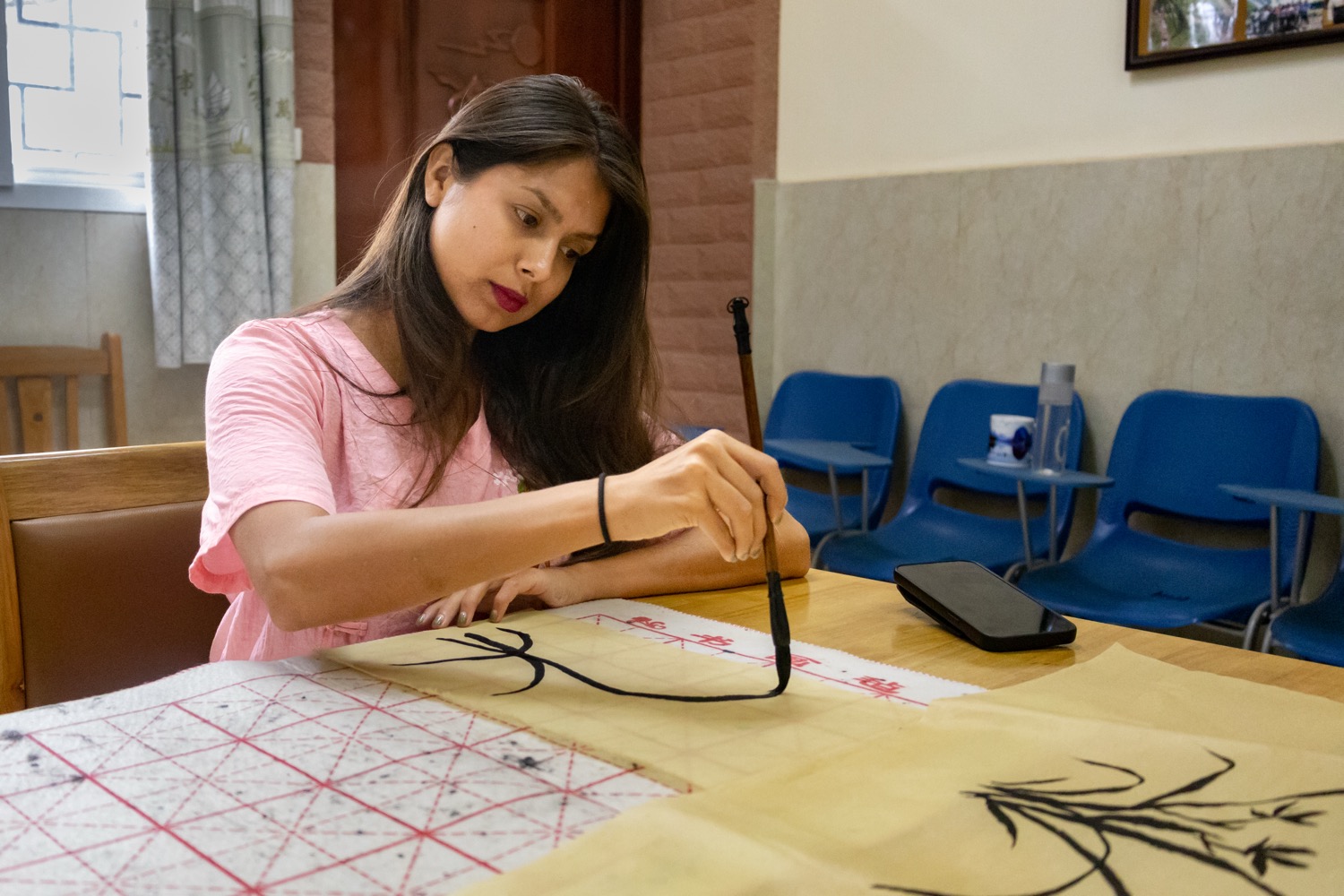
Study Chinese in Guilin or Start Online
CLI offers personalized Chinese instruction built around your goals. Join our Immersion Program in Guilin or begin from anywhere with a free Chinese lesson .
04 Everyday Chinese Nouns and Question Words
These words come up constantly in daily life, from ordering water to asking where something is. A few of them also introduce useful grammar points.
How to Say “Cat” in Chinese (猫)
The word for “cat” is 猫 (māo), easy to remember because it sounds like a cat. People often add 小 (xiǎo, “little”) to say 小猫 (xiǎo māo), much like “kitten.”
As with most Chinese nouns, you need the right Chinese measure word; here it is 只 (zhī). So “a cat” is 一只猫 (yī zhī māo).
How to Say “Water” in Chinese (水)
水 (shuǐ) means “water.” To ask for drinking water specifically, you have options.
Say 白开水 (báikāishuǐ) for boiled water or 矿泉水 (kuàngquán shuǐ) for mineral water.
How to Say “What” in Chinese (什么)
什么 (shénme) is the standard way to ask “what,” and it usually follows the verb, as in 你在看什么? (nǐ zài kàn shénme?, “What are you looking at?”).
Combined with other words it forms more question words, such as 为什么 (wèishéme, “why”) and 什么时候 (shénme shíhòu, “when”). On its own, 什么? can also express surprise, just like “What?!” in English.
How to Say “Moon” in Chinese (月亮)
“Moon” is 月亮 (yuèliàng), combining 月 (yuè, “moon” or “month”) with 亮 (liàng, “bright”).
The moon is central to many traditions, so it is worth reading about the Chinese lunar calendar and how it shapes festivals.
How to Say “Here,” “There,” and “Where” in Chinese
“Here” is 这儿 (zhè'er), “there” is 那儿 (nà'er), and “where” is 哪儿 (nǎ'er). Be careful: 那儿 and 哪儿 differ only by tone, so getting Mandarin tones right is essential.
Compare 我的朋友在哪儿? (Wǒ de péngyǒu zài nǎ'er?, “Where is my friend?”) with 我的朋友在那儿。 (Wǒ de péngyǒu zài nà'er., “My friend is there.”).
You can replace 儿 (er) with 里 (lǐ) or 边 (biān). Northern speakers favor 儿, while southern speakers tend to use 里.
05 Basic Chinese Vocabulary List for Beginners
Use this quick-reference table to review the core words and phrases above. Practicing them with audio and spaced repetition will help them stick.
| Chinese | Pinyin | Meaning |
|---|---|---|
| 你好 | Hello | |
| 谢谢 | Thank you | |
| 对不起 | Sorry | |
| 欢迎 | Welcome | |
| 好 | Good; okay | |
| 我爱你 | I love you | |
| 是 | Yes; to be | |
| 不是 | No; is not | |
| 开心 | Happy | |
| 阿姨 | Aunt; older woman | |
| 奶奶 | Grandma (paternal) | |
| 家 | Family; home | |
| 朋友 | Friend | |
| 猫 | Cat | |
| 水 | Water | |
| 什么 | What | |
| 月亮 | Moon | |
| 哪儿 | Where |
Mandarin is not something you can master overnight, but a strong vocabulary base makes everything that follows easier. If you want to keep going, our Chinese study plan lays out a clear path, and many beginners find that learning Chinese as an adult is far more achievable than they expected.
06 Frequently Asked Questions About Basic Chinese Words
What is the most common Chinese phrase for beginners?
你好 (nǐ hǎo), meaning “hello,” is the most common starting phrase. It works in almost any setting and is easy to pronounce.
How do you say yes and no in Chinese?
Mandarin has no single fixed word for “yes” or “no.” You usually repeat the verb to agree or add 不 (bù) to disagree, though 是 and 不是 work for “Are you …?” questions.
How many Chinese words do I need for basic conversation?
Knowing a few hundred high-frequency words lets you handle most everyday situations. Starting with greetings, family terms, and question words gives you the fastest return.
Why do tones matter for basic Chinese words?
Tones change meaning. For example, 那儿 (nà'er, “there”) and 哪儿 (nǎ'er, “where”) differ only in tone, so accurate tones prevent confusion.
Is it hard to learn basic Chinese words?
Basic vocabulary is very approachable, especially once you know pinyin. Characters take more time, but spoken basics can be learned quickly with regular practice.
07 Final Thoughts
A short list of basic Chinese words and phrases can open the door to real conversations, travel, and friendships. Greetings, courtesies, family terms, and question words give you a foundation you will use every day.
May this be the start of a happy learning journey. When you are ready to go further, explore our Chinese language immersion program in Guilin and keep building from here.