
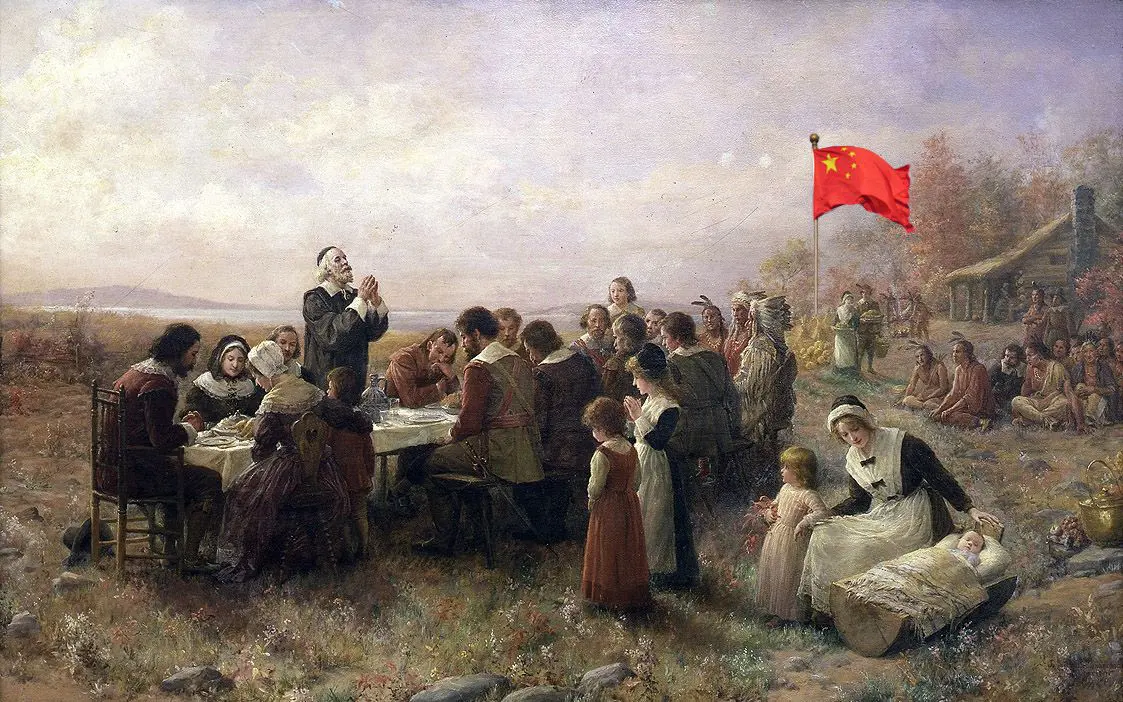
- Thanksgiving is not a Chinese holiday, but CLI marks it every year in Guilin with a shared meal that brings Chinese and international students to the same table.
- The celebration was held at Tian Fu Lou, a local Buddhist restaurant in Guilin, where the entire menu is vegetarian.
- Thanksgiving and China's Mid-Autumn Festival (中秋节, Zhōngqiū Jié) share a common core: family, food, and taking a moment to be grateful for what is easy to overlook.
- In Mandarin, Thanksgiving is 感恩节 (Gǎn'ēn Jié) — literally the "gratitude festival" — and 感恩节快乐 (Gǎn'ēn Jié kuàilè) is how you wish someone a happy one.
CLI takes great delight in gathering the community together for a celebration — especially if good food is involved. Although not traditionally a Chinese holiday, Thanksgiving was definitely not missed here in Guilin!
In its endless quest to bring Chinese and Western cultures together in innovative ways, CLI booked a feast at Tian Fu Lou, a unique local Buddhist restaurant in Guilin. The occasion was thanks, giving, and the spirit of recognizing how amazing life is.
What follows is a short account of how the evening went — the food, the speeches, and the answers to the one question no Thanksgiving table can avoid.
01 A Thanksgiving Feast at a Guilin Buddhist Restaurant
There was no turkey. There was, however, a very long table and a great deal of food.
Tian Fu Lou is a Buddhist restaurant, which in China means the kitchen is entirely vegetarian. Dishes are built from tofu, wheat gluten, mushrooms, bamboo shoots, and seasonal greens rather than meat.
That made for an unusual Thanksgiving menu by American standards and a very fitting one by every other measure. A holiday about gratitude and abundance translates surprisingly well onto a table of shared vegetarian plates in Guilin.

Why a Buddhist Restaurant?
Vegetarian restaurants of this kind are a long-standing part of Chinese food culture, with roots in temple kitchens that cooked without meat, and often without garlic or onion as well. Many of them are known for mock-meat dishes — tofu skin and gluten prepared to imitate the texture of duck, fish, or pork.
For a group with a wide mix of diets and preferences, it is also simply the easiest place to feed everyone at once.
Looking for a meat-free meal in China? The words to know are 素食 (sùshí, vegetarian food) and 素菜 (sùcài, vegetarian dish), and any restaurant with 素 on the sign is a safe bet.
Our guide to being vegetarian in China covers the phrases that save the most trouble at the table.
02 A Table Where Two Languages Meet
To complete the atmosphere of cultural fusion, CLI students could be heard practicing their Chinese. Local Chinese students, meanwhile, seized the opportunity to use their English.
This is the part of the evening that never shows up in the photos. A dinner table is one of the best classrooms there is, because nobody is being graded and everybody wants to keep talking.

03 Thanksgiving and the Mid-Autumn Festival
After a warming speech from CLI co-founder Bradford Fried, everyone was a bit more versed on the history of Thanksgiving and its significance to Americans. There were even some parallels drawn between America's Thanksgiving and China's Mid-Autumn Festival.

What the Two Holidays Share
Both of these holidays serve as a time to get together with family, appreciate the things in life that we often take for granted, and show gratefulness to friends and loved ones. Both also revolve around a specific meal that people travel a long way to attend.
The Mid-Autumn Festival (中秋节, Zhōngqiū Jié) is built around the idea of 团圆 (tuányuán) — reunion, or literally "round and whole." The full moon overhead is the symbol of it, and mooncakes are the food that goes with it.
Where They Differ
The differences are mostly in the calendar and the menu. Thanksgiving falls on the fourth Thursday of November every year, while the Mid-Autumn Festival follows the lunar calendar and lands on the fifteenth day of the eighth lunar month, usually in September or early October.
Thanksgiving traces back to a colonial harvest feast in 1621 and became a fixed annual national holiday in the United States in 1863. The Mid-Autumn Festival has been celebrated for well over a thousand years.
The instinct underneath them, though, is the same.
Thanksgiving in Mandarin is 感恩节 (Gǎn'ēn Jié), where 感恩 means "to feel grateful" and 节 means "festival." Turkey, meanwhile, is 火鸡 (huǒjī) — literally "fire chicken."
04 "What Are You Thankful For?"
Of course, no Thanksgiving holiday would be complete without asking the ultimate Thanksgiving question: "What are you thankful for?" Several people were brave enough to stand up and share their thoughts with everyone.
Victoria Klink, one of CLI's study abroad students, gave special thanks to her family and friends for supporting her and giving her the opportunity to come to China for a semester of study. She described it as a life-changing experience she will remember forever.

It is a familiar sentiment among students who spend a semester studying abroad in Guilin. A holiday spent away from home tends to sharpen exactly the gratitude the holiday is about.

Study Chinese in Guilin or Start Online
CLI offers personalized Chinese instruction built around your goals. Join our Immersion Program in Guilin or begin from anywhere with a free Chinese lesson .
05 Thanksgiving and Gratitude Vocabulary in Chinese
If you want to talk about Thanksgiving with Chinese friends, a handful of words will carry most of the conversation. The list below also covers the Mid-Autumn Festival, since that comparison comes up almost immediately.
For a broader starting point, see our collection of basic Chinese words.
| Chinese | Pinyin | Translation |
|---|---|---|
| 感恩节 | Thanksgiving | |
| 感恩节快乐 | Happy Thanksgiving | |
| 感恩 | to be grateful; gratitude | |
| 感谢 | to thank; to be thankful | |
| 谢谢 | thank you | |
| 节日 | holiday; festival | |
| 庆祝 | to celebrate | |
| 火鸡 | turkey (literally "fire chicken") | |
| 中秋节 | Mid-Autumn Festival | |
| 月饼 | mooncake | |
| 团圆 | family reunion; to be reunited | |
| 家人 | family members | |
| 朋友 | friend | |
| 聚会 | gathering; get-together | |
| 饭菜 | meal; food | |
| 素食 | vegetarian food | |
| 素菜 | vegetarian dish | |
| 佛教 | Buddhism | |
| 豆腐 | tofu | |
| 好吃 | delicious | |
| 干杯 | cheers; "bottoms up" | |
| 留学生 | international student | |
| 学期 | semester; term | |
| 文化交流 | cultural exchange | |
| 珍惜 | to cherish; to treasure | |
| 桂林 | Guilin (city name) |
The 快乐 (kuàilè) pattern works for almost every holiday greeting in Chinese: 生日快乐 (shēngrì kuàilè, happy birthday), 节日快乐 (jiérì kuàilè, happy holidays), 中秋快乐 (Zhōngqiū kuàilè, happy Mid-Autumn Festival).
Learn the template once and you can congratulate someone on almost anything.
06 Celebrating the Holidays Far From Home
Learn Chinese in China for a semester and you end up carrying two calendars: the one you grew up with, and the one everyone around you lives by. Both get celebrated, which is arguably the best possible outcome.
That is really what an evening like this is for. Not to recreate a holiday exactly as it happens at home, but to share it with people who have never had it before — and to be handed theirs in return.
CLI祝你感恩节快乐!Happy Thanksgiving from the CLI staff!