


- The Ghost Festival, also known as Zhongyuan Festival (中元节; Zhōngyuán Jié) or the Hungry Ghost Festival, falls on the 15th day of the seventh month of the Chinese lunar calendar (the 14th in much of Guangxi and parts of Guangdong).
- The festival combines Daoist Zhongyuan beliefs, Buddhist Yulanpen traditions, Chinese folk religion, and the Confucian value of filial piety.
- Common Ghost Festival rituals include food offerings, incense burning, chanting, joss paper burning, public salvation rites, and performances intended for wandering spirits.
- Although it is sometimes called "Chinese Halloween," the Ghost Festival is not mainly about costumes or entertainment. It is a ritual period for honoring ancestors, appeasing wandering ghosts, and caring for the dead.
- For Chinese learners, understanding Zhongyuan Festival offers insight into how language, ritual, family duty, and Chinese worldview intersect.
Each year, as the seventh Chinese lunar month arrives, many Chinese communities enter a ritual period known as Ghost Month. Incense smoke rises outside homes and temples, food offerings appear on temporary altars, and joss paper curls into ash in roadside burners or temple furnaces.
At the center of this period is the Ghost Festival, also known as Zhongyuan Festival (中元节; ), Hungry Ghost Festival, or Yulanpen Festival (盂兰盆节; ).
The festival is observed in many Chinese communities, especially in southern China, Hong Kong, Macau, Taiwan, and parts of the Chinese diaspora. Practices vary by region, family tradition, and religious context, but the same themes run through all of them: honoring ancestors, relieving the suffering of wandering spirits, and maintaining harmony between the living and the dead.
For that reason, "Chinese Halloween" is a poor fit. The Ghost Festival is a solemn tradition shaped by Daoist ritual calendars, Buddhist compassion, Chinese folk religion, and the enduring importance of filial piety.
01 What Is the Ghost Festival in China?
The Ghost Festival is a traditional Chinese festival held during the seventh month of the lunar calendar. In Mandarin, it is commonly called Zhongyuan Festival (中元节; ) or Ghost Festival (鬼节; ).
In many communities, the seventh lunar month is known as Ghost Month (鬼月; ). Folk belief holds that during this period, the gates of the underworld open and spirits are able to enter the human realm. These spirits may include deceased relatives, neglected souls, and hungry ghosts who lack proper care or offerings.
The festival itself falls on the 15th day of the seventh lunar month, though in much of Guangxi (including Guilin) and parts of Guangdong, families observe it a day early, on the 14th. Families may make offerings to ancestors at home, while temples and local associations may hold larger public rituals for wandering spirits. Common practices include lighting incense, offering food, burning joss paper, chanting scriptures, and performing rites of salvation.
The Ghost Festival reflects a worldview in which relationships do not end completely at death. Ancestors continue to be remembered, wandering spirits deserve compassion, and ritual action helps maintain balance between visible and invisible worlds.
Ghost Festival customs vary widely. A family in Guilin, a temple association in Guangdong, a Yu Lan gathering in Hong Kong, and a Pudu ceremony in Taiwan or Malaysia may all share similar themes, but the exact rituals, foods, performances, and local taboos are not identical.
When Is the Ghost Festival Celebrated?
The Ghost Festival is celebrated on the 15th day of the seventh month of the Chinese lunar calendar. On the Gregorian calendar, this usually falls in late summer, often in August or September. Like Chinese New Year, the Dragon Boat Festival, and other traditional observances, its exact Gregorian date shifts each year because it follows the lunar cycle.
Many communities treat the whole seventh lunar month as Ghost Month. In those places, rituals may begin on the first day of the month and continue until the "ghost gate" closes at the end of the lunar month. Notably, the seventh lunar month also contains Qixi, sometimes called Chinese Valentine's Day, though its romantic themes are entirely different in tone from the solemn atmosphere of Ghost Month observances.
Ghost Month vs. Ghost Festival
Ghost Month refers to the entire seventh lunar month, while Ghost Festival usually refers more specifically to the 15th day of that month. In practice, however, many people use the terms loosely, especially when describing the wider season of offerings, taboos, and public rituals.
02 Why the Ghost Festival Is Not "Chinese Halloween"
Because the Ghost Festival involves spirits, nighttime rituals, and ghost stories, it is sometimes described in English as "Chinese Halloween." This comparison is easy to understand, but it is also misleading.
Halloween is often associated with costumes, trick-or-treating, playful fear, and popular entertainment. Zhongyuan Festival is rooted in religious belief, family duty, and ritual responsibility. Its purpose is not to mock ghosts or turn fear into fun, but to honor the dead and reduce suffering.
During the Ghost Festival, people make offerings to ancestors and wandering spirits, especially those believed to have no descendants to care for them. These acts express both caution and compassion: spirits are respected, fed, appeased, and ritually guided.
If a comparison with another global festival is useful, Mexico's Day of the Dead shares some structural similarities because both traditions involve offerings, ancestral remembrance, and the belief that the dead temporarily draw close to the living. Even so, the emotional tone differs. Day of the Dead is often marked by colorful celebration and reunion, while Zhongyuan Festival tends to emphasize appeasement, restraint, and ritual care.
In Chinese tradition, death is not usually treated as something to celebrate casually. It is something to harmonize through proper conduct, remembrance, and ritual order.
03 Origins of the Ghost Festival: Daoist, Buddhist, and Folk Traditions
The Ghost Festival developed through the blending of several religious and cultural traditions. Its most important layers include Daoist Zhongyuan beliefs, Buddhist Yulanpen traditions, Chinese folk religion, and the broader moral importance of filial piety. For a wider view of how these belief systems developed alongside one another, see our guide to religion in ancient China.
Daoist Origins: Zhongyuan Festival and the Three Officials
In Daoist tradition, Zhongyuan Festival belongs to the Three Yuan (三元; ) system, a ritual calendar connected with the Three Officials (三官大帝; ).
The Three Officials are the Heavenly Official, the Earthly Official, and the Water Official. Each is associated with a different ritual date and function. Shangyuan (上元; ), the Upper Yuan, is associated with the Heavenly Official and coincides with what is now widely celebrated as the Lantern Festival. Zhongyuan (中元; ), the Middle Yuan, is associated with the Earthly Official (地官; ), who is connected with pardoning sins. Xiayuan (下元; ), the Lower Yuan, is associated with the Water Official.
This Daoist framework helps explain why Zhongyuan Festival is strongly associated with repentance, forgiveness, ritual offerings, and the salvation of suffering spirits.
Buddhist Origins: Yulanpen Festival and the Story of Mulian
The Buddhist layer of the Ghost Festival is closely connected with Yulanpen Festival (盂兰盆节; ), also known as Ullambana. One of the most important stories behind this tradition concerns Maudgalyayana, known in Chinese as Mulian (目连; ), one of the Buddha's disciples.
According to Buddhist tradition, Mulian saw that his deceased mother had fallen into the realm of hungry ghosts, where she suffered from hunger and thirst. When he tried to feed her, the food could not relieve her suffering. The Buddha then instructed him to make offerings to the monastic community on the 15th day of the seventh lunar month, transferring merit to help rescue his mother.
This story gave the festival a powerful Buddhist emphasis on compassion, salvation, and repaying parental kindness. Over time, it merged with Chinese ancestor veneration and local folk beliefs to shape many of the Ghost Festival practices seen today.
Filial Piety and Ancestor Veneration
The Ghost Festival is not "Confucian" in the same institutional sense that it is Daoist and Buddhist, but Confucian values help explain its moral tone. The concept of filial piety (孝道; ) gives ancestor care a deep ethical meaning. Many of the ideas attributed to Confucius on duty, reverence, and proper conduct continue to shape how families approach ritual obligations; for a closer look at these teachings, see our collection of Confucius quotes.
In many Chinese families, honoring the dead is not simply a religious act. It is also a continuation of family responsibility. This is why Ghost Festival offerings often feel less like superstition and more like a ritual language of care.
Anyone who has studied the complexity of the Chinese family tree will already have a sense of how deeply family relationships structure Chinese language and culture. The Ghost Festival extends that logic beyond the boundary of death.
Study Chinese in Guilin or Start Online
CLI offers personalized Chinese instruction built around your goals. Join our Immersion Program in Guilin or begin from anywhere with a free Chinese lesson .
04 Hungry Ghost Beliefs and the Meaning of 饿鬼
The English name "Hungry Ghost Festival" comes from the Buddhist and folk-religious idea of hungry ghosts (饿鬼; ). In Buddhist cosmology, hungry ghosts are beings trapped in a state of intense craving, hunger, or deprivation, often understood as the karmic result of greed, attachment, or wrongdoing in past lives.
In Chinese folk belief, the category of wandering spirits is broader. It can include ghosts without descendants, souls who died tragically, spirits who did not receive proper rites, or the neglected dead who lack regular offerings.
During Ghost Month, people make offerings to these beings not only out of fear, but also out of compassion. Food, incense, chanting, and paper offerings are meant to feed, comfort, and ritually assist the dead. At the same time, properly appeasing wandering spirits is believed to protect the living from misfortune.
The rituals are both compassionate and protective: they help suffering spirits while also keeping human life in balance.
In Taiwan and some southern Chinese communities, people may use euphemisms such as "good brothers" rather than saying "ghosts" directly. This reflects a wider pattern in Chinese culture: potentially dangerous or sensitive forces are often addressed with polite or indirect language.
05 Where Is the Ghost Festival Observed?
Ghost Festival traditions are found across many Chinese communities, but the visibility and style of the festival differ greatly by location.
Mainland China
In mainland China, Zhongyuan Festival is especially associated with southern and coastal regions, including areas such as Guangdong, Fujian, Guangxi, and parts of Jiangnan and southwest China. In some places, observances are family-based and relatively quiet; in others, temple rituals or community ceremonies may be more visible.
Because religious practice, urban regulations, and local custom vary, the Ghost Festival should not be imagined as a uniform public event across all of China. In many cities, ritual burning may be restricted or moved to designated locations because of fire safety and air-quality concerns.
Hong Kong and Macau: Yu Lan Gatherings
In Hong Kong and Macau, the festival is often associated with Yu Lan gatherings (盂兰胜会; ). In Hong Kong, Chiu Chow communities are especially known for organizing large-scale Yu Lan observances.
These events may include ancestral worship, rituals for wandering ghosts, temporary altars, paper offerings, rice distribution, and opera performances. Cantonese or Chiu Chow opera may be performed not only for human audiences, but also for spirits who are believed to be present. For readers curious about the linguistic landscape of these communities, our comparison of Mandarin vs. Cantonese offers helpful background.
Taiwan: Pudu and Water Lanterns
Taiwan has some of the most elaborate Ghost Month traditions in the Chinese-speaking world. Zhongyuan Pudu (中元普渡; ) ceremonies are held at temples, homes, businesses, and community spaces.
The Keelung Mid-Summer Ghost Festival is especially famous. Its water lantern parade takes place on the 14th day of the seventh lunar month, before lanterns are released onto the water to guide and invite wandering spirits. The festival is one of Taiwan's major local religious events and has been celebrated for generations.
In Yilan, the opening of Ghost Month is also marked by water lantern rituals. These ceremonies reflect the broader belief that Ghost Month is a time when spirits return to the human world and must be ritually received, guided, and cared for.
Singapore, Malaysia, and the Chinese Diaspora
The Ghost Festival is also observed in many overseas Chinese communities, particularly in Singapore and Malaysia. Local practices may include public offerings, stage performances, temple rituals, charity events, auctions, and Pudu ceremonies.
In Malaysia, Penang's Hungry Ghost Festival traditions are especially well known. In Singapore, getai performances, offerings, and community observances are strongly associated with the seventh lunar month. These diaspora practices show how Ghost Festival traditions adapt to new social environments while preserving core themes of ancestor remembrance and care for wandering spirits.

06 Ghost Festival Rituals and Traditions
Ghost Festival rituals differ by region, but most are built around the same basic concerns: feeding the dead, honoring ancestors, appeasing wandering spirits, and ritually transferring merit or goods to the spirit world.
Food Offerings and Ritual Meals
Food offerings are one of the most common features of Ghost Festival observances. Families and communities may prepare cooked dishes, rice, fruit, tea, wine, sweets, snacks, or symbolic meat offerings, depending on local custom and ritual purpose.
Offerings may be directed toward ancestors, deities, household spirits, or wandering ghosts. In some places, offerings for wandering spirits are placed outdoors, at roadsides, near temples, or in public ritual spaces rather than inside the home.
After the ritual is complete, food offerings may be shared among family members or distributed within the community. The exact practice varies.
Burning Joss Paper and Spirit Money
Joss paper, also called spirit paper or ghost paper, plays a central role in many Ghost Festival rituals. People burn paper money and sometimes paper replicas of clothing, houses, phones, vehicles, or other goods so that spirits may receive them in the afterlife.
This practice is not unique to the Ghost Festival. Joss paper is also burned during funerals, death anniversaries, Qingming Festival, and other memorial rites. During Ghost Month, however, paper offerings may be made not only to ancestors but also to wandering spirits who have no family to provide for them.
For a fuller explanation of this practice, see our guide to why Chinese people burn paper money.
Pudu Ceremonies and Universal Salvation
Pudu (普渡; ) means "universal salvation" or "universal deliverance." During Ghost Festival observances, Pudu ceremonies are performed to feed, appease, and ritually assist wandering spirits.
Depending on the region, these ceremonies may involve Daoist priests, Buddhist monks, chanting, food offerings, incense, paper burning, and ritual invitations to spirits. The goal is not simply to keep ghosts away, but to extend compassion to beings who are suffering or neglected.
Opera, Getai, and Performances for Spirits
Public performances are an important part of Ghost Festival observances in some Chinese communities. In Hong Kong, Yu Lan gatherings may include traditional opera performances. In Singapore and Malaysia, getai-style stage performances are especially associated with Ghost Month.
These performances are often understood as entertainment for wandering spirits as well as for human audiences. In some places, the front rows may be left empty symbolically for unseen guests.
Water Lanterns
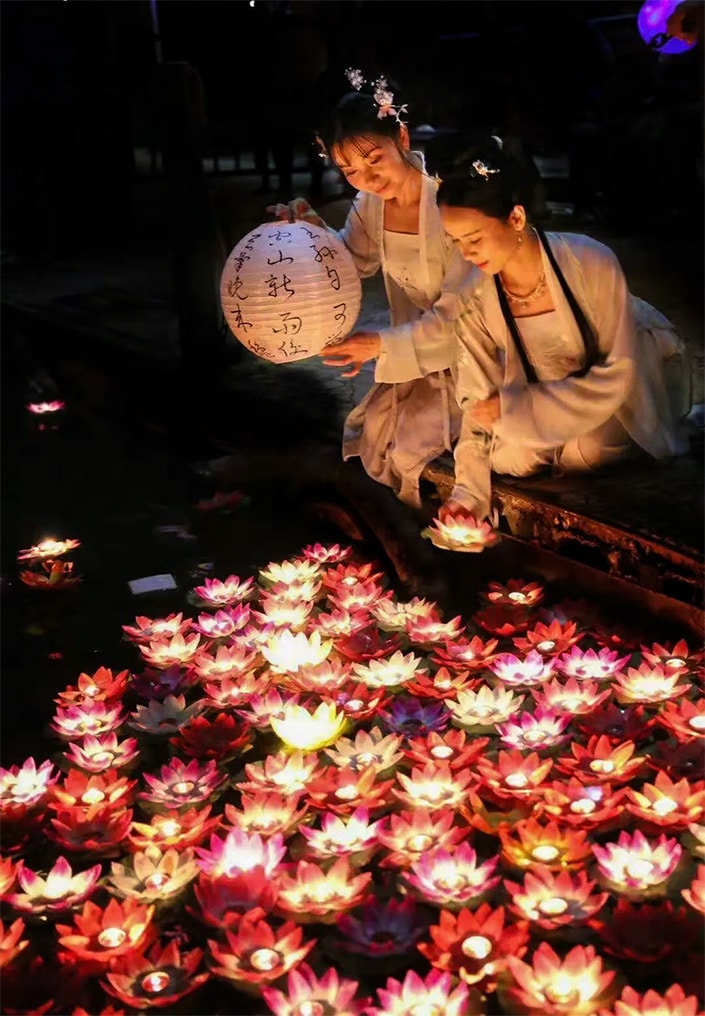
Water lantern rituals are especially prominent in parts of Taiwan. In Keelung and Yilan, lanterns are released onto rivers or the sea during Ghost Month to guide, welcome, or send off spirits.
The lanterns are ritual beacons for spirits, especially lonely souls associated with water, travel, or unsettled death.
07 Ghost Month Taboos and Superstitions
In many communities, Ghost Month is surrounded by taboos (禁忌; ). These beliefs vary widely, and not everyone observes them seriously today. Still, they remain an important part of the cultural atmosphere of the seventh lunar month.
Avoiding Water at Night
One common belief, especially in Taiwan and some southern Chinese communities, warns against swimming or going near bodies of water at night during Ghost Month. The fear is that water ghosts may seek a replacement soul, a belief sometimes described with the phrase 抓交替 (), meaning to "find a replacement."
Avoiding Major Life Events
Some families avoid weddings, moving house, opening a business, or making major purchases during Ghost Month. The reasoning is that the month is considered spiritually unstable and lacking in auspicious yang energy.
This is not a universal rule, and many modern people do not follow it strictly. However, the belief remains familiar enough that businesses, wedding planners, and families may still take the lunar calendar into account.
Everyday Taboos
Other Ghost Month taboos may include avoiding whistling at night, not picking up money or red envelopes found on the street, avoiding late-night outings, and not hanging laundry outside overnight. These beliefs are usually explained as ways to avoid attracting or offending wandering spirits.
Today, younger generations may treat some of these taboos with humor or nostalgia, while still recognizing their cultural importance.
Modern Ghost Month Entertainment
Ghost Month has also inspired horror films, escape rooms, restaurant themes, and other forms of modern entertainment, especially in Taiwan, Hong Kong, Singapore, and Malaysia. In these settings, traditional ghost beliefs are often reworked into playful, scary, or comedic experiences for younger audiences.
Ghost Month taboos should be understood as folk beliefs, not fixed rules followed by all Chinese people. Their importance depends heavily on family background, region, religion, age, and personal belief.
08 Why the Ghost Festival Still Matters Today
The festival still matters because it deals with questions every family faces: What do we owe the dead? How should families remember those who came before them? What happens to those who are forgotten?
For some people, Zhongyuan Festival is a serious religious observance. For others, it is a family custom, a community event, or a cultural memory passed down from older generations. Like the Mid-Autumn Festival and other traditional holidays tied to the lunar calendar, it illustrates how deeply seasonal rhythms continue to shape Chinese community life. In practice, these meanings often overlap.
Modern life has changed how the festival is practiced. Urban restrictions may limit open burning. Younger people may reinterpret Ghost Month through media, food, travel, or entertainment. Some families may observe only small home rituals, while others participate in large temple ceremonies or public Pudu events.
Even with these changes, the core of the festival is the same: care for ancestors, compassion for the neglected dead, respect for unseen forces, and continuity between past and present.
For learners of Chinese, understanding Zhongyuan Festival offers insight into how language, ritual, and worldview connect. Words such as 孝道 (; filial piety), 祖先 (; ancestors), 祭祀 (; ritual offering), and 鬼月 (; Ghost Month) are a good place to start, because each carries part of how Chinese culture thinks about family, morality, death, and memory.
Students who learn Chinese in China often find that encountering traditions like these firsthand transforms their understanding of both the language and the culture behind it. In Guilin, where the festival falls on the 14th, CLI students can see these customs firsthand.
09 Useful Ghost Festival Vocabulary in Chinese
The following vocabulary will help you discuss Zhongyuan Festival, Ghost Month, ancestor rituals, and hungry ghost beliefs with more confidence. If you are still building your foundation in Mandarin, start with our guide to basic Chinese words and phrases before tackling specialized cultural vocabulary like the terms below. For help recognizing the characters themselves, our guide to learning Chinese characters offers practical strategies for reading and retention.
| Chinese | Pinyin | Meaning |
|---|---|---|
| 中元节 | Zhongyuan Festival / Ghost Festival | |
| 鬼节 | Ghost Festival | |
| 饿鬼 | Hungry ghost | |
| 鬼月 | Ghost Month | |
| 盂兰盆节 | Yulanpen Festival | |
| 三元 | Three Yuan (Daoist festival system) | |
| 三官大帝 | Three Officials (Daoist deities) | |
| 地官 | Earthly Official | |
| 超度 | To deliver souls / perform salvation rites | |
| 普渡 | Universal salvation ceremony | |
| 祖先 | Ancestors | |
| 祭祀 | Ritual offering / worship | |
| 施孤 | Offering to wandering spirits | |
| 香火 | Incense (ritual burning) | |
| 冥纸 | Joss paper / spirit paper | |
| 烧纸钱 | To burn paper money | |
| 水灯 | Water lantern | |
| 禁忌 | Taboo | |
| 孝道 | Filial piety | |
| 轮回 | Reincarnation |
10 Learn More About Chinese Culture
The Ghost Festival is only one part of a much larger world of Chinese ritual, belief, and family tradition. The more you learn about customs like these, the easier it becomes to understand how Chinese culture works in everyday life.
If this topic interests you, you may also enjoy our guides to why Chinese people burn paper money, Qingming Festival, Lantern Festival, and Chinese holidays.
11 Selected References
- Encyclopaedia Britannica: overview of the Hungry Ghost Festival, including its Buddhist and Daoist background, offerings, incense, paper burning, and ritual specialists. View source →
- Hong Kong Intangible Cultural Heritage Office: official information on the Yu Lan Festival of the Hong Kong Chiu Chow community, including ancestral worship and rituals for wandering ghosts. View source →
- Taiwan Ministry of the Interior, Taiwan Religious Culture Map: official overview of Yilan Water Lantern Festival and the belief that Ghost Month opens the boundary between the living and the dead. View source →
- Keelung City Government Tourism: official travel information describing the Keelung Mid-Summer Ghost Festival as a month-long local festival and noting the water lantern release. View source →
- Encyclopaedia Britannica: background on ancestor worship and the broader practice of maintaining ritual relationships with deceased family members. View source →
- Stephen F. Teiser, The Ghost Festival in Medieval China (Princeton University Press, 1988): the definitive academic study of the Yulanpen festival, the Mulian story, Buddhist-Confucian interaction, ancestor worship, and the ritual culture of the seventh lunar month. View source →
- Dharma Drum Mountain: explanation of Yulanpen Festival, Ullambana, Maudgalyayana/Mulian, hungry ghosts, and offerings to the monastic community on the 15th day of the seventh lunar month. View source →
- Dharma Drum Mountain: discussion of Ullambana as a practice connected with repaying parents' kindness, relieving hungry ghosts, and liberating beings from suffering. View source →
- FYSK Daoist Culture Centre Database: entry on the Festival of the Spirits of the Dead, confirming the Three Officials, the Earthly Official's role in pardoning sins, Daoist offering rites for ancestors, and the overlap with the Buddhist Ullambana festival. View source →
- UNESCO Intangible Cultural Heritage: documentation of the Chaozhou Hungry Ghosts (Yulan) Festival as Hong Kong's and China's national-level intangible cultural heritage, including community ritual practices and their resilience. View source →
- Academy of Chinese Studies: overview of Hong Kong's intangible cultural heritage, confirming that the Yu Lan Festival includes invoking gods, chanting scriptures, offerings to deceased hometown members and wandering spirits, and distributing auspicious rice. View source →
- Taiwan Ministry of the Interior, Taiwan Religious Culture Map: official overview of the Keelung Zhongyuan Ghost Festival and its water lantern parade on the 14th day of the seventh lunar month. View source →
- Keelung City Government, Culture and Tourism Bureau: official description of the full Keelung Mid-Summer Ghost Festival ritual sequence, from the opening of the shrine door through the water lantern release and Zhongkui dance. View source →
- Chan, Hong Yin, "The Hungry Ghost Festival in Singapore: Getai (Songs on Stage) in the Lunar Seventh Month," Religions 11, no. 7 (2020): 356: peer-reviewed journal article documenting getai performances, community observances, and the cultural role of the Hungry Ghost Festival in contemporary Singapore. View source →
- Singapore National Heritage Board (Roots.gov.sg): official heritage entry on Zhong Yuan Jie, covering dual Daoist-Buddhist origins, food and joss paper offerings, getai performances, Ghost Month taboos, and community practices. View source →
- Chinese Text Project: classical Chinese reference material useful for broader context on ritual, filial piety, and serving the dead with sincerity. View source →