


- Mandarin is best understood as having four main tones plus a neutral tone.
- The most important tone sandhi rules for learners involve third tones, 不 (bù), and 一 (yī).
- In standard pinyin, tone changes are usually not written; you normally see each syllable's citation tone instead.
- Good tone habits are much easier to build early than to fix later.
- Regular listening, speaking, and teacher feedback are still the fastest path to more natural Mandarin pronunciation.
You may have heard that Chinese is a tonal language, but many learners do not realize that Mandarin pronunciation involves more than just memorizing four basic tones. In connected speech, certain tones change depending on what comes before or after them.
This guide explains the core tone change rules learners actually need, why they matter, and how to practice them without getting overwhelmed. Whether you are studying on your own or planning to learn Chinese in China, understanding tone changes will make your Mandarin sound more natural and easier for others to understand.


Want clearer pronunciation feedback from the start?
CLI's one-on-one Chinese programs help learners build accurate tone habits early, then reinforce them through real conversation, daily practice, and personalized correction.
01 What Tones Exist in Mandarin?
Standard Mandarin, or Putonghua, is usually taught as having four main tones (四声 sìshēng). Some learners also hear the neutral tone described informally as a fifth tone. For practical learning purposes, though, it is best to think in terms of four main tones plus the neutral tone.
One reason tones feel difficult is that they are not always pronounced exactly the same way in connected speech. To understand tone changes, it helps to first review the basic tone system itself.
| Tone | Chinese Name | Basic Description | Example |
|---|---|---|---|
| First tone | 阴平 (yīnpíng) | High and level | 高 (gāo, high; tall) |
| Second tone | 阳平 (yángpíng) | Rising | 茶 (chá, tea) |
| Third tone | 上声 (shàngshēng) | Often taught as dipping, though it changes heavily in connected speech | 买 (mǎi, to buy) |
| Fourth tone | 去声 (qùshēng) | Falling | 树 (shù, tree) |
| Neutral tone | 轻声 (qīngshēng) | Light and unstressed; pitch depends on the previous syllable | 东西 (dōngxi, thing) |
The third tone is commonly introduced as a dipping tone, but in real connected speech it is often realized as a low tone that does not fully rise back up. That is why third-tone sandhi feels so important so early.
Not everyone's tones start at exactly the same pitch. A child with a high voice and an adult with a low voice may place the tones at different absolute heights. What matters is the relative pattern: high and level, rising, low or dipping, and falling.

How are tones written?
The most common Mandarin romanization system is pinyin. In pinyin, tone marks are written over the vowel of each syllable. For example, 我想去桂林。 becomes Wǒ xiǎng qù Guìlín.
Sometimes tones are written with numbers instead. In that system, the first tone is shown with a 1, the second with a 2, and so on. A 5 or 0 is often used for the neutral tone. Some apps also use color coding to reinforce tone patterns.
Unfortunately, you usually cannot tell a character's tone just by looking at it. That is why it helps to keep a good Chinese dictionary such as Pleco close by while learning new words.
Why tones matter
Tones in Mandarin are essential. In very obvious situations, listeners may still guess what you mean from context. However, as soon as the context becomes thinner, correct tones matter much more.
In many cases, the pinyin spelling looks almost identical and tone is the main thing that distinguishes one word from another. For example, compare 外教 (wàijiào, foreign teacher), 外交 (wàijiāo, diplomacy), and 崴脚 (wǎijiǎo, to sprain one's ankle).
The same problem appears in pairs like 教师 (jiàoshī, teacher), 教室 (jiàoshì, classroom), and 礁石 (jiāoshí, reef). This is why ignoring tones is risky even when your vocabulary is otherwise correct.

02 What Are Mandarin Tone Changes?
Tone changes in Mandarin are called 变调规则 (biàndiào guīzé). In linguistics, they are often discussed under the broader label tone sandhi.
The idea is simple: each syllable has an underlying citation tone, but in real speech that tone may change when it appears next to certain other syllables. In other words, Mandarin tone changes are contextual.
Tone changes do not usually alter the way words are written in pinyin. They mainly affect how those words are actually pronounced in connected speech.
If you have ever wondered why your teacher says a word one way but your dictionary writes it another way, tone sandhi is often the reason.
03 The 3 Most Important Mandarin Tone Change Rules
Some tone changes are optional or highly context-dependent. For most learners, though, three mandatory rules matter far more than the rest: third-tone sandhi, tone changes with 不 (bù), and tone changes with 一 (yī).
| Rule | What Changes | Common Example |
|---|---|---|
| Third tone + third tone | The first third tone is pronounced like a second tone | 你好 → níhǎo |
| 不 before a fourth tone | 不 changes from fourth tone to second tone in pronunciation | 不对 → búduì |
| 一 before a fourth tone | 一 is pronounced as second tone | 一个 → yígè |
| 一 before a non-fourth tone | 一 is pronounced as fourth tone in most common uses | 一起 → yìqǐ |
Third tone changes
The third tone is one of the hardest tones for learners to master, partly because it almost never appears in textbook form when you are speaking naturally. When a third tone combines with other syllables, it often changes.
- When two consecutive third tones appear together, the first is pronounced like a second tone. The classic example is 你好. In citation form, both 你 and 好 are third tone, but in speech the phrase is pronounced níhǎo.
- When several third tones appear in a row, pronunciation depends on grouping. A common example is the cold-medicine brand 九九九 (jiǔjiǔjiǔ), which is often pronounced more like jiújiújiǔ when spoken as a three-syllable unit.
- In many other environments, the third tone is realized as a low tone rather than a full dip-and-rise contour. This is why some teachers describe the practical third tone as low and slightly falling in connected speech.
Once you notice this pattern, third-tone sandhi stops feeling random. It becomes a predictable part of natural Mandarin rhythm instead.
If you want a clear visual explanation of this issue, AllSet Learning's updated tone diagram is a useful reference, and Hacking Chinese also has a thoughtful discussion of how the third tone is taught.
Tone changes with 不 (bù)
The character 不 means "not" or "no" in Chinese. Its citation tone is fourth tone.
However, when 不 comes before another fourth-tone syllable, it is pronounced as a second tone. For example, 不对 is written bùduì in pinyin, but pronounced búduì.
Outside of that environment, 不 usually keeps its ordinary fourth-tone pronunciation.

Tone changes with 一 (yī)
The character 一, meaning "one," is another very common word that changes tone often in connected speech. In isolation, and in some number-like uses such as dates or addresses, it keeps its first tone.
In many everyday combinations, though, these rules apply:
- Before a fourth tone, 一 is usually pronounced as a second tone. For example, 一个 is pronounced yígè.
- Before anything other than a fourth tone, 一 is usually pronounced as a fourth tone in common uses. For example, 一起 is pronounced yìqǐ.

Other tone changes
Mandarin also includes other, more optional or context-dependent pronunciation changes. These can involve subtle adjustments such as how one fourth tone sounds before another fourth tone.
Since they are less essential for early learners, it is usually better to focus first on the three core rules above. If you want to explore the rest later, Hacking Chinese has a helpful overview of optional versus obligatory tone changes.
04 How Are Tone Changes Written in Pinyin?
In standard pinyin, tone changes are generally not written down. You usually see the original citation tone for each character instead, even when the pronunciation changes in connected speech.
That means 你好 is still written nǐhǎo, even though it is commonly pronounced níhǎo. The same principle applies to words like 不对 and 一个.
This convention helps learners identify each character's underlying tone, but it also means that beginning students often feel confused when spoken Mandarin does not line up perfectly with the pinyin on the page.

05 Why Learn Tone Changes Early?
Learning tone changes is an important part of learning Mandarin well. Surprisingly, many students reach the lower-intermediate stage only vaguely aware that these rules even exist.
One reason is that some teachers avoid explaining tone sandhi too early because they worry it will intimidate beginners. That instinct is understandable. Still, skipping the topic entirely often creates more problems later.
If you plan to continue beyond the elementary stage, it is better to start hearing and applying these rules from the beginning. Otherwise, you may spend a great deal of time undoing pronunciation habits that have already become automatic.
You do not need to master every advanced phonology detail right away. You do, however, want to build the habit of noticing tone patterns early and correcting them consistently.

06 How to Practice Tones and Tone Changes
There is no single perfect method. Still, a few habits consistently help learners improve faster.
Treat tones as important from day one
Tones and tone changes are not optional decoration. They are part of the language itself. The earlier you and your teachers treat them that way, the easier they are to build into your speaking habits.
Tones may take months or years to feel automatic, so do not get discouraged. Pinyin and basic vocabulary may come quickly, but accurate pronunciation usually takes longer and requires more deliberate effort.
If you're just starting, lesson 1 of our free Chinese course trains your ear on the four tones with recorded drills, and the later lessons show each tone change the way it's said.

Use mnemonics when needed
If you often mix up similar-looking pinyin syllables, simple memory aids can help. For example, many learners need repeated reinforcement to keep 外教 and 崴脚 apart in both tone and meaning.
If you like visual memory systems, you may find this memory aid helpful as a temporary scaffold while building recall.
Use tools that let you see pitch
Some learners improve faster once they can visualize their pitch contour. Tools such as AmPitch, SingScope, and Praat can make tone patterns easier to notice and correct.
Learn tone pairs, not just single tones
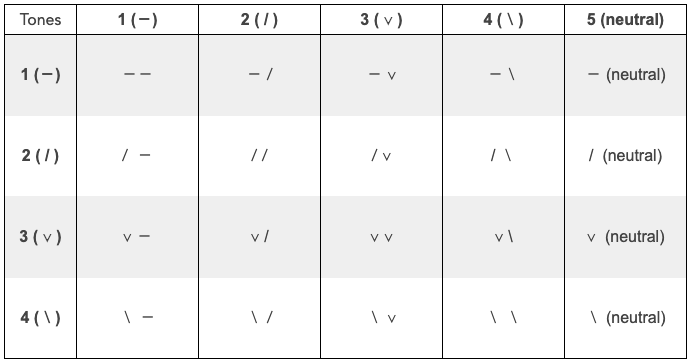
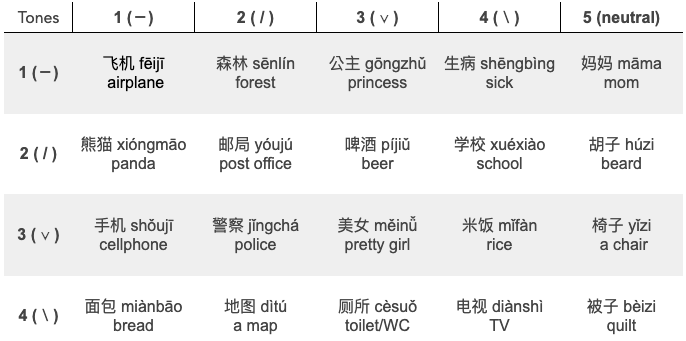
Hearing tones in isolation is easier than hearing them in sequence. That is why it helps to practice tone pairs systematically: 1-1, 1-2, 1-3, and so on through the full set of common combinations.
If you include the neutral tone for learning purposes and remember that no word begins with a neutral tone, there are 20 possible two-syllable tone combinations to practice. Also remember that two third tones in a row are pronounced as 2-3 because of tone sandhi.
Speak and listen to Chinese often
Native speakers usually do not think consciously about tone change rules. They simply acquired them through years of listening and speaking. As a learner, your long-term goal is the same: to develop a natural feel for how Mandarin actually sounds.
The best way to do that is to speak with native speakers regularly and listen to large amounts of understandable Chinese. Any opportunity to talk with a native speaker is also an opportunity to reinforce tones and tone changes.
Learning Chinese in China is one of the best ways to build this kind of immersive feedback loop. If that is not possible, learning Chinese online, listening to Chinese podcasts, enjoying Chinese songs, and watching Chinese TV shows can all help.
The more you listen and communicate, the more natural your tones will become.

Teacher correction matters most when you are still building the habit. Pronunciation work is one of the clearest cases where fast feedback saves time.
Tones and tone changes are a tricky part of Mandarin, but they are too important to ignore. Pay attention to them from the beginning, and your future self will thank you.
07 Tone Change Vocabulary
Here are some of the most useful Chinese terms you will encounter when studying Mandarin tones and tone changes.
| Chinese | Pinyin | Translation |
|---|---|---|
| 声调 | shēngdiào | Tone |
| 四声 | sìshēng | The four tones |
| 阴平 | yīnpíng | First tone |
| 阳平 | yángpíng | Second tone |
| 上声 | shàngshēng | Third tone |
| 去声 | qùshēng | Fourth tone |
| 轻声 | qīngshēng | Neutral tone |
| 变调 | biàndiào | Tone change; tone sandhi |
| 变调规则 | biàndiào guīzé | Tone change rule |
| 拼音 | pīnyīn | Pinyin |
| 第三声 | dì sān shēng | Third tone |
| 第二声 | dì èr shēng | Second tone |
| 第一声 | dì yī shēng | First tone |
| 第四声 | dì sì shēng | Fourth tone |
| 不 | bù | Not; no |
| 一 | yī | One |
Sources
- AllSet Learning — tone diagram and connected-speech explanation. View source →
- Hacking Chinese — discussion of how learners should understand the third tone. View source →
- Hacking Chinese — overview of optional versus obligatory Mandarin tone changes. View source →
- AmPitch — free pitch-visualization tool for pronunciation practice. View source →